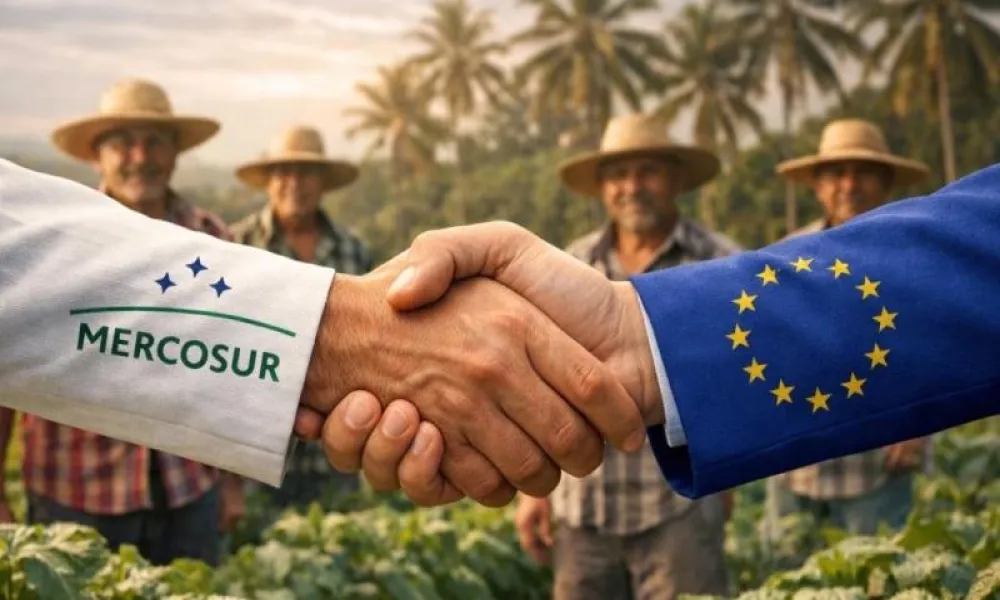

The agreement was politically concluded on 6 December 2024, signed on 17 January 2026, and the Interim Trade Agreement has been provisionally applied since 1 May 2026.
What is Mercosur?
Mercosur is a South American economic bloc made up of Argentina, Brazil, Paraguay and Uruguay. Together, these countries represent a market of more than 295 million people.
For the EU, Mercosur is a major economic partner. In 2024, EU exports of goods to Mercosur reached €57 billion, while EU services exports amounted to €29 billion in 2023. The EU is also the largest foreign investor in Mercosur, with an investment stock of €390 billion in 2023.
Why did the EU negotiate this agreement?
The EU negotiated the agreement because Mercosur was one of the last major Latin American markets with which the EU did not have a preferential trade agreement.
Until now, European companies faced major obstacles when exporting to Mercosur countries, including high import tariffs, complicated procedures and technical standards that often differed from international norms.
The agreement aims to remove many of these barriers, making it easier for European businesses to export goods, provide services and invest in the region.
What are the main benefits for the EU?
The agreement is expected to:
Remove tariffs on more than 91% of EU goods exported to Mercosur.
Improve access for European companies to Mercosur markets.
Open government procurement opportunities for EU firms.
Support SMEs by making customs rules and business information more transparent.
Protect European Geographical Indications, including distinctive regional food and drink products.
Strengthen access to raw materials needed for European industry.
Promote sustainability, labour rights and environmental commitments.
The European Commission estimates that the agreement could generate an overall economic impact of almost €80 billion for the EU once fully implemented.
Which European sectors stand to gain most?
Several EU sectors currently face very high Mercosur tariffs. The agreement is expected to benefit especially:
Cars, which currently face tariffs of up to 35%.
Machinery, with tariffs of 14–20%.
Chemicals, with tariffs of up to 18%.
Pharmaceuticals, with tariffs of up to 14%.
Wine and spirits, with tariffs ranging from 20% to 35%.
Clothing, textiles and leather shoes, which can face tariffs of 35%.
The agreement is expected to significantly increase EU exports in areas such as motor vehicles, machinery and chemicals.
What does it mean for agri-food products?
The EU agri-food sector is expected to gain easier access to a large consumer market. European products such as wine, cheese, dairy products, pork, chocolate, biscuits, spirits and processed foods currently face high tariffs in Mercosur.
The agreement would remove or reduce many of these duties, making European products more competitive.
At the same time, the deal includes protections for sensitive EU agricultural sectors, including beef, poultry, sugar, ethanol, honey and pork, through quotas and safeguard mechanisms.
What about European farmers’ concerns?
European farmers have raised concerns about competition from Mercosur agricultural imports, particularly in sectors such as beef and poultry.
In response, the Commission proposed additional safeguards after the political agreement was concluded. These include enhanced monitoring, faster investigation procedures and the possibility of rapid safeguard measures if imports cause harm to EU producers.
A proposed Unity Safety Net worth €6.3 billion is also intended to support farmers in the event of serious market disruption.
Will EU food safety standards change?
No. The agreement does not change EU food safety rules.
All food products sold in the EU, whether produced inside the EU or imported, must comply with EU sanitary and phytosanitary standards. This includes rules on pesticide residues, veterinary medicines, contaminants, GMOs, animal health and plant health.
The Commission has also announced stronger controls, including more audits in third countries and increased checks at EU borders.
What about sustainability and climate commitments?
The agreement includes commitments on climate change, labour rights, sustainable forest management, deforestation, animal welfare, antimicrobial resistance and responsible business conduct.
A key difference from the 2019 text is that the new agreement makes the Paris Agreement an essential element of the EU-Mercosur relationship. This means the agreement could be suspended if one side seriously breaches the Paris Agreement or withdraws from it.
The agreement also includes commitments linked to halting deforestation after 2030 and supporting sustainable development.
How are workers’ rights protected?
The EU and Mercosur commit not to weaken labour laws in order to attract trade or investment.
The agreement refers to core labour rights defined by the International Labour Organization, including:
Freedom of association
The right to collective bargaining
Elimination of forced labour
Elimination of child labour
Non-discrimination at work
Labour inspection
Health and safety at work
These commitments are enforceable through a dispute settlement mechanism involving independent experts and civil society.
What are Geographical Indications and why do they matter?
The agreement protects 344 European Geographical Indications in Mercosur countries.
This means products such as Roquefort, Parmigiano Reggiano, Polska Wódka and Irish whiskey cannot be imitated or marketed misleadingly.
For European producers, this protection helps defend product identity, reputation and export value. For consumers, it provides assurance that products sold under protected names are authentic.
How will SMEs benefit?
Smaller businesses often struggle more than large companies with customs rules, technical regulations and lack of market information.
The agreement includes a dedicated chapter for small and medium-sized enterprises, aiming to make rules clearer, procedures simpler and information easier to access.
More than 30,000 EU SMEs already export to Mercosur. The deal is designed to help more small businesses enter the market.
What does Mercosur gain?
Mercosur countries gain improved access to the EU market, provided their exporters respect EU standards.
The agreement is also expected to help Mercosur countries diversify their economies, attract more European investment, participate in more advanced value chains and move beyond dependence on commodity exports.
The EU is also supporting the green and digital transition in Mercosur through a €1.8 billion cooperation fund under the EU-LAC Global Gateway Investment Agenda.
When did negotiations begin?
Negotiations began on 28 June 1999. They were later suspended and restarted in 2010. Talks gained new momentum in 2016, and a political conclusion was reached in 2019.
Further improvements, especially on sustainability, were agreed on 6 December 2024. The EU and Mercosur signed the Partnership Agreement and Interim Trade Agreement on 17 January 2026.
What happens next?
The agreement has two legal tracks.
The EU-Mercosur Partnership Agreement requires ratification by all EU Member States.
The Interim Trade Agreement covers areas of exclusive EU competence and can apply more quickly through the EU-level ratification process. According to the European Commission, the iTA has been provisionally applied since 1 May 2026.
Why does this agreement matter politically?
The agreement is not only about trade. It is also a geopolitical signal.
At a time of rising protectionism, economic uncertainty and global rivalry, the EU and Mercosur are presenting the agreement as a statement in favour of rules-based trade, democracy, sustainability and closer cooperation between Europe and Latin America.
For the EU, it strengthens ties with a major region at a time when access to markets, raw materials and strategic partners has become increasingly important.
The bottom line
The EU-Mercosur agreement is ambitious, complex and politically sensitive.
Its supporters see it as a major opportunity for European exporters, consumers, investors and geopolitical influence. Its critics worry about agricultural competition, environmental enforcement and food production standards.
What is clear is that the agreement represents a major step in Europe’s trade strategy. It seeks to combine economic opportunity with sustainability commitments, while testing whether modern trade agreements can respond to both market needs and public concerns.