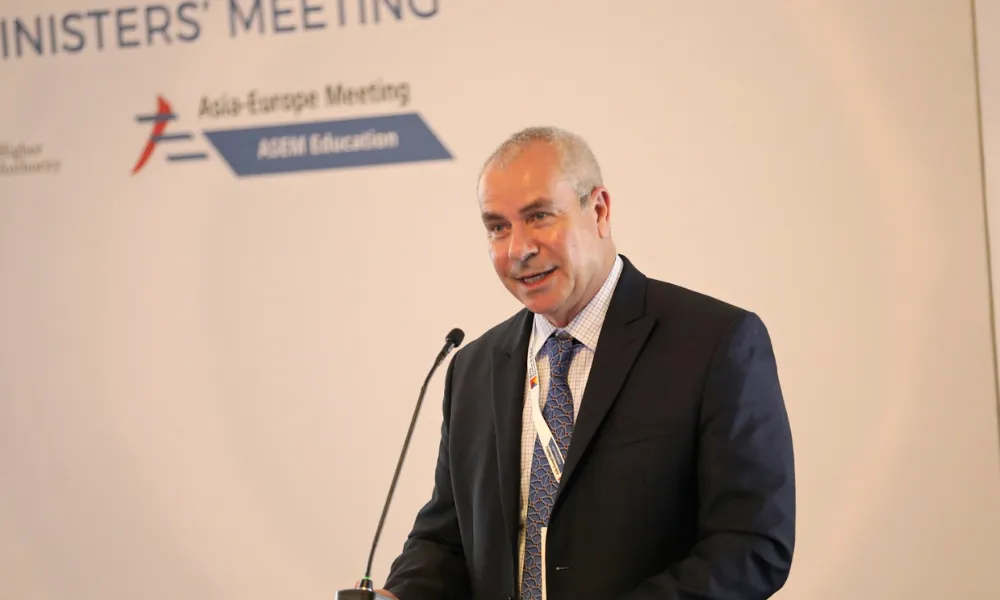

Higher education in Cyprus is growing, with more institutions, programmes and choices for students. The critical question, however, is whether this growth is accompanied by genuine quality and academic credibility. The Cyprus Agency of Quality Assurance and Accreditation in Higher Education (CYQAA) stands at the centre of this process, tasked with evaluating and accrediting institutions and study programmes. CYQAA president Andreas Charalambousdiscusses the role of accreditation, the need for families to choose their studies based on documented information, and the importance of the agency's institutional independence, so that quality becomes not merely a control process, but a shared culture across higher education.
Investing in education
To begin, Mr Charalambous, could you explain what CYQAA's role actually involves, and why it should matter to a student or a family preparing to choose a study programme?
CYQAA is the official independent body responsible for quality assurance and accreditation in higher education in the Republic of Cyprus. "Our mission is to ensure that the universities, higher education schools and study programmes offered in our country meet high academic and quality standards." The role of CYQAA is to ensure that this investment takes place within a credible, quality academic environment that operates on the basis of continuous improvement. In this way, we strengthen the trust of students and society in the Cypriot higher education system, and contribute to the international recognition of qualifications awarded by institutions in our country.
Accreditation
When a study programme is accredited by CYQAA, what does that guarantee for the student? What criteria are examined before accreditation is granted?
Accreditation of a study programme means that the programme has undergone a strict, multidimensional process of external evaluation by independent experts from universities abroad, and has been found to meet the quality standards applied across the European higher education area.
It is not only course content that is examined. The evaluation covers a broad range of parameters, including the academic structure and philosophy of the programme, the clarity of learning outcomes, the adequacy and qualifications of academic staff, the staff-to-student ratio, laboratory and library infrastructure, the technological capacity to support teaching, student assessment procedures, internal quality assurance mechanisms and policies, as well as student welfare and support services.
At the same time, the evaluation examines whether the programme remains current and compatible with contemporary scientific developments, responds to the demands of a constantly changing social and professional environment, and promotes academic excellence and scientific independence. Accreditation, therefore, represents an overall confirmation that the study programme can offer students a high-level educational experience and a degree with academic credibility.
Beyond advertising
How can a prospective student or a parent check, beyond an institution's advertising, whether a study programme is genuinely credible?
The agency's evaluations and accreditations serve as a reliable guide for prospective students and their families. Before choosing a study programme, it is important to confirm that it is accredited by CYQAA, as accreditation ensures that it has been evaluated against internationally recognised quality standards.
CYQAA's accreditation decisions, external evaluation reports and thematic analyses are publicly available on the agency's website. "This transparency allows students, parents and anyone interested to access reliable information and make informed decisions when choosing a study programme or institution."
These reports provide valuable information on the strengths of a study programme, the improvement recommendations submitted, and how the institution responds to European and national quality standards. At the same time, the thematic analyses offer a broader picture of developments and trends in Cyprus's higher education sector.
For this reason, I would encourage every family not to rely solely on commercial promotion or advertising presentations from an institution, but to make use of the objective data published by CYQAA. Transparency is a core operating principle of the agency, and the available data can serve as a particularly useful tool for making an informed and responsible choice of studies.
Growth with quality
Cyprus now has a considerable number of universities, schools and study programmes. Does more choice necessarily mean more quality?
The growth of the higher education sector in Cyprus is undoubtedly a positive development. It creates more opportunities for students, attracts international students, and contributes to the country's economic and social development.
However, the increase in the number of institutions and programmes makes the existence of strong quality assurance mechanisms even more necessary. Quality does not arise automatically from growth. It requires systematic evaluation, continuous monitoring and ongoing improvement.
CYQAA's role is to ensure that the continuous growth of the higher education sector keeps pace with high quality standards, so that Cyprus continues to strengthen its position and credibility on the international education map.
Quality in practice
What issues are most frequently identified in the evaluations of programmes or institutions?
Every evaluation is different, and no generalisations apply. However, through the processes of external evaluation and accreditation, certain issues have emerged more frequently, relating to the continuous improvement of quality in higher education.
These include the need to strengthen permanent academic staff, improve the connection between learning outcomes, teaching and assessment, strengthen student-centred learning, make more systematic use of student feedback, further develop internal quality assurance systems, strengthen research activity where required, and continuously upgrade infrastructure and services.
At the same time, the agency does not limit itself to examining individual cases. Through systematic study of the reports produced by External Evaluation Committees, it carries out thematic analyses, which allow conclusions and trends to be drawn at the level of the entire higher education system.
These analyses help identify good practices, common challenges and emerging issues facing institutions, while also supporting the development of guidelines and policies for the continuous upgrading of quality. It is important to stress that the purpose of these evaluations is not to impose sanctions, but to drive continuous improvement. The recommendations of evaluation committees and the conclusions of CYQAA's thematic analyses serve as tools for strengthening the quality of study programmes and institutions. Quality assurance, therefore, functions as a lever for the development and upgrading of higher education in Cyprus.
Protecting students
What happens when a programme or institution fails to meet the required standards? And above all, how are students already enrolled there protected?
Protecting students is our highest priority. When serious shortcomings are identified, CYQAA can request corrective action, impose conditions, refuse accreditation, or decline to renew an existing accreditation. Evaluation functions primarily as a tool for strengthening quality and driving continuous improvement.
In cases where compliance with the required standards is not ensured, CYQAA applies the procedures set out in legislation, which may include withholding or revoking accreditation. In every case, decisions are made in a way that safeguards the rights of already enrolled students, their academic progress and their entitlements, always in accordance with the current institutional framework.
The philosophy of the system is not to create problems for students, but to ensure they are not adversely affected by weaknesses that may arise at an institution or in a study programme.
The need for CYQAA's autonomy
You have spoken about the need for greater autonomy for CYQAA. What would change in practice for the agency, and why is this linked to the credibility of the higher education system?
Greater autonomy and further strengthening of CYQAA's independence are in line with the European principles and standards governing quality assurance agencies, as applied within the framework of the European Association for Quality Assurance in Higher Education (ENQA). This independence is a fundamental precondition for the agency's credibility, effectiveness and international recognition.
Stronger institutional independence would give the agency greater flexibility in staffing, faster and more effective processing of procedures, better strategic planning, and more efficient use of available resources.
At the same time, it would strengthen the agency's readiness to respond to developments and new challenges in higher education, further reinforcing the trust of European and international partners in Cyprus's higher education quality assurance system.
A culture of quality
What is your vision for CYQAA and for the quality of higher education in Cyprus in the coming years?
Our vision is to establish a strong culture of quality and excellence in higher education, centred on the student, academic integrity, innovation and continuous improvement. CYQAA's new board has already approved an ambitious five-year strategic plan, centred on the continuous support of higher education institutions in their academic development, outward orientation, and the strengthening of their international competitiveness. "Our core aim is for quality to become a shared culture and collective commitment across the entire education system, not merely a process of control and compliance."
At the same time, as CYQAA's board, we place particular emphasis on the internationalisation of Cypriot higher education, through active participation in the European higher education area, the development of international partnerships, the adoption of best practices, and the use of academic diplomacy as a tool for knowledge exchange and strengthening Cyprus's international presence.
Our goal is for Cyprus to further strengthen its position on the international education map, establishing a model of higher education based on quality, innovation, transparency and substantive international cooperation.