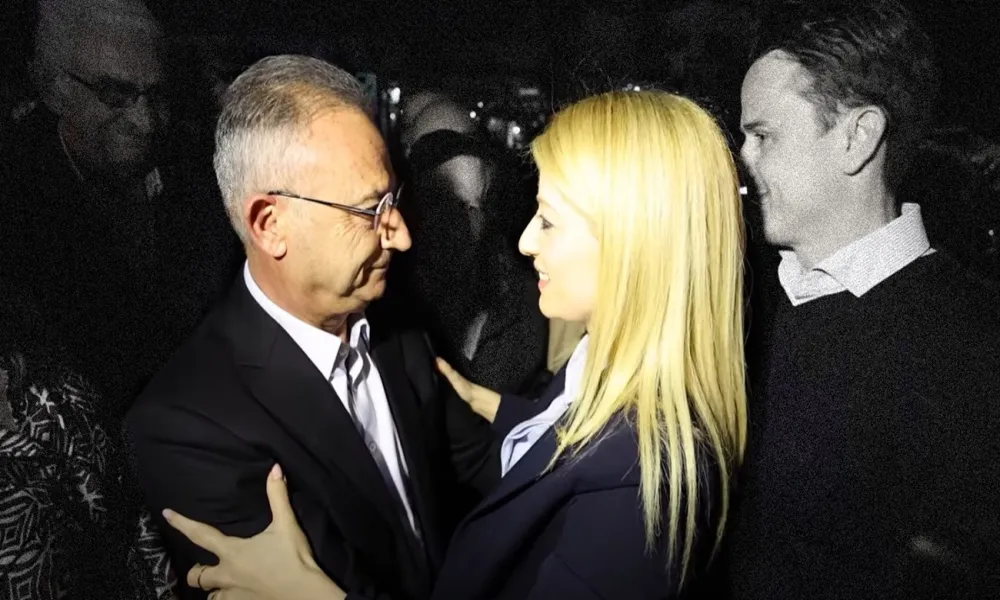
Over the past week, and with the much-discussed dinner at a fish taverna as the immediate backdrop, the bigger picture of the civil war within the Democratic Rally (DISY) has been laid bare. This is not simply a personal feud, a clash between AnnitaDemetriou and Averof Neophytou, but an expression of deeper problems within DISY. Beyond personal agendas, unrestrained ambitions and petty grievances, the various factions that have always competed for control of the party and power are also underpinned by substantive differences over positions on the Cyprus problem, the economy and social issues. In the past, these differences were concealed beneath what was described as DISY’s “broad appeal and pluralism”; today, more and more partymembers and outsiders alike are talking about “Babel”, “a hotchpotch” and “discord”. The paradox, however, is that DISY is not currently in numerical collapse. In last May’sparliamentary elections, it performed somewhat better than even its leadership hadexpected.
The wounds of 2023
One of the roots of the current crisis in DISY lies in 2023. Averof Neophytou was eliminated from the second round of the presidential election. The DISY vote split because of Christodoulides’ candidacy, the corruption/decay of the decade-long Anastasiades administration, Neophytou’s limited appeal beyond DISY and the strongly party-oriented campaign line. This was followed by the election of Annita Demetriou as party president and of a new leadership, without any genuine discussion beforehand about the reasons for the presidential election defeat. All the party’s problems and unresolved issues were swept under the carpet, and this was considered the way to heal the wounds.
The new president inherited a party in pieces, defeated, with a significant part of itsbase having shifted towards Nikos Christodoulides, with two former presidents — former President of the Republic Anastasiades and former DISY president Neophytou — seeking to keep her under their control, with “Judases” who were in DISY in the morning and at the Presidential Palace by the afternoon, and with major financial problems.
In addition, DISY has been suffering from an identity crisis ever since, given that half of the Christodoulides government was/is made up of DISY figures. DISY still does notknow whether it is the constructive opposition it proclaims itself to be and wants to be seen as, or a party that is covertly part of the government.
A different DISY
Much has changed in DISY between 2023 and today. Annita Demetriou is now DISY president, Speaker of the House of Representatives for a second term, a figure associated with the party’s electoral recovery/stabilisation in the 2026 parliamentaryelections, and now a candidate for the party’s presidential nomination.
Averof Neophytou is no longer party president, nor even a Member of Parliament. He isassociated with DISY’s prolonged inward-looking phase and will be a candidate in the 2028 presidential election, whether or not he goes through the party’s procedures.
In addition, senior DISY figures make no secret of their preference for Christodoulides and their efforts to pull DISY towards the Presidency, culminating in President Christodoulides’ appointment of Nikos Tornaritis — until recently the third-ranking figure in DISY — as special envoy for the Cyprus problem in Africa and Asia.
The fishy business
The past week smelled fishy. Public discussion focused on the much-discussed dinner at a fish taverna and what exactly was on the menu: a package deal for the presidenciesof the House of Representatives and the Republic of Cyprus, or simply a discussion about those presidencies.
The diners — Chris Panayiotou (owner of Politis), Dionysis Dionysiou (editor of Politis) and Annita Demetriou (Speaker of the House and DISY president) — maintain that no agreement was reached and that it was a friendly gathering involving an open discussion.
Averof Neophytou, the former president of DISY, insists, however, that Mr Panayiotouproposed helping Ms Demetriou, “to the extent of his influence”, to be re-elected Speaker of the House in exchange for her support for his bid for the presidency of the Republic.
The dinner acquired political significance from the moment it was made public in themanner in which Averof Neophytou chose to make it public. It was seized upon by DISY figures and others alike for harsh criticism, but also to substantiate a different narrativeabout who had — and has — what role.
The former DISY president is using the dinner to argue that there had been prior political understandings and that the current situation did not arise as a result of any sudden change of position on his part.
The official position of the Democratic Rally is that anyone interested in seeking the party’s nomination for the presidential election has the right to do so, but that the routeis through the party’s statutory procedures. On Friday, DISY’s Political Bureau unanimously decided that nominations for the presidential nomination would ultimatelybe submitted on 26 October, with the internal party election taking place on 28 November. Averof Neophytou was not present; he was travelling abroad.
Gains – losses
Annita Demetriou and Averof Neophytou have both made political gains, but they have also suffered losses in recent years and as a result of the latest developments. Both — the current and former DISY presidents — have their strengths and weaknesses, their certainties, their assets and their risks.
Gains/advantages for Annita
(a) She now has her own political base. Annita Demetriou is no longer simply “Averof Neophytou’s successor”. She was elected DISY president in 2023 with 69% of the vote and, in 2026, retains control of the party through its institutional bodies.
(b) She has institutional weight. Her second election as Speaker of the House, with 29 votes, gives her a political presence beyond the party machinery.
(c) She can present herself as “the candidate of the process”. This is perhaps the most important point. She does not need to convince anyone that she is anyone’s“natural successor”. Thousands of DISY members will decide.
(d) The conflict is forcing her to develop a clearer political identity. Until now, part of her political image has been tied to her institutional role, which allows her to maintain a consensual presence in public life and in the management of the party, with broad positions that satisfy a large part of the audience without upsetting almost anyone. Nowshe will be forced to say precisely what she proposes for Cyprus in 2028.
Losses/risks for Annita
(i) The conflict is forcing her to abandon the role of above-party manager. The greater the confrontation becomes, the harder it is for her to remain simply the “president of everyone”. Once she becomes a candidate, she becomes one of the sidesin the internal contest.
(ii) The dinner creates a persistent question. Even if there was no agreement, there is political damage from a controversial behind-the-scenes conversation. And while avoiding a direct response/explanation may offer her some short-term protection, at thesame time it leaves Averof Neophytou room to shape part of the public narrative.
(iii) The process must be — and must be seen to be — clean. If Averof Neophytoudecides to participate in the internal party process for the nomination and there are allegations of procedural problems/issues, Annita Demetriou will face the difficult political question: “How can the party president be both a candidate and the guarantorof the process?”
Gains/advantages for Averof
(a) He is regaining political autonomy. After 2023, everything suggested that AverofNeophytou would remain a former DISY president of historical significance. With hisannouncement that he will run in the 2028 presidential election, he has returned to the centre of the political debate. His aim is for his candidacy not to be confined to DISY but to appeal to society as a whole and across the political spectrum. This is why he has chosen not to present himself as a candidate in a party process, but as a candidate withan independent political platform.
(b) He is shifting the discussion from himself to politics. His central narrative is the Cyprus problem, the need for more active political engagement and criticism of DISY’sstance towards the Christodoulides government. He argues that DISY has ended up giving the impression of being a “silent government ally” and asks what the politicaldistinction would be between a Demetriou candidacy and the Christodoulides government. He is trying to turn the internal party battle into an ideological/political one, rather than merely a personal contest.
(c) He is activating the DISY base. He has created — and is expanding — a group ofDISY figures and members who are favourably disposed towards him and who are participating in internal party processes, planning and meetings of the party’s bodies and organs. This means the debate is not simply “Averof versus the leadership”. There is a genuine internal party constituency that has to be taken into account.
Losses/risks for Averof
(i) 2023 remains part of his political legacy. Averof Neophytou is not entering 2028 asan unknown quantity. He carries with him his presidency of DISY, his 2023 presidential defeat and the entire debate over the Anastasiades-DISY-Christodoulides relationship. Consequently, his return to the presidential race inevitably brings the discussion back to2023.
(ii) His relationship with the party is unclear. This is perhaps his most importantstrategic difficulty. Mr Neophytou says that his candidacy goes beyond the boundariesof the Democratic Rally, while the party insists that anyone seeking its nomination must go through the internal party process. This creates the fundamental question: “Does hewant to be DISY’s candidate, or does he want DISY to decide whether it will follow his candidacy?”
(iii) Attacking the process could alienate part of the base. Averof Neophytou hasspoken of a “stacked deck” and has implied that he does not want to participate in a process he considers predetermined. But there is an opposite risk. The more hechallenges the process, the more he may find himself confronting the very party he governed for years. And that makes the equation “I am DISY, but I do not accept DISY’s process” extremely difficult to sustain.
Gains/losses for DISY
The Democratic Rally is being forced, however painfully and hastily, to have the political discussion it had been avoiding: What is its identity? What kind of opposition is it? Whatis its relationship with Christodoulides? What is its position on the Cyprus problem and the economy, among other issues? Which person can represent the party’s base? Whoultimately decides?
On the other hand, until these questions are answered, the party’s public image is beingdominated by personal confrontations, behind-the-scenes manoeuvring and “fish tavernas”, allegations of a “stacked deck”, public clashes between party figures and arguments over timetables.
DISY is simmering in its own juices
The most interesting point is that the confrontation within the Democratic Rally is not simply between Annita Demetriou and Averof Neophytou. And this may be where theessence of the current crisis lies. DISY has multiple internal lines and factions.
DISY deputy president Efthymios Diplaros and vice-president Yiannis Karousos clashed publicly over issues of political direction and the party’s relationship with the Christodoulides government.
DISY MP Giorgos Pamboridis, who has already expressed his interest in the 2028 presidential election, strongly criticised the situation within the party and raised issues concerning both timetables and procedures.
DISY vice-president Giorgos Karoullas called on Averof Neophytou to enter the internal party process and urged restraint.
Michalis Sofocleous, who among other things served as a DISY MP, said that “Annita Demetriou gives the impression of being a lone operator, wanting all the positions for herself”, while the party’s vice-president, appearing on Omega’s lunchtime programme, became emotional as she spoke about the division within DISY, which could once again lead AKEL up the hill to the Presidential Palace…
What kind of DISY will exist after 2028?
So, the Democratic Rally does not simply have three camps — Christodoulidessupporters, Averof supporters and supporters of the leadership/Annita. Rather, there appears to be a framework with at least three dimensions:
(1) The institutional DISY under Annita Demetriou’s leadership, where decisions are taken by the party’s organs and members.
(2) Averof Neophytou, who emphasises his political autonomy and argues that political substance and the Cyprus problem should take precedence over party machinery.
(3) Internal reformist/dissenting factions, who are concerned about their political future in a DISY that is falling apart, and who see the problem as broader than the two individuals and perhaps requiring a political reset.
In addition, there appear to be deeper political differences within the party behind the clashes that periodically erupt.
A recent example is Averof Neophytou, who is seeking to build his candidacy around theCyprus problem and the need for a more active confrontation with, and differentiation from, the government. He argues that DISY’s differentiation from Christodoulides isinadequate.
Annita Demetriou and her associates, meanwhile, are seeking to keep DISY within an institutional and oppositional, but non-confrontational, framework.
Consequently, the battle for the presidency is tending to develop into something much more serious: what kind of DISY will exist — will there even be a DISY? — after 2028, whether the presidential election is won or lost.
Will it be a DISY that is an institutional, moderate, democratic, European centre-rightparty with a clear identity, direction and political character? Or a Democratic Rally with anationalist and populist agenda, dabbling in the murky waters of the far right and tornapart by excessive personal ambitions and interests?
Annita, Averof, DISY and… the country
Finally, the result of last May’s parliamentary elections should not be lost amid the noise of recent days.
Despite the predictions of various analysts and polling results, as well as the poaching ofthe party by Nikos Christodoulides, internal party disputes and personal ambitions, the Democratic Rally — through the efforts of satisfied and dissatisfied, old and new party figures, and with the votes of Christodoulides supporters, Averof supporters and others — remained the largest party, with 27.1% (27.77% in 2021), maintaining a comfortablelead over second-placed AKEL, which received 23.9%, while also increasing its absolutenumber of votes: 101,013 in 2026, compared with 99,331 in 2021.
Consequently, the current leadership cannot be considered to have failed, nor is there any need for Averof Neophytou or Nikos Anastasiades to return to save the party.
However, the opposite is not true either. In other words, Annita Demetriou — and her inner circle (something she needs to be careful about before it is too late) — has notfully consolidated her position in the new DISY, nor can Averof Neophytou be considered a thing of the past.
The former party president still has political capital and a network within the party, whilethe current public debate shows that there is a section of party figures who support him, as well as quite a few others who view him favourably.
These are precisely the factors that make the contest a real one rather than a symbolic one.
In DISY, the time for evasions, pretexts and excuses appears to be over. Annita Demetriou cannot afford to regard the new Democratic Rally as a fait accompli, and Averof Neophytou cannot regard the old DISY as his property. And at some point the others will have to decide whether they want to play a supporting role or take a place at the wheel.
The internal contest will not be decided solely by personalities, but by what DISY will be the day after and, above all, by what the present and future of our country will look like.
We all know that Cyprus is at a very critical juncture. Turkey speaks — and negotiates — only in terms of two states, the international community has absolutely no concern for the Cyprus problem (even Commission President von der Leyen has forgotten about it), and citizens are facing enormous problems that are tearing apart their everyday lives.