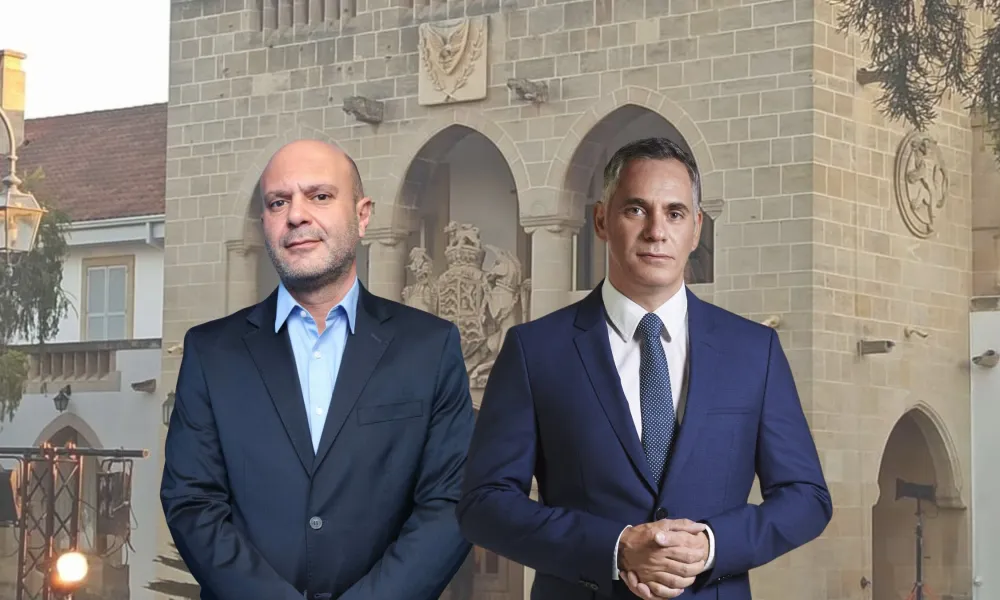

Everyone’s attention is focused on DISY, which was the first party to cross the finish line in its internal process for the presidential elections. However, two parties with a very important role remain in the background. The stance taken by DIKO and ELAM in the 2028 presidential election could prove decisive for the outcome at the ballot box.
The two parties secured a significant number of votes in last May’s parliamentary elections. ELAM received 40,572 votes, or 10.9%, while DIKO secured a total of 37,223 votes, or 10%. That gives them twice the electoral strength of ALMA and Direct Democracy, which each received just over 20,000 votes. Therefore, no presidential candidate can afford to ignore DIKO and ELAM, even if they do not wish to, or are unable to, form an alliance with either party.
Fragmentation
First of all, a fragmented political landscape is emerging on the centre-right, making the first round a genuine political thriller and political alliances an imperative.
If the scenario of a three-way split on the centre-right materialises, with Annita Demetriou, Averof Neophytou and Nikos Christodoulides running as candidates, then the candidate who secures the support of either DIKO or ELAM, or both, would have a greater chance of making it through to the second round.
Many believe it is almost certain that the candidate backed by AKEL will make it through to the second round, given the fragmentation of the centre-right. Within this reading, the question is who will ultimately face the AKEL-backed candidate in the second round. The answer may be determined by the choices made by DIKO and ELAM.
Discontent within DIKO
DIKO is currently the only parliamentary party participating in the governing coalition, and it has the largest number of ministers in the government of Nikos Christodoulides. However, the party leadership has made clear that its support for Christodoulides in 2028 cannot be taken for granted.
On the contrary, it is evident that there are serious problems in the party’s relationship with the government, with political disagreements and clashes emerging periodically. The latest example was the recent dispute between DIKO president Nikolas Papadopoulos and Finance Minister Makis Keravnos.
DIKO president Nikolas Papadopoulos and deputy president Christiana Erotokritou have said that an internal party dialogue is under way, involving district meetings, and that decisions on the presidential election will be taken by the party’s collective bodies. They have also ruled out no scenario — including the possibility of DIKO fielding its own candidate.
That remains the official position of DIKO, even as two of the party’s ministers have publicly and repeatedly stated that the party will support Nikos Christodoulides in 2028.
Sources told “P” that the number of party officials recognising the problems in the relationship with the government is steadily increasing. The issue has been raised by DIKO on numerous occasions but has not been resolved.
Instead, many party officials believe President Christodoulides is openly ignoring the governing coalition parties and operating as a “one-man show”. In many cases, the leaderships of the coalition parties learn about the President’s decisions through the media.
These officials say in private conversations that President Christodoulides is undermining the coalition parties during his first term, despite knowing that he will need their support for a second term.
As a result, they are asking what his approach would be if he were re-elected, knowing that he would then be unable to seek a third term. They fear that, in such circumstances, he would take the parties into account even less.
Two camps
A party source told “P” that two camps currently dominate DIKO. One favours continuing the cooperation with Nikos Christodoulides, while the other is looking for a way out and a means of breaking free from the current arrangement.
Among the second group of officials, the idea of a DIKO candidate in the presidential election has begun to gain traction.
The comments made last week by Famagusta MP Zacharias Koulias were not accidental. He said that a large section of DIKO wants Nikolas Papadopoulos to run.
This school of thought believes that a Papadopoulos candidacy would put DIKO ministers who support Nikos Christodoulides in a very difficult position, because no one can imagine party officials openly opposing their party president. If they did so, they would effectively place themselves outside DIKO.
The faction opposed to supporting Nikos Christodoulides again includes officials who favour cooperation with DISY. However, there are also figures within this group who are looking towards AKEL, which is preparing to enter into dialogue with the other political forces to explore the possibility of alliances.
That scenario cannot be ruled out either. In such a case, DIKO would drop out of the centre-right alliance equation and ELAM would acquire even greater importance.
ELAM
Until just a few days ago, the prevailing assumption was that ELAM would support President Christodoulides in the 2028 presidential election. The party’s low-key approach, despite supposedly being in opposition, has reasonably fuelled suspicions that ELAM is preparing the ground for cooperation with Nikos Christodoulides.
However, last week party president Christos Christou also put DISY on the map of potential alliances.
Speaking on OMEGA’s “Enimerosi Tora” programme, Christou said that the problem that had existed with DISY president Annita Demetriou had been overcome, making clear that ELAM no longer had any complaints.
He stressed that, during the current parliamentary term, “Ms Demetriou has given ELAM not anything more, but what it is entitled to based on its percentage of the vote and its ranking”.
He was also asked whether there was a possibility of ELAM supporting Annita Demetriou in the presidential election. He reiterated that the previous issue no longer existed.
He added that the party was considering various scenarios and that it was still too early for definitive decisions.
A party source told Politis, however, that ELAM’s discussion on the presidential election will begin next January, stressing that the party is not ruling out any scenario.
The party’s strategic objective is to participate in the executive branch — in other words, to form a government with other parties on the basis of certain areas of policy convergence.
Consequently, the possibility of ELAM running independently in the presidential election with its party president as candidate cannot be ruled out, although it appears increasingly remote. This was the approach ELAM adopted in previous elections.
Nevertheless, party officials stress that ELAM is not what it was 10 years ago. They believe that the 11% it secured in the parliamentary elections, together with its 40,000 voters, does not allow the party to adopt a purely oppositional stance.