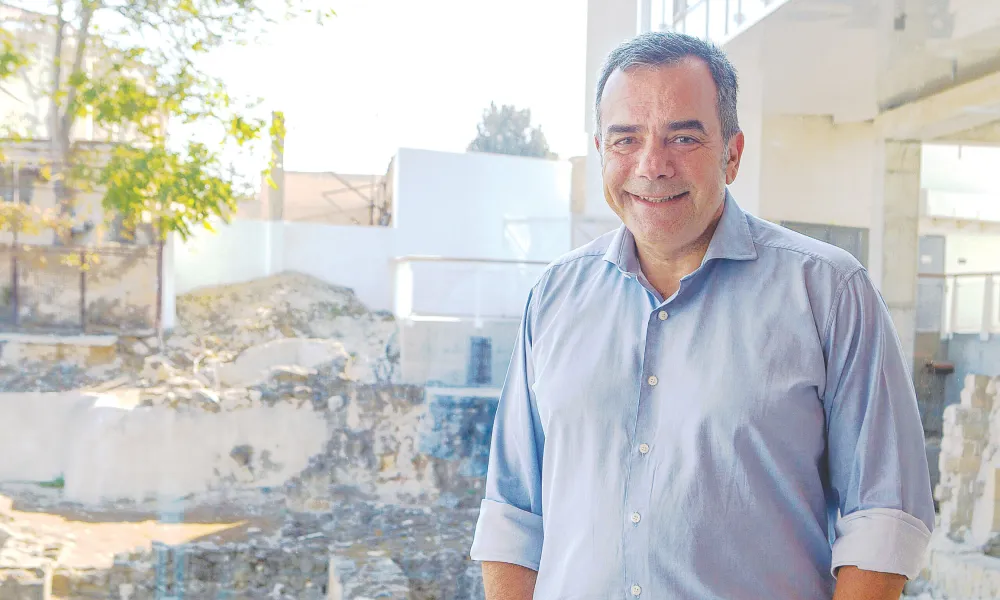

The Melios zoo case is no isolated incident. Constantinos Yiorkadjis, President of the Nicosia District Local Government Organisation (EOA), sees it as symptomatic of a wider malaise. In his view, the problem reaches both the licensing and management that fall under the Ministry of Interior and the very workings of the state's central structures.
In the first interview of a Politis series on the need to modernise legislation, Yiorkadjis traces the root of the problem to laws that make no provision for smooth cooperation between departments and ministries.
Laws for a state of another era
"The problem is outdated legislation, or legislation that has never been updated," he said. "I believe the laws, and the way the ministries operate, reflect how they should perhaps have operated 60 or 70 years ago. There needs to be serious reform."
He does not try to single out any one law as the culprit. What he can say with certainty, he noted, is that reform is needed, either to make cooperation between ministries easier or to merge some of their departments.
By way of example, he pointed out that it is still being debated who is responsible for planning the road network. Is it the Department of Town Planning and Housing at the Ministry of Interior, or the Public Works Department at the Ministry of Transport?
The Nicosia EOA has been operating since 2024. Under the local government reform, it took over responsibility for water supply, sewerage, building permits, school boards and waste management.
For Yiorkadjis, the organisation is proof that services work better when they are unified. It brought together bodies that had operated for decades, each under its own legal framework. The problem, he argued, is that unification stopped at local government.
Water pricing awaiting approval
The clearest example, according to the EOA President, concerns water. The former Minister of Agriculture had announced that waste would be tackled through pricing policy. The average consumer and household would not be affected, but the price would rise on a sliding scale above a certain level of consumption.
"Had the pricing policy gone ahead as the Water Development Department and the ministry proposed, we would not be seeing residents 'watering' the pavement to clean it," he said.
The policy stalled, he explained, because water pricing falls not under the Ministry of Agriculture but under the Ministry of Interior.
"And don't ask me why. Nobody knows," he remarked.
For months, the EOA has been waiting for the Ministry of Interior to approve the new pricing policy proposed by the Ministry of Agriculture. The approval would come through the EOA operating regulations.
Asked which legislative change is the most urgent, he answered without hesitation that it is this one. The need became all the more pressing, he noted, when the public was told of possible 10% cuts in water supply.
Eight departments, no single counterpart
Yiorkadjis describes local government and the ministries as "two sides of the same coin". In his view, they must work together to give citizens the best possible service.
"The state was right to reform local authorities. The EOAs were created, the municipalities changed. The other side was not reformed," he said.
The result, he says, is that the EOA has to deal with seven or eight different departments that do not communicate with one another.
He cited a case in Pyrgos Tyllirias. The EOA had proposed installing a temporary sewage treatment unit until the sewerage network planned for the area is completed.
For two years, he said, the competent ministries tried to secure around €300,000. To this day, it is not known whether the money was found.
The Water Development Department eventually applied to purchase and install the unit, which Yiorkadjis described as a significant help to the area's hoteliers. The Department of Environment of the same ministry then rejected the proposal.
"I imagine they had their reasons," he observed. "What I am trying to show is that reforming one side without reforming the other creates enormous bureaucracy and costs us countless hours of work."
The organisation had a similar experience with its first budget. The Ministry of Finance amended the organisational structure that had been agreed with the Ministry of Interior. The file then went back to the Ministry of Interior, and from there to the EOA for explanations, which delayed approval.
The structure the EOA proposes in order to meet its annual targets, he explained, requires the approval of two ministries. In this case, one ministry agreed to it and the other rejected it.
A Water Authority and a single point of contact
The Nicosia EOA has submitted two specific proposals.
The first is the creation of an Independent Water Authority. According to Yiorkadjis, most European countries have a single body responsible for everything to do with water. In Cyprus, where water is the scarcest resource, the body that produces the water is also the regulator.
The ideal solution, in his view, would be a Deputy Ministry of Water with full control over water resources and networks. In its absence, the organisation has formally proposed setting up the Authority. The proposal has already been made public and sent to the relevant authorities.
The second proposal concerns a Deputy Ministry of Local Government. The alternative would be a single body within central government that local authorities could turn to on every issue.
"There is not one person in central government I can turn to in order to resolve the issues that concern the EOA," he said.
According to Yiorkadjis, the organisation will soon submit a proposal for an independent body to support local authorities under the Ministry of Interior.
He has spent ten and a half years as Mayor of Nicosia and two and a half years as EOA President. That experience leads him to conclude that "it is an enormous ordeal to have to speak to eight, nine, ten different people".
A matter of decision, not bureaucracy
Asked who is to blame for the delays, whether Parliament, the executive or the bureaucracy, Yiorkadjis replied that responsibility lies with the ministries.
"It is not a matter of bureaucracy. It is a matter of decision. There is no decision to make the changes we are discussing," he said.
He added that there is currently no plan to create an independent Water Authority or a body to support local government. He acknowledged that these are the organisation's own proposals, which others may not share.
Public sector reform, he noted, is a far broader issue. On the local government side, he proposes a joint team drawn from every ministry and department that deals with local authorities, to examine which laws need to change.
That, however, requires a political decision. "Someone has to give the instructions. Someone has to recognise that there is a need," he said.
The autonomy the EOA seeks does not mean an absence of oversight, he clarified. The organisation has three internal auditors and an Internal Audit Committee, and it is also subject to scrutiny by the Auditor-General.
"Auditing decisions is one thing. Interfering in how decisions are made is quite another," he said.
Good practice from abroad
The Nicosia EOA is also looking beyond Cyprus for good practice. It has signed memoranda of cooperation to exchange experience and expertise with two partners:
- the Thessaloniki Water Supply and Sewerage Company (EYATH)
- Mekorot, Israel's national water company, which operates under water scarcity conditions closer to those in Cyprus
"We are not saying we know everything. We are saying we are constantly looking for good practice from other organisations," said Yiorkadjis.
He added that in areas such as wastewater treatment and the production of recycled water, the Nicosia EOA outperforms both of its partners.