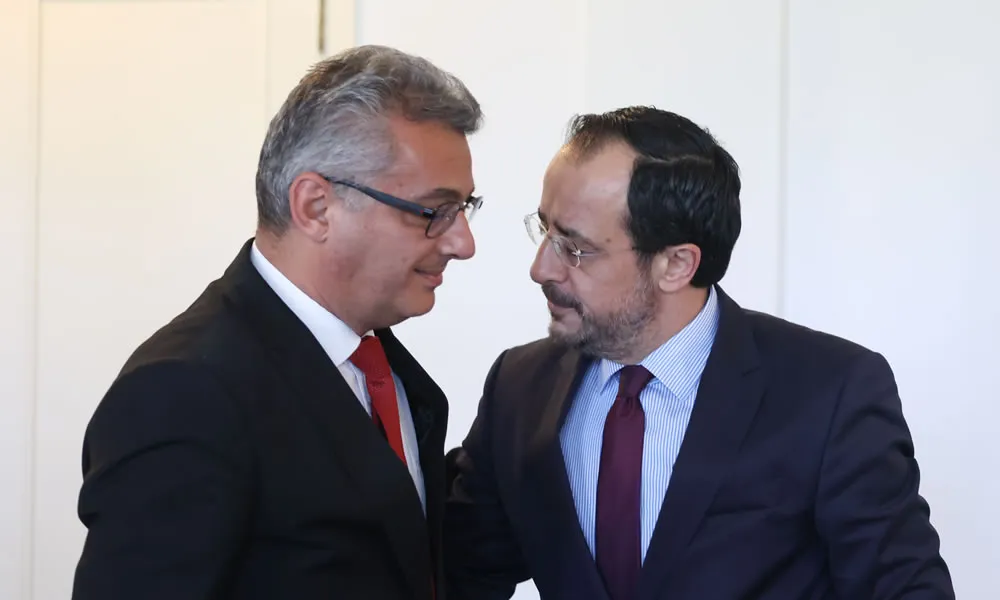
The outcome of Friday’s meeting between Nikos Christodoulides and Tufan Erhürman was both expected and unsurprising. In essence, it confirmed what had been increasingly evident for weeks, following their previous meeting in early April: the Cyprus problem is in a phase of political maintenance rather than substantive negotiation. What is taking place is more a management of deadlock, or at the very least a management of a form of de facto partition on the ground.
Despite public references to a ‘positive climate’, ‘productive talks’ and ‘momentum’, the facts emerging from the two-hour meeting once again showed that neither new crossing points nor the resumption of a meaningful process are close to implementation.
Managing division
The two sides agreed on four confidence-building measures of limited political weight: the creation of a civil society advisory body, a framework for conducting religious services across the island, continued cooperation on combating foot-and-mouth disease and the establishment of a subcommittee on trade certification for Turkish Cypriot products, including halloumi.
These steps undoubtedly keep channels of communication open and allow for some functional cooperation. However, they do not signal political convergence on the core of the Cyprus problem. Rather, they point to a form of low-intensity management along partitionist lines.
Zero momentum
Against this backdrop, the most significant aspect of the meeting was ultimately what did not happen. There was no progress on opening new crossing points, despite the fact that the UN Secretary-General’s personal envoy, Maria Angela Holguín, considers this issue crucial for creating the necessary momentum towards a new ‘5+1’ conference. The inability to reach agreement even at this level demonstrates that the two sides remain locked into different logics and different political starting points.
Contact without pressure
In practice, the current phase of the Cyprus problem is characterised by a peculiar parallel course. Nikos Christodoulides and Tufan Erhürman do not openly clash, but neither do they converge. Their public statements suggest an effort to preserve a space for political contact without assuming the cost of a head-on confrontation, knowing that a complete collapse of the process would generate pressure on both sides. As a result, the ‘positive climate’ functions more as a tool for managing deadlock than as a reflection of real progress.
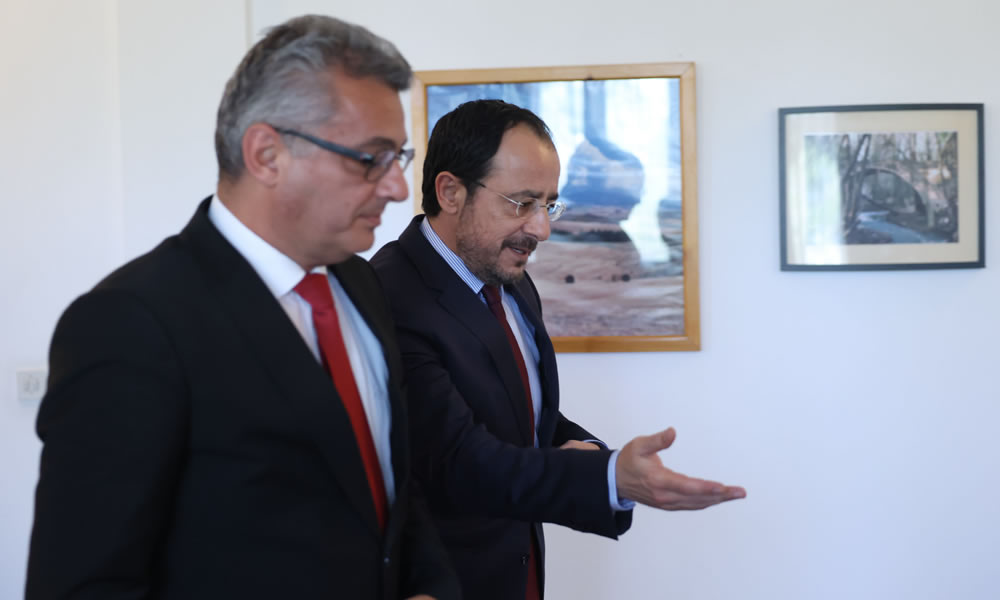
This is also evident in how each side describes the process itself. The Greek Cypriot side speaks of momentum, development and prospects for resuming talks. The Turkish Cypriot side appears far more cautious, treating contacts primarily as a means of maintaining communication rather than as a prelude to immediate negotiations. This difference is not merely communicative but reflects political tactics with elements of strategic positioning.
Where is the framework?
Following the meeting, Nikos Christodoulides once again sought to sustain the image of a process moving forward, stating that the aim remains an expanded conference in the summer at which the resumption of negotiations could be announced. However, behind this rhetoric there is still no discernible negotiating framework. Neither a common basis for discussion nor a clear indication that the sides have agreed, even minimally, on how a substantive process could be restarted has been presented.
References to the UN Secretary-General, António Guterres, as the driver of a ‘new initiative’ create expectations, but these are not yet accompanied by concrete parameters. It remains unclear what the political framework of a possible new conference would be, which issues would be on the table and how far the sides are prepared to go. The result is an appearance of momentum without the substantive foundations to support it. If the Secretary-General is indeed attempting a final initiative before the end of his term, this would point not to the ‘informal meetings’ of recent months but to a possible attempt at a structured process. Such a prospect suggests that Guterres and his envoy will not take at face value statements made domestically for internal consumption, instead seeking a minimum of common ground and, above all, clear clarification of intentions.
Turkish Cypriot internal dynamics
At the same time, Nikos Christodoulides sought to shift part of the responsibility for stagnation onto internal factors within the Turkish Cypriot community, making pointed references to the governing coalition led by the National Unity Party (UBP). His mention of upcoming political developments in the north was not accidental. He appears to believe that internal political dynamics directly affect Erhürman’s room for manoeuvre, particularly amid discussions of possible early ‘parliamentary’ elections.
There is also an assessment that if the Republican Turkish Party manages to capitalise politically on the momentum generated after the recent ‘presidential’ elections, forces supporting a federal perspective could gain a stronger overall role in the north. For now, however, this debate concerns future scenarios rather than immediate developments.
An exercise in polishing
For his part, Tufan Erhürman adopted a more subdued tone after Friday’s meeting, arguing that the convergences achieved may appear small but are important for improving intercommunal communication. His stance reflects a different reading of the current situation. The two sides are not yet at a point where they can seriously discuss the substance of the Cyprus problem. They remain in a phase of maintaining contact and avoiding complete disengagement.
Seeking clear positions
This reality appears to be recognised by the United Nations as well. António Guterres does not seem inclined to convene a new international conference without first establishing clear political intentions for substantive talks. The experience of failed past efforts has generated strong reservations in New York over the value of launching another process without a basic common foundation.
For this reason, Maria Angela Holguín’s return to Nicosia is not considered a given without a prior assessment of the parties’ real intentions. Throughout the previous period, she pressed for better use of time, arguing that prolonged inertia works in favour of entrenching the existing status quo.
Two directions
Behind the scenes, different approaches appear to be under discussion regarding how a new effort could be organised. On the one hand, there is talk of a strategic agreement document that would define basic parameters before any new conference. On the other, a more flexible approach is also being recorded, attributed to Holguín, who seems to believe that only a bolder, gradual process, even with elements of loose federation, could break the current inertia.
For now, however, the Cyprus problem remains in a transitional but unclear phase. Meetings continue, the United Nations maintains its interest and both leaders avoid a rupture. Yet the distance between managing the process and engaging in real negotiation remains wide, with adverse dynamics continuing to entrench the partition status quo.