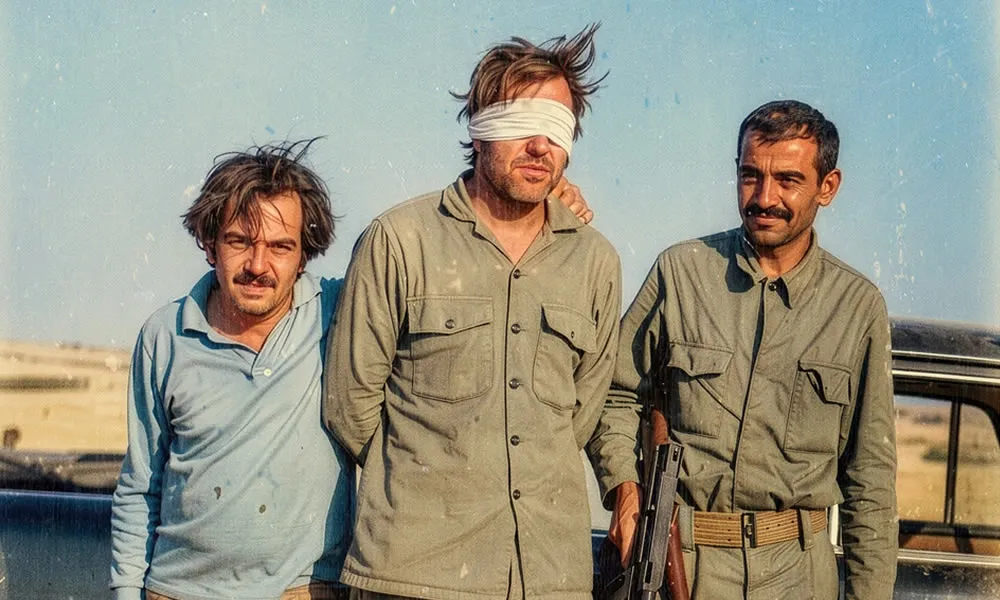

A photograph of a blindfolded Greek Cypriot prisoner of war from 1974 is currently doing the rounds on social media, reigniting a debate on the issue of missing persons in Cyprus.
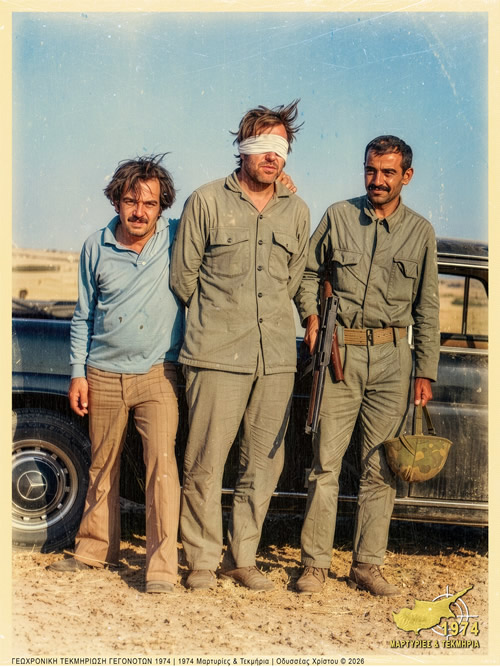
On 4 May, 2026, independent researcher and administrator of the ‘1974 Witness Accounts and Evidence’ Facebook page Odysseas Christou posted a colour photo of a tall man, blindfolded with his hands behind his back, flanked on either side, by what appear to be his captors, a civilian on his right, and an armed soldier on his left. They are in a dry, yellow field. Behind them is parked a black Mercedes.
The post is titled, ‘The Giant Prisoner – Who is he and what is his fate?’. Underneath, Christou gives a long account of the photographic evidence, linking it to the ‘Black Mercedes’ at the Ayios Demetrios Church in the Mandres Kaimakliou area, south of Mia Milia village.
“Anyone who can contribute with testimony is kindly asked to leave a comment or contact us.”
The picture is striking and a stark reminder of the tragedy of war. It also raised questions on the public nature of such investigations into missing persons – do they help the relatives; do they aggravate unhealed wounds – or both?
Blindfolded man one of 933 still missing
The Facebook post garnered hundreds of comments, some saying they recognise the blindfolded figure. Others claimed the photo is doctored.
Contacted by Politis, the Committee on Missing Persons in Cyprus (CMP), said that it is aware of the case and that an investigation into the specific person photographed is already underway. As a rule, the CMP does not comment on any of the ongoing investigations into the missing, it added.
According to the CMP, the total number of missing persons recorded in Cyprus is 2,002 (1510 Greek Cypriots, 492 Turkish Cypriots).
As of last month, just over half, that is, 1,069 missing persons have been identified (764 Greek Cypriots, 305 Turkish Cypriots). There are still 933 people considered missing (746 Greek Cypriots, 187 Turkish Cypriots).
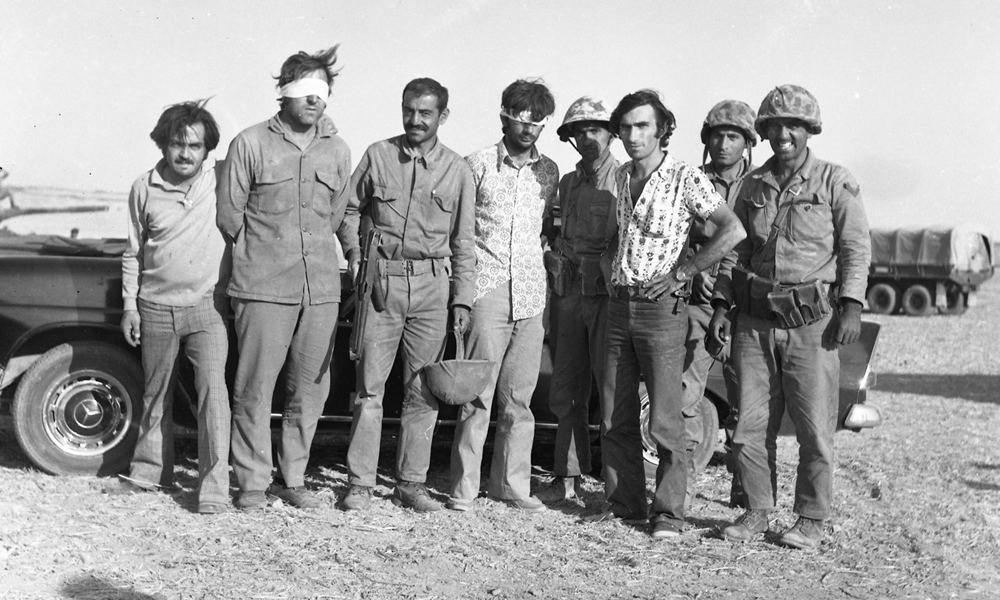
Original photo
Politis was able to track down the original black-and-white photo which shows another five people to the right of the three in the colour photo. A second person is seen blindfolded with his hands behind his back and wearing civilian clothing, three are soldiers. A fifth is also in civilian clothing, with clearly defined features. He is believed to be a Turkish journalist working for TRT. They stand in front of a black Mercedes. Apart from the two blindfolded prisoners, the rest are staring straight at the camera with an air of confidence.
European Parliament
DIKO Member of European Parliament Costas Mavrides posted a video on Facebook on 8 May highlighting that the researcher Odysseas Christou has brought new information to light regarding the presence of a Turkish TV crew filming in the area during the second phase of the Turkish invasion in August 1974. Mavrides noted that the journalist in charge of that crew is alive today.
The MEP announced that he will bring the issue to the European Parliament, with Christou and others, with the aim of seeking information to uncover the truth.
Relatives
Head of the Pancyprian Organisation of the Relatives of Undeclared Prisoners and Missing Persons Nicos Sergides welcomed the fact that there was still sensitivity on the issue of the missing, but seemed ambivalent as to the value of releasing information to the media.
He noted that many photos appeared in the past, usually published by foreign media, and relatives of missing persons would identify their own people in those photos or video footage. However, detailed investigations by state services would often find that the persons in question were prisoners of war who had been released, and not the missing persons originally thought.
At the same time, he acknowledged Christou’s role as a professional who is trying to help.
The researcher
Speaking to Politis, Odysseas Christou confirmed that the photo had been edited using artificial intelligence on purpose.
“Throughout my (Facebook) page you won’t find a black and white photo. I always make them colour, and the reason I do that is to make them more attractive to the viewer and to protect my sources,” he said.
The aim is not to evaluate the photo but to identify the blindfolded prisoner and to raise awareness about the location so that if there are eyewitnesses who were in the area and remember something, they can come forward, he said.
Asked why he separated the three people shown in the colour photo from the other five in the original, he said the aim was to seek information in phases. First, to find information on the blindfolded prisoner on the left, while clearly showing the black Mercedes in the background. Then to try to get information on the second blindfolded prisoner on the right, and finally to home in on the Turkish journalist who was in the area at the time with a television crew.
According to Christou, one of the people in the original photo is then TRT television journalist Selim Esen, the winner of numerous journalism awards in Turkey, who later also worked at Anadolu Agency. “He has a huge archive of photographs and footage from the war. If he can help us, we call on him to help us with his archive.”
Any photographic material that could help to confirm the fate of missing persons and provide closure to the relatives would be very helpful from a humanitarian angle, he noted.
Asked to comment on the impact of going public on relatives of the missing, who potentially see photos of loved ones on social media after decades, he argued it was necessary to provide a form of indirect pressure on those who have information to give it.
Social media provides the means for mass communication, which could lead to information about their loved ones. The missing cannot remain missing forever, and the more time passes, the less chances of determining their fate, Christou argued. “We need to intensify the effort.”
He added: “I cannot have a photograph in my drawer and not explore who it is.”
In this specific case, the prisoner in the photo was in a more dignified stance, compared to other cases where the content of the photograph is such that they cannot be made public, he said.
The researcher noted that he also collaborates with CMP, sending them the reports that he prepares using his own time and resources. Christou uses chronological and environmental evidence and a Geographic Information System to provide information on the events of 1974.
He sends photographic material to CMP first. If there is no progress, he might then choose to go public, he said. His methodology, including the use of social media to raise awareness and extract information – which the CMP cannot do – has been proven successful, said Christou.
Asked if he also works to determine the fate of Turkish Cypriots, he replied that he is currently working on one such case but could not make headway. “I will try again,” he said, noting it might be easier to talk to witnesses now that his profile has been raised in the media.