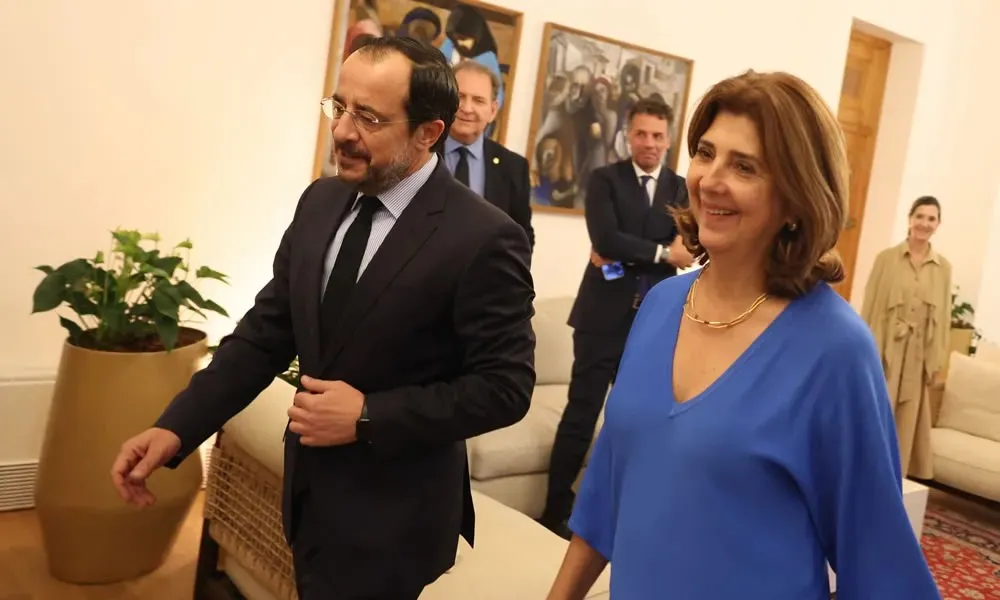

There are not only public references but also indications that the United Nations, through Ms Holguín, is working towards preparing a new expanded “5+1” meeting this summer, during which a settlement proposal on the Cyprus issue will be put forward. The question is how ready the two sides are to enter a final discussion.
The question now returning with intensity in the Cyprus issue is not only whether a new five-party or expanded conference will be convened. It is mainly what content the UN Secretary-General will bring to such a process, and whether María Ángela Holguín is this time trying to construct a framework that both sides can interpret differently without it collapsing from the outset.
According to information circulating around the contacts of the UN Secretary-General’s personal envoy, the idea under discussion is not a return to the classic, heavy federal model of previous decades. Instead, it is a looser solution within the European Union, which Greek Cypriots will be able to call a federation and Turkish Cypriots a confederation. The political essence of this formula is clear – to bridge, even through constructive ambiguity, the gap between the Greek Cypriot position for a bizonal, bicommunal federation and the Turkish Cypriot insistence on sovereign equality and recognition of its distinct political status.
Holguín appears to be moving in a far more dynamic way than previous mediators. She is not limited to meetings with the two leaders. She is engaging with politicians, groups of academics, representatives of civil society from both communities, the guarantor powers, and the European Union. Her aim, as it emerges, is not to recycle the familiar framework but to shape a proposal that is specific enough to lead to negotiation and sufficiently flexible not to be rejected from the outset by either side.
Land in exchange for recognition
At the core of the discussion taking shape is an old but decisive trade-off – return of territory in exchange for recognition. The territorial dimension appears to be based on the Crans-Montana map, with the return of areas – Varosha, Morphou and parts of the Mesaoria – serving as the strongest tangible exchange for the Greek Cypriot side.
On the other hand, the Turkish Cypriot side will seek recognition of its political equality not merely as a rhetorical declaration but as a functional element of the new state. This is precisely where the greatest difficulty lies – how much recognition can be given without being seen as partition, and how much federation can remain without being seen as a cover for a confederal solution.
The model under discussion is described as a state with a loose relationship between two constituent states. It is not a heavy federal structure with the 120 common competences discussed in earlier phases. Instead, the logic appears to be a drastic reduction in shared powers and the transfer of most day-to-day governance to the two constituent states. The central structure would retain only absolutely necessary competences so that the new state can function internationally, within the EU and institutionally, without producing constant deadlock.
According to the same information, the model would include two constituent states, two parliaments and a body functioning more as an overarching council for federal matters. There would be no directly elected federal parliament – instead, it would be composed of Greek Cypriot and Turkish Cypriot MPs, something some compare to a Council of Europe-type institutional logic. This body would handle common issues – matters that cannot be left exclusively to the two constituent states. It is an architecture that seeks to reduce Greek Cypriot fears of paralysis through Turkish Cypriot vetoes, as well as Turkish Cypriot fears of being numerically absorbed by the Greek Cypriot majority.
Presidential council
At the level of executive power, the scenario under discussion provides for a presidential council led by the two community leaders on a rotating basis, with a ratio of 2-1 or 3-1 in favour of the Greek Cypriot side. This idea attempts to reintroduce political equality in a more flexible way than the classic rotating presidency.
At the same time, according to information, President Nikos Christodoulides appears to have shown readiness to discuss the existence of a rotating, federal but largely ceremonial President, with real executive power transferred to a permanent Greek Cypriot Prime Minister. Such an idea could be presented to Greek Cypriot public opinion as a guarantee of functionality, but it would be difficult for the Turkish Cypriot side to accept unless accompanied by strong safeguards of political equality.
At this point, a critical provision comes into play – at least one decisive vote by a Turkish Cypriot minister in the Council of Ministers. This is the well-known issue of effective participation, which remains one of the biggest sticking points in the talks. For Turkish Cypriots, without such a vote there is no genuine political equality. For Greek Cypriots, a decisive vote risks becoming a mechanism for daily blockage. The challenge, therefore, is to find a formula that allows participation without paralysis – either through limiting the scope of such a vote to specific vital issues or through deadlock-resolution mechanisms.
Holguín, according to the same assessments, believes that the joint cabinet should not exceed five or six ministries. The key competences under discussion concern foreign affairs, defence, internal affairs with emphasis on citizenship, finance and European affairs. In other words, the common state would deal only with matters absolutely necessary for international representation, security, relations with the EU and basic economic cohesion. Everything else would, as a rule, belong to the two constituent states. In any case, both communities would implement European legislation, with the Turkish Cypriot side entering a period of harmonisation with the acquis communautaire.
There is also interest in the idea of supporting the cabinet with technocratic teams on issues such as tourism and innovation, as well as a group of “wise persons” on reconciliation. This provision shows that the model under discussion does not focus only on institutional engineering. It recognises that reunification, even in a loose form, will require social, cultural and psychological management. Cyprus suffers not only from institutional division but also from 50 years of separation, different narratives, fear and mistrust.
Guarantees
Greek Cypriots want the abolition of the 1960 system of guarantees. Turkish Cypriots insist that they should remain or that there should be a long period before Turkish troops leave Cyprus. As a middle ground, the United Nations appears to view NATO favourably.
Cyprus’s accession to NATO would guarantee its security and allow, within the framework of a small NATO force or bases, the presence of Turkish, Greek, French, British and American troops on the island. Based on Holguín’s discussions in Ankara, the issue is not ruled out by Turkey, but always as part of a broader solution.
Transitional phase
A transitional period of two or three years is being discussed for implementing the solution. During this period, initial territorial returns would need to take place, with Varosha being the most characteristic example, while the so-called “three Ds” requested by the Turkish Cypriot side would be gradually introduced – direct trade, direct contacts and direct flights.
During the same period, restrictions in the Turkish FIR for Cypriot aircraft could be lifted, and Cypriot ships allowed to access Turkish ports. In this way, the solution would not remain on paper but would begin to produce immediate, measurable benefits for both sides.
At the same time, discussions could begin on the exploitation of natural gas. According to information, Turkey has expressed readiness to build pipelines to Cyprus, showing a clear willingness to buy Cypriot natural gas – as stated – “at prices much higher than those discussed with Egypt.”
Is there political will?
The major question is whether the leaderships are ready to enter such a process. Tufan Erhürman appears, based on discussions, much more prepared to negotiate such a framework. Nikos Christodoulides, by contrast, is presented as more hesitant, while a UN source also spoke of confusion “as to how he will balance the need to restart the process with internal political pressures”.
The difficulty for the President is not only negotiating but also communicative – how to explain to the Greek Cypriot public that a loose federation, with limited common competences and strong Turkish Cypriot participation, is not a slide towards confederation. On the other hand, if the Greek Cypriot side does not become fixated on labels and focuses on the functionality of the new state, public perception could shift dramatically.
Trade-offs
From Turkey’s side, the message conveyed is that Ankara is ready to engage in dialogue and participate in a five-party conference, on the condition that there are substantial returns from the European Union, mainly on customs union issues. This means that the Cyprus issue is no longer discussed only as a bicommunal or Greek-Turkish matter. It is now part of a broader EU-Turkey package, in which Ankara will seek tangible benefits and Brussels will have to decide how far it is prepared to go to support a new settlement effort.
The plan Holguín appears to be shaping is essentially one of political realism. It does not attempt to restore the past as it was. It seeks to turn constructive ambiguity into a tool – to give Greek Cypriots the federal continuity they need and Turkish Cypriots the political equality and recognition they demand. This is both the strength of the new plan and perhaps its greatest risk. A formula that allows significant flexibility for each side can open the path to a solution. But it can also collapse when the time comes for clear commitments.
A change of paradigm
What is certain is that Holguín is trying to change the paradigm. The two sides cannot return to where they left off in 2017, nor can they move forward with a two-state solution. What needs to be explored is whether they can agree on a new and flexible European framework of coexistence.
Whether this will be called a federation, a confederation or something in between may ultimately depend less on the name and more on guarantees of functionality, security, European legality and mutual acceptance. That is where it will be decided whether this new momentum is a real opportunity or just another milestone in the long history of missed opportunities in the Cyprus issue.