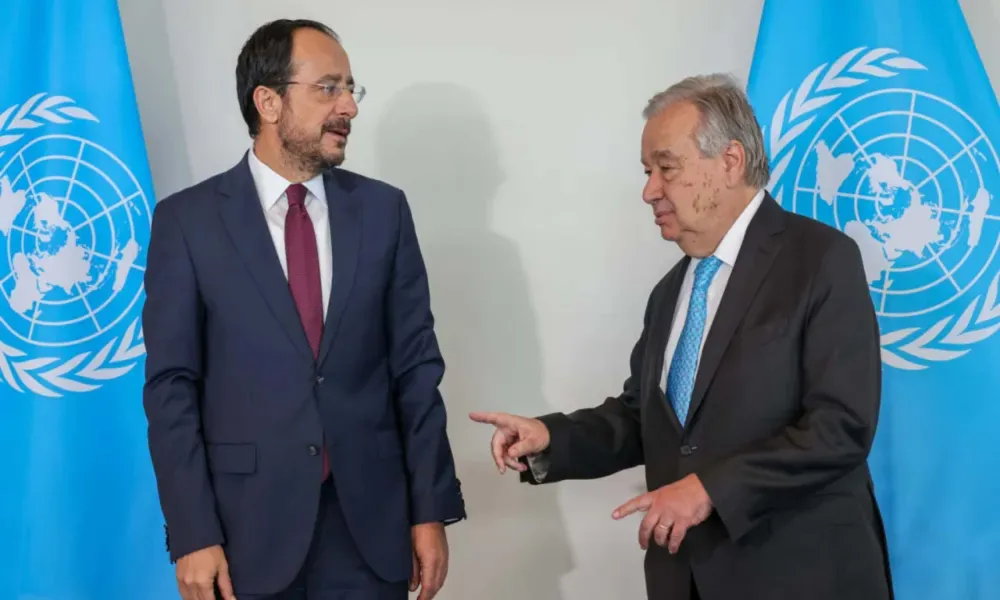

The forthcoming visit of UN Secretary-General António Guterres to Nicosia, at a time when there appears to be little prospect of convening a new enlarged informal five-party conference before the end of the summer, carries several noteworthy dimensions.
Most important is the effort to keep alive a process marked by both significant demands and considerable difficulties.
In that context, Guterres is sending a clear message that he is doing everything possible to prevent a return to a prolonged period of stagnation in the Cyprus issue.
In short, through his presence in Nicosia at the end of the month, the UN chief is confirming that the United Nations initiative remains active. Although initial plans for a new multilateral meeting do not appear likely to materialise within the timetable he had hoped for, he is taking advantage of his presence in the region to engage directly with both sides, reaffirming his commitment to investing political capital in efforts to restart the process.
His objective is not merely to record the already well-known positions of the two sides. He also wants to determine the extent to which genuine room for flexibility exists, where the red lines lie, and whether the minimum conditions can be created for a new enlarged five-party conference that would not simply repeat the disagreements of the past but open the way to a more substantive next phase of the process.
That, at least, is what both Guterres and his envoy, María Ángela Holguín, hope to achieve and are working towards.
At the same time, he may also seek meetings with representatives of civil society, a move carrying considerable symbolic significance.
The secretary-general is attempting to demonstrate that the process does not concern only the two leaders but also requires broader political and social support.
In this way, he aims to maintain interest in the process and strengthen constructive forces that could play a supportive role in any future negotiations.
Not enough on its own...
At the same time, diplomatic sources believe that Guterres' decision to proceed with the visit is also linked to the contacts he has held in recent months with the Turkish side, particularly with Turkish Foreign Minister Hakan Fidan.
Although those discussions do not appear to have produced any dramatic shift in Turkey's positions, Guterres' circle believes there are at least some indications that do not justify abandoning the effort.
Ankara continues to link progress on the Cyprus issue to broader developments in its relationship with the European Union. Nevertheless, the UN secretary-general appears to believe there is still room to manage that reality politically.
Viewed through that lens, the visit to Nicosia serves as a message to all parties involved that he remains personally committed to the process.
He has chosen to maintain momentum until conditions emerge that would allow the resumption of a meaningful negotiating process.
That persistence is consistent with the position he has repeatedly outlined in his reports to the Security Council, where he notes that, despite the difficulties, the role of the United Nations is to keep the prospect of a settlement alive while effectively placing the parties before their responsibilities, particularly with regard to creating the necessary conditions on the ground as a complementary step towards substantive negotiations.