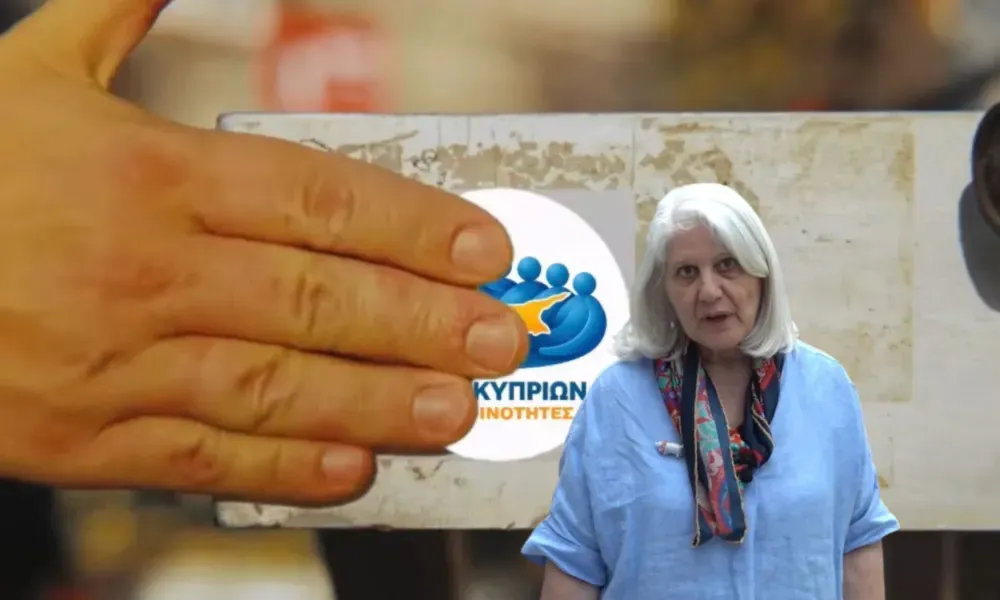
A new online initiative titled "The Communities of Cyprus" is seeking to explain key aspects of the Cyprus issue through a series of ten short videos, each lasting around one minute.
The project was launched by Famagusta-born author Vivian Avraamidou-Ploumbi, who, together with an informal group of friends and collaborators, aims to translate complex concepts from the Cyprus peace process into simple, accessible language.
The initiative comes at a time of renewed diplomatic activity on the Cyprus issue, coinciding with UN Secretary-General António Guterres' visit to the island.
Filling a knowledge gap
Speaking to Politis, Avraamidou-Ploumbi said the idea emerged from a growing awareness that many people lack a clear understanding of both the history of the Cyprus issue and the concepts that dominate public discussion.
"What made me start this project was the realisation that many people do not have a clear picture of why we are in the situation we are today, or what it means to take, or not take, a particular step on the Cyprus issue. In my view, we are missing the history."
She noted that even commonly used expressions, such as calls to resume talks "from where they stopped at Crans-Montana," are not always understood by the wider public.
A personal connection
Avraamidou-Ploumbi has lived in Prague for almost 29 years but says distance has never weakened her connection to Cyprus.
Originally from Famagusta and displaced in 1974, she describes her relationship with the Cyprus issue as deeply personal.
She was just 16 years old when the coup and subsequent Turkish invasion took place.
"The coup was a tremendous shock for me and it was then that I realised we did not know our own history. When you do not know, you end up paying the price."
Explaining complex issues simply
In recent years, Avraamidou-Ploumbi has written extensively, including for Politis, on historical and political issues that she believes remain poorly understood.
She argues that neither her generation nor younger generations have been adequately equipped through education to understand what happened before and after 1974.
According to her, this lack of understanding makes it difficult for citizens to form informed views about a potential settlement.
The one-minute video format was chosen with that challenge in mind.
"There are many people willing to learn, but they are not going to spend more than one or two minutes doing so. The idea was to create short videos explaining specific aspects of the Cyprus issue in a simple and logical way. In one minute you cannot explore a subject in depth, but you can provide a starting point."
‘Plain and simple’
The philosophy behind the project is summed up by a Cypriot expression.
"We want to explain things plainly and clearly. There is no point hiding behind our finger. How can we hope for a solution if people do not understand it in advance and are therefore unable to make an informed choice about what a solution, or the absence of one, would mean?"
The videos focus on core issues linked to a potential settlement, including security, the benefits a solution could bring and relations between the island's communities.
"We tried to build the entire series around the idea of the day after," she said.
A year's work
Preparation for the initiative began around a year ago.
According to Avraamidou-Ploumbi, distilling complex issues into a one-minute format required extensive work and careful attention to language.
"You have to be careful not to sound preachy or patronising and not to use expressions that people do not understand. I do not know whether we fully succeeded, but that was our goal."
An informal group effort
She stressed that the project is not backed by an organisation or formal movement.
Instead, it is the work of a small informal group of friends who frequently discuss the Cyprus issue and wanted to contribute to public understanding.
Avraamidou-Ploumbi said she was initially unsure about appearing in the videos herself, worrying that her age or appearance might make the content seem instructional.
Ultimately, however, she felt it was important to show that the initiative was created by ordinary people rather than self-appointed experts.
"We are simply people trying to understand our history, what happened to us and how we behaved as a society."
Positive response so far
The project currently operates on Instagram, Facebook and YouTube.
According to Avraamidou-Ploumbi, the reaction has so far been overwhelmingly positive.
"People are telling us, 'keep going', 'we want to learn more', 'we want to see more'."
The group hopes eventually to expand beyond one-minute videos and create opportunities for broader discussion on the Cyprus issue and its future.