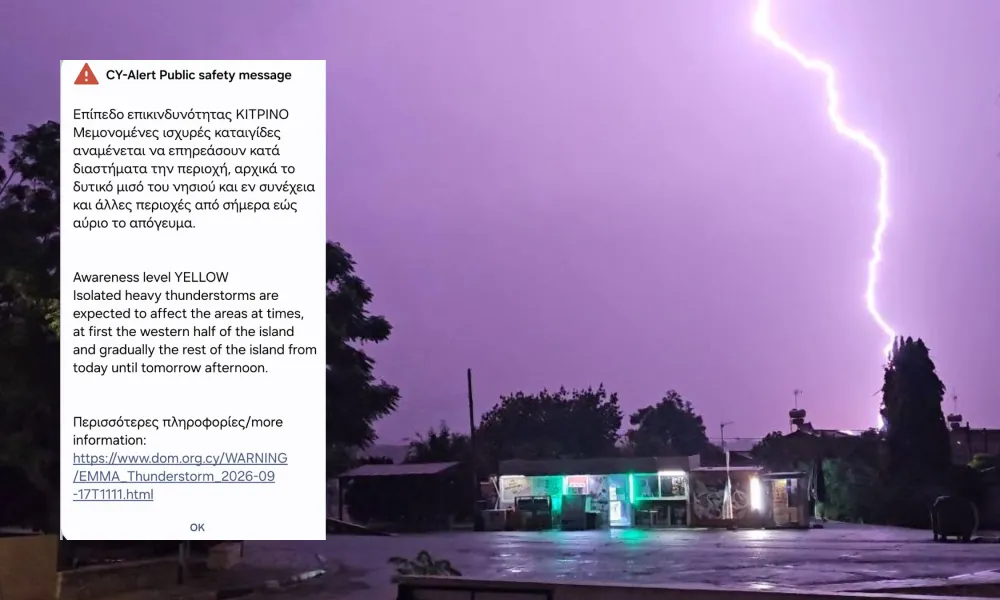

The dispatch of a CY-Alert message over yesterday's yellow meteorological warning brought the new early-warning system back to citizens' phones, this time without the distinctive siren sound that had accompanied previous activations.
The difference was not down to a technical issue. As Civil Defence spokesman Panayiotis Liasides explained to Politis, the message did not concern an emergency situation but was preventive in nature, falling under the category "Public Safety Message."
"Civil Defence spoke with the Department of Meteorology, and given the situation, it was judged necessary to send the message. It was not, however, an emergency message. It was a preventive message, which also linked through to the Meteorological Service's forecast," he said.
As he explained, an emergency-level alert, accompanied by the loud warning sound, is different from a public safety message, which appears on the device with a vibration instead.
The system has five alert categories:
- National Emergency Alert
- Extreme Danger
- Severe Danger
- Public Safety Message
- Abduction/Missing Person
Yesterday's message fell into the fourth category.
Will CY-Alert sound for every yellow warning?
One question this raises is whether the issuing of a yellow warning will now, as a rule, trigger a CY-Alert message.
Civil Defence's answer is that this will not happen automatically.
"It might not," Liasides said, explaining that each case is assessed separately. In this instance, he said, severe weather had already hit the Akamas and Polis Chrysochous area, and the forecast showed the conditions would begin in Paphos and move eastward, as far as Famagusta.
"That's why it was judged necessary to send this warning," he noted.
He clarified, however, that whether CY-Alert is sent for a yellow warning will continue to be decided "case by case," based on how serious the situation is judged to be.
For its part, the Meteorological Service said yesterday's warning was nothing unusual in terms of its level.
Philippos Tymvios, Director of the Department of Meteorology, described it as "business as usual," noting that it was a standard yellow warning, of the kind issued even before CY-Alert existed.
"Just as we did it last year without CY-Alert, we're doing it the same way this year. Nothing changes," he said.
He also made clear that the decision to send yesterday's message was not a recommendation from the Meteorological Service.
"Issuing the warning is a meteorological matter and falls under our responsibility. Once it leaves our hands, informing the public is Civil Defence's responsibility. The decisions taken concern crowd and public management, which is not something we can do," he said.
He added that the initial approach had been for the system to be used mainly for red warnings, but that its use in practice had shown there may be value in using it at lower risk levels as well.
"A lot of factors are assessed, and the decisions are made by those who know this work best," he said.
'We need to learn to live with CY-Alert'
Extending the system's use to preventive messages inevitably raises the question of overuse.
Liasides acknowledged that Civil Defence is aware of the risk that frequent alerts could lead the public to attach less importance to them.
"What matters is that people read the message and, if there's nothing they need to do and it's purely for information, they've been informed and that's where it ends," he said, adding that this is precisely why different alert levels exist.
"The system was set up with citizens' safety as its goal. Citizens' safety doesn't mean we only send alerts in an emergency. We can also send preventive guidance. It's a measure that can help build greater resilience in case something more serious happens," he stressed.
He believes citizens should gradually familiarise themselves with how the system works.
"We need to learn to live with CY-Alert. It's a tool that sends notifications. Spend 20 seconds, see what it says, and if it concerns you, act on it. If not, move on. Every day, all of us receive plenty of messages on our phones," he said.
Too early for 'alert fatigue'
Professor George Boustras is more cautious about whether there is currently a risk of public fatigue with these alerts.
Asked about the phenomenon of so-called "alert fatigue," the possibility that frequent notifications could gradually lead citizens to ignore them, he said it is still far too early to draw such conclusions in Cyprus.
"We haven't received many," he said, adding that so far messages have been sent "very sparingly" and have concerned significant events.
He also noted that these are mainly recommendations to the public, rather than orders.
In his view, CY-Alert is still a new system and needs time to be evaluated in practice. "We need to trust it, as happens elsewhere in Europe too. Like any system, it gets tested, Civil Defence gathers the feedback it needs, and the right decisions will be made," he said.
The picture so far, then, does not suggest Cyprus is already facing an "alert fatigue" phenomenon. The question that remains open is where, in practice, the line will be drawn between useful preventive information and a frequency of CY-Alert use so high that the message risks gradually losing its weight.