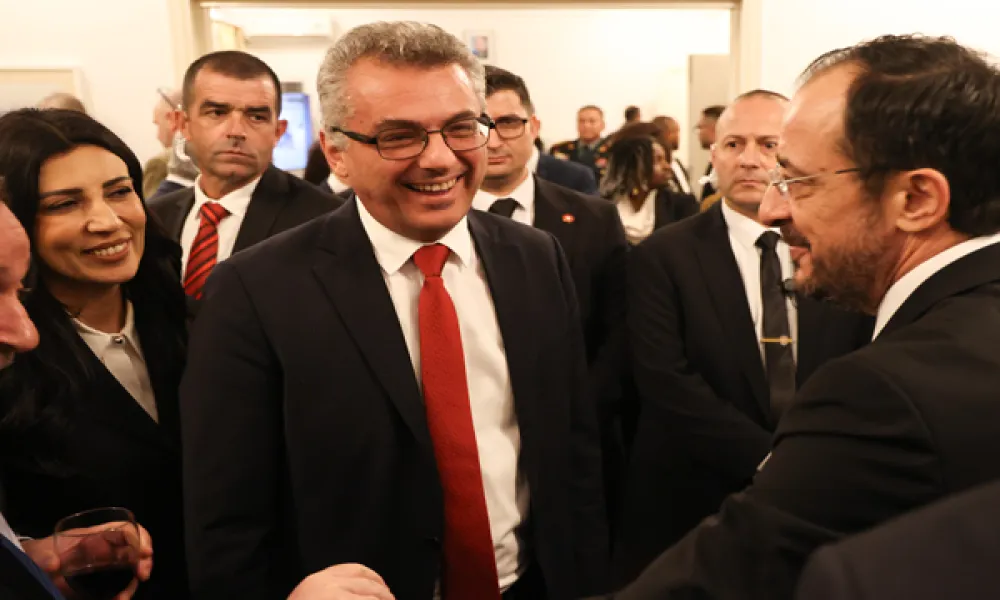

The two leaders meet on Wednesday for the second time since UN Secretary-General António Guterres left the island in late July, continuing their effort to convince that conditions are ripe for a new enlarged meeting.
After meeting on 26 August, the leaders postponed their next scheduled meeting due to the ferry disaster off Kyrenia, which left 14 dead with 14 still missing.
Guterres expects President Nikos Christodoulides and Turkish Cypriot leader Tufan Erhürman to make “adequate” progress on confidence-building measures (CBMs), methodology and issues of substance before calling a new 5+1.
Both leaders seem to have been dancing around the prospect of progress in their bilateral meetings, with little to show for it yet, beyond a few small steps taken on issues already agreed in principle.
They are due to meet Guterres on the sidelines of the UN General Assembly (UNGA) in New York later this month to brief him separately on any progress to date.
Leaders left to their own devices
Following Wednesday’s meeting, they will have around two weeks left until the UNGA High-Level Week to record progress, or else risk going to Guterres empty-handed.
Christodoulides said he hopes to meet Erhürman two-three times before New York.
The leaders’ meetings in Cyprus will take place without UN Envoy María Ángela Holguín who – due to illness – has cancelled her planned trip to the island. Instead, she hopes to meet the leaders on the sidelines of the UNGA.
It remains to be seen whether Christodoulides and Erhürman can rise to the occasion in the remaining weeks and achieve significant progress for a new 5+1 to be convened.
Time is not on their side, however, Guterres leaves office in December, while Holguín has hinted that she will stick around for as long as he does.
Ankara weighing options
Meanwhile, there is a sense among some observers that it is not just Guterres that needs convincing. It is believed Ankara is also assessing the intentions of the Greek Cypriot side – and Christodoulides in particular –before deciding whether to soften its stance on the preferred basis for a solution.
The negotiating acquis
Another unknown is what the UN will do with the document currently being compiled on the negotiating acquis in terms of its content, whether it will be delivered to the sides, how and when.
Christodoulides speaks to Turkish Cypriots
In an interview with Turkish Cypriot daily Yenidüzen published on Tuesday, the president said he agrees with Erhürman on three of his four-point methodology proposal.
Christodoulides said he told Erhürman that he agrees on preserving the gains achieved in the negotiations – though this should include all points up to the final hour at Crans-Montana.
He also suggested there will be a natural timetable if the two sides pick up from where they left off, as opposed to starting from scratch.
The president said he “fully respects” political equality and included it in the joint statement after the leaders’ meeting in December.
“The only point regarding (Erhürman’s) methodological proposals on which I disagree is the issue of pre-agreed consequences,” he said.
According to Christodoulides, methodology and issues of substance have more or less been resolved with Erhürman, leaving only CBMs, which he once again claimed are not a prerequisite for a new 5+1.
The president told Yenidüzen that when in Cyprus, Guterres proposed a new route for the Athienou-Pyroi-Aglandjia route, which passed only 30% through the buffer zone and 70% north of it. Christodoulides said he accepted this “reasonable compromise” but Erhürman did not.
On past convergences, he said: “The most important convergences for all parties were achieved during Crans-Montana, and the reason for that was the Guterres framework.”
Asked about Turkey’s role, he noted that Ankara plays the leading role on security and guarantees, as well as on some other issues.
“If everything were in Mr Erhürman’s hands and mine, we could reach a solution by next week. But the decision does not depend solely on us,” he said.
On the reported suggestion to delay a referendum after agreement, Christodoulides rejected the idea of a transitional period where a solution is implemented on a provisional basis. However, he said he could discuss proposals for “bold” CBMs on Varosha and trade.