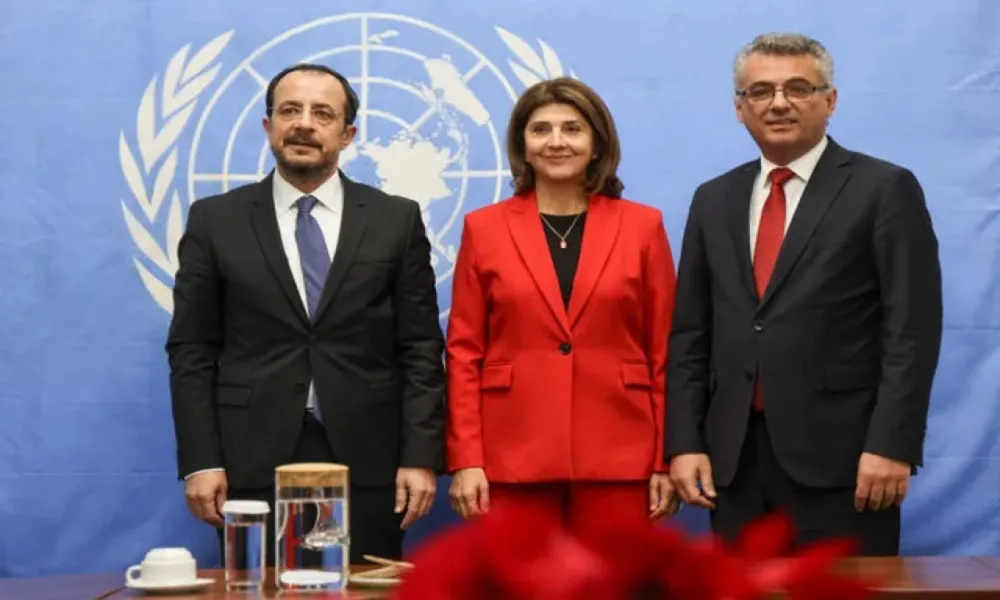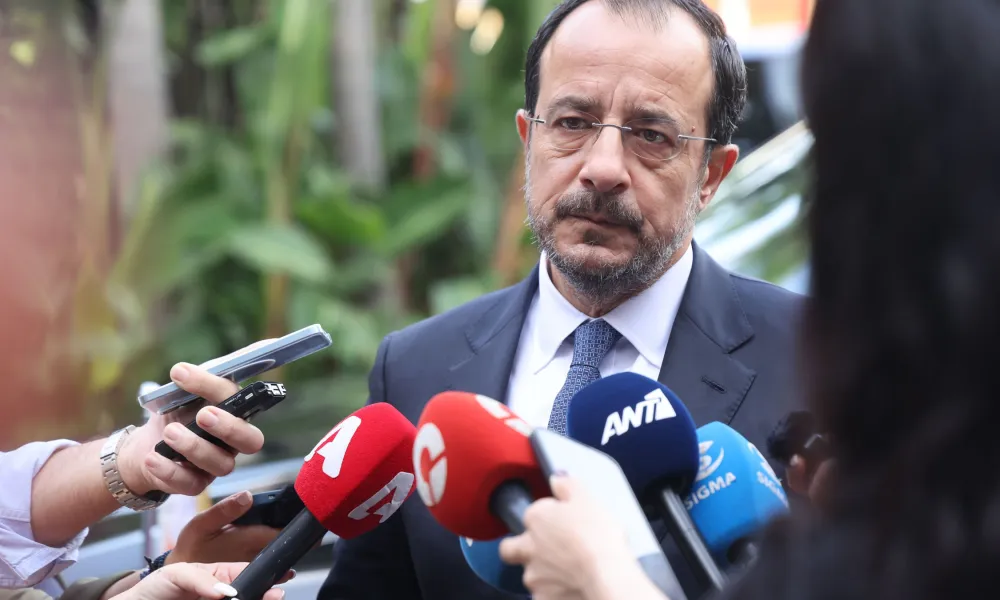

President Nikos Christodoulides said on Sunday that setting terms and preconditions before the resumption of Cyprus talks is a tactic that does not help create progress.
Speaking to reporters on the sidelines of a memorial service for heroes of Trikomo in Limassol, Christodoulides commented on recent statements by Turkish Cypriot leader Tufan Erhürman and the prospects for restarting negotiations on the Cyprus issue.
Response to Erhürman’s criticism
Asked whether Erhürman had been annoyed by remarks he made on Friday evening in Pyla, Christodoulides said he had no indication that this was the case.
“I cannot know why the Turkish Cypriot leader did not make any statements. He did not mention anything to me during the event, and I do not believe that I said anything that would justify any irritation.”
Responding to suggestions that references to Ankara may have caused offence, the President rejected the characterisation.
“These are not hints. It is a clear position that the key to solving the Cyprus problem lies in Turkey,” he said, adding that he was not overlooking the role that Cypriots themselves can play in advancing a settlement.
Rotating presidency and preconditions
Commenting on Erhürman’s interview with Politis, in which the Turkish Cypriot leader called on him to clarify his position regarding the rotating presidency, Christodoulides said the interview was “particularly revealing”.
According to the President, the Turkish side is effectively demanding prior acceptance of positions important to the Turkish Cypriot community before negotiations resume, while showing no willingness to discuss or accept Greek Cypriot positions on other important aspects of the Cyprus issue.
“That is why I have repeatedly said that all these issues must be discussed at the negotiating table,” he said.
“To set terms and preconditions before the resumption of negotiations is a tactic that does not help developments.”
He argued that Erhürman’s interview reveals one of the main reasons why negotiations have not yet restarted.
The controversy over the 19 proposals
Asked about Erhürman’s statement that he never received the Greek Cypriot side’s 19 proposals in writing, Christodoulides said he had never claimed otherwise.
“I never said they were submitted in writing,” he said.
“They were submitted verbally. He knows the 19 very specific proposals. On some he has taken a position; on others he has not yet done so.”
The President added that the National Council is fully aware of the proposals and said the issue had also been discussed during Friday night's meeting.
“He told me, ‘Yes, I said these issues were conveyed to me verbally, they were not given in writing.’”
Varosha remains on the table
Asked about Erhürman’s assertion that positions attributed to him regarding Varosha were inaccurate, Christodoulides said he did not want to engage in a blame game.
“I am not here to assign responsibilities, nor do I believe that helps the effort to restart negotiations.”
However, he stressed that the fenced-off area of Varosha remains among the issues raised by the Greek Cypriot side.
He said the matter was discussed recently with UN Secretary-General António Guterres in New York and was also included in a letter he sent to the UN chief.
“I do not want to say more at this stage. Depending on developments, we will comment further.”
Only negotiations can test intentions
Christodoulides argued that only the resumption of formal negotiations will demonstrate who genuinely wants a settlement.
“Only the resumption of negotiations will prove in practice who truly has the will to solve the Cyprus problem,” he said.
He stressed that this observation applies not only to the two communities, but also to the guarantor powers and particularly Turkey.
Pyla meeting ‘important but not enough’
Asked whether anything negative was said during Friday evening’s meeting in Pyla, the President said there had been no tensions.
“No, nothing negative was said. It was a social gathering.”
He described the event as an opportunity to send a message of hope and commitment to working jointly for the reunification of Cyprus.
“Such meetings are important,” he said, “but they are not enough to reach the desired goal.”
Nonetheless, he added, they have their own added value.
Talks without an open-ended timeline
Commenting on Turkey’s position favouring negotiations without an open-ended timetable, Christodoulides said the duration of any process depends on where discussions begin.
“If they start from where they stopped in Crans-Montana, we know very well what the disagreements are and what issues need to be discussed. Naturally, the time required would be shorter.”
However, if some parties seek to restart discussions from scratch, he said, “no one can determine the timeframe”.