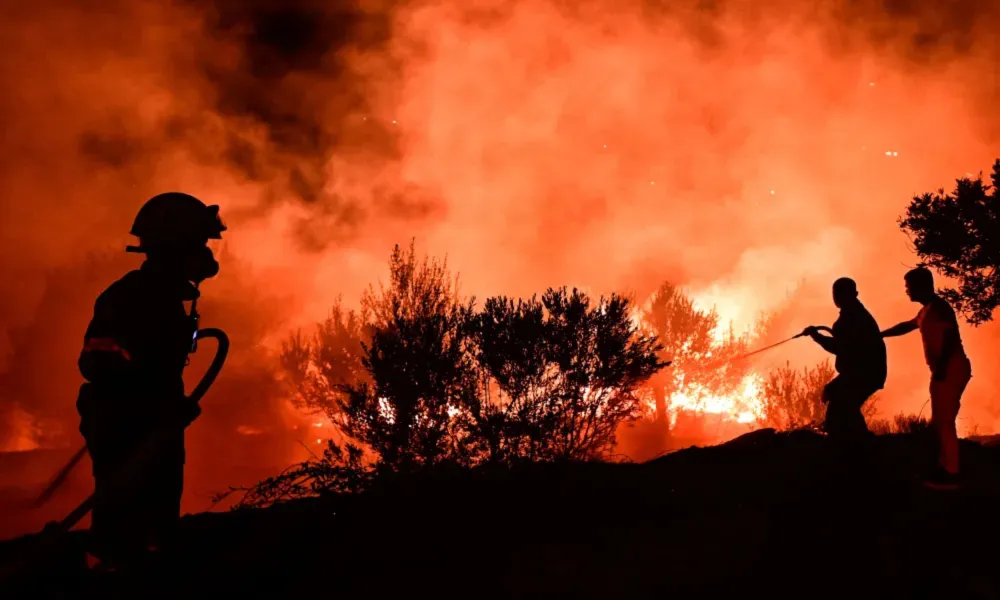

The European Union is deploying aircraft, helicopters and firefighting teams to assist Belgium and Spain in combating major wildfires through the EU Civil Protection Mechanism (UCPM).
More than 19,000 hectares have already been destroyed by fires in the two countries, while the EU is also supporting operations through satellite mapping services.
According to a statement from the European Commission Representation in Nicosia, two firefighting aircraft from the EU's rescEU fleet were sent from Sweden to Belgium, along with:
- Two helicopters from the Netherlands
- Two helicopters from Norway
- Two helicopters from Germany
The resources are supporting local authorities battling wildfires in the Hautes Fagnes region, where more than 3,000 hectares have burned so far.
In Spain, 104 firefighters and 36 vehicles from France have been deployed to assist Spanish crews in Aragon, where nearly 16,000 hectares have already been destroyed.
Copernicus support
The EU is also assisting emergency services through satellite mapping.
The Copernicus Emergency Management Service is currently supporting wildfire responses in:
- Belgium
- Spain
- Greece
- Germany
- Montenegro
- Albania
- France
- Italy
The service provides rapid mapping to help authorities assess affected areas and organise response and recovery efforts.
"No country should face fires alone"
Hadja Lahbib, the European Commissioner for Crisis Management, said no country should have to face wildfires on its own.
She said that through the Civil Protection Mechanism, Europe is rapidly moving aircraft, helicopters and firefighters wherever they are needed most.
Severe wildfire season
The Commission noted that the 2026 wildfire season is already proving exceptionally severe.
By the end of July, the area burned across Europe was two and a half times higher than the seasonal average.
Through the Civil Protection Mechanism, countries can quickly draw on a much broader pool of firefighters, aircraft and emergency assets when national resources come under pressure.
At the centre of the system is the European Commission's Emergency Response Coordination Centre, which receives requests for assistance, coordinates offers from member and participating states, and supports the deployment of available resources.
The Commission also co-finances these deployments.
Source: CNA