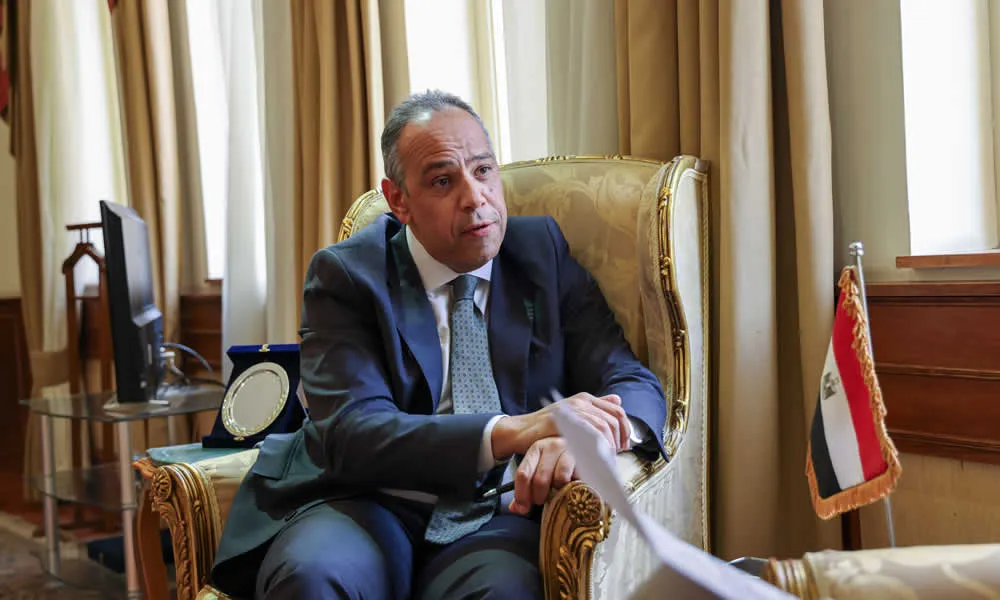

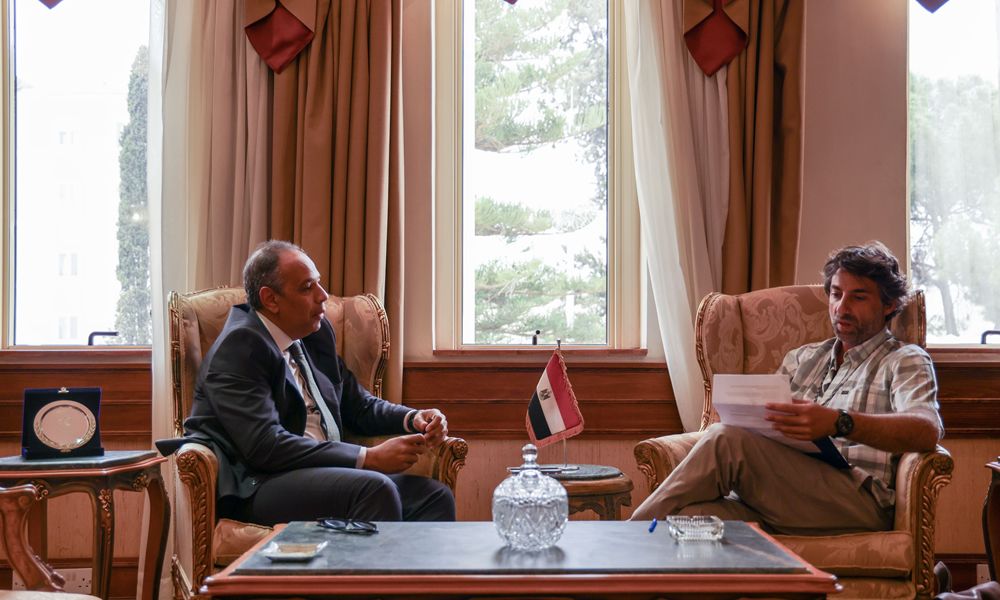
In an interview with Politis, Egyptian Ambassador to Cyprus Mohamed Zaazou highlighted the important step Cyprus is taking to monetise its gas many years after first discovery. He hailed the “outstanding” coordination between the two countries over the past decade, noting it can serve as an example to others in the region on the benefits of cooperation over confrontation.
Egypt is around 100 times larger than Cyprus in terms of land mass and population. Yet the distance from Limassol to Port Said is less than 400km. A proximity emulated on the cultural, diplomatic and political front too, according to the Egyptian Ambassador to Nicosia.
The two countries are “bound by history and culture,” said Zaazou. “Cypriots and Greeks have been a part of the social fabric in Egypt from a long time ago.”
On political relations, he said: “The level of coordination and cooperation between the two sides has been outstanding for the past 10 years.”
Cyprus and Egypt have signed multiple agreements in recent years on a range of issues. Most recently in April, on the sidelines of the EU informal summit in Nicosia, they signed a joint declaration on a strategic partnership, strengthening cooperation in multiple areas including energy, security, defence, trade, investment, and technology.
‘Important step’ towards monetisation
The cornerstone of the Cyprus-Egypt partnership is energy. Egypt was the first country that Cyprus signed a maritime boundary agreement with in 2003. The two countries adopted the median line to delineate their respective exclusive economic zones (EEZ), opening the door to similar agreements with Lebanon and Israel.
In 2011, the first natural gas field – Aphrodite – was discovered in Cyprus’ EEZ. But it is the 2022 Cronos gas discovery that looks most likely to go to market first. Last Tuesday, the Council of Ministers approved Eni-Total’s development and production plan (DPP) to pipe Cronos gas to Egypt’s Zohr field infrastructure and from there onshore to Egypt’s liquefaction terminal at Damietta for export as liquefied natural gas (LNG).
The Cypriot government had hoped to secure more favourable terms with Eni, the Cronos operator, but based on reports, seems to have opted for a potentially costlier yet speedier path towards first gas, possibly within 2028.
Credit: Eleni Papadopoulou
Zaazou described the cabinet decision as “a very substantial step” that should hopefully lead Eni to make a Final Investment Decision (FID) soon that would start the countdown for Cronos gas to be transferred from the Cypriot EEZ to Egypt and then on to European and global markets.
Role model for region
The Egyptian diplomat argued that beyond monetising the gas, tangible benefits of collaboration could encourage more projects in the region.
“In the current regional tensions, it's important that we see the East Mediterranean also provide this type of cooperation between two leading countries in the East Med, Egypt and Cyprus.
“Gas cooperation can be a model of regional cooperation for other countries in the region to pursue,” he said.
Concentration risk?
Cronos is earmarked mostly for LNG exports via Egypt. Should things run smoothly, Eni could potentially send its smaller Zeus and Calypso gas finds to market using the same Egyptian infrastructure. Chevron’s offshore concession Aphrodite is also heading to Egypt with first gas expected in 2031. Chevron has already agreed gas prices with Egypt’s state gas company EGAS.
In terms of Cypriot gas discoveries, that leaves ExxonMobil-QatarEnergy’s Glaucus and Pegasus fields. Last Wednesday, QatarEnergy signed a Memorandum of Understanding with Egypt and ExxonMobil to study the potential commercialisation of Cypriot gas discoveries through Egypt’s existing gas and LNG export infrastructure.
Asked if Cyprus was at risk of putting all its eggs in one basket, the ambassador replied: “Why is Cyprus selling gas to Egypt? Because we have the liquification facilities for that.
“It makes sense to have the gas first transferred through our facilities and then to the global market.
“And of course in the case of Aphrodite, a substantial percentage will be used in the domestic market,” he added.
Zaazou noted that tensions in the Middle East but also in the Russia-Ukraine war were a threat to energy security globally. Cyprus-Egypt energy cooperation could act as a counter to that while serving energy supply diversification.
“East Mediterranean maritime routes for energy could be very much relevant in that regard.”
Balanced understanding of region
Regarding bilateral relations, the ambassador said: “It's important for Egypt and Cyprus to continue their strong level of coordination,” noting the roles both countries play in de-escalation, diplomacy, and regional stability.
“We highly value Cyprus' perspective when it comes to the situation in the region. Cyprus as an EU country has a balanced understanding of the developments taking place every day in the region.”
He noted that Cyprus’ geographic proximity to the Middle East gives it a cultural closeness that makes it more in tune with developments.
He commended Cyprus for effectively “introducing a complementary role to bring humanitarian aid to Gaza through the maritime corridor Amalthea.”
The ambassador also highlighted the two countries’ cooperation on maritime issues and in defence and security, including participation in Egypt’s annual military exercise Bright Star and the naval maritime exercise Medusa also with Greece, and occasionally other Gulf countries.
Bringing the EU closer
Zaazou said Cyprus’ role has been particularly “indispensable” now that it holds the Presidency of the EU Council.
“When President Christodoulides says Cyprus is a bridge between the Middle East and Europe, he backs it up with steps. He managed to convene a high-level informal EU leaders’ meeting here in Cyprus and invite major regional leaders as well.
“It was very important for both sides to exchange views, for us as Egypt to lay out our positions regarding the current crisis in the region.”
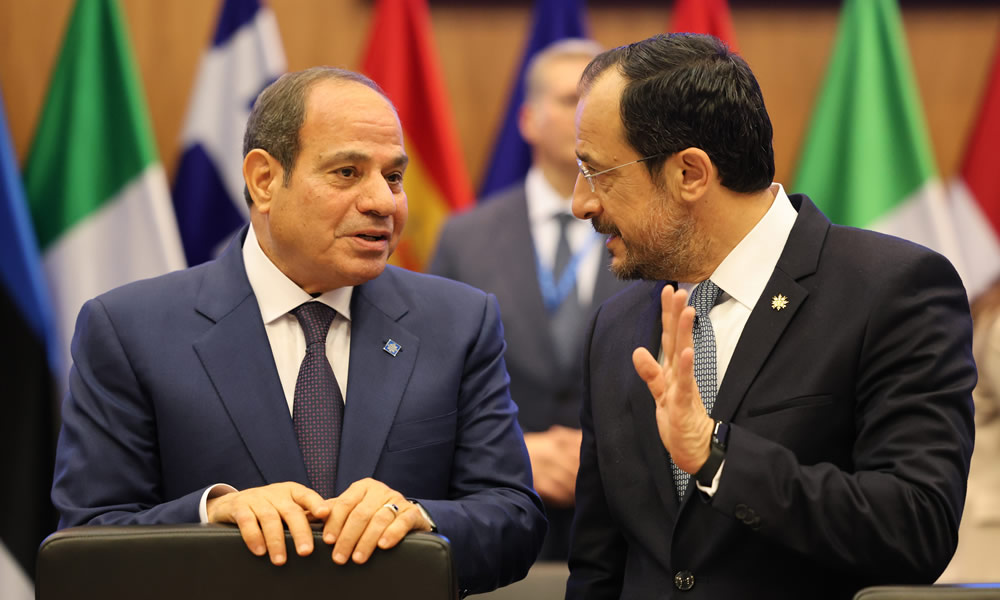
He commended Cyprus for putting EU-Middle East relations at the forefront of its EU Presidency and for sharing ideas on how to do more to connect the two regions “in a much more progressive way”.
Cyprus part of wider Middle East
While Cyprus-Egypt relations have history and depth, the diplomat noted: “What we’re seeing now is much more engagement between the Gulf countries and Cyprus.”
This boils down to Cyprus’ “very positive and balanced positions” on issues important to the Arab world, like the Palestinian question, but also to shared interests in energy, energy security, maritime routes, trade and investment.
“Cyprus is an EU country. It can be a gateway, for example, for the region, for Gulf countries, to export and re-export to European markets. That's why connectivity is so important. And we consider Cyprus as part of the wider Middle East.”
Trilaterals more important now than ever
The ambassador highlighted the importance of the trilateral mechanisms developed between Cyprus and Greece with Egypt on the one hand, and Jordan on the other, arguing they were more relevant now than ever before.
“In the midst of the current regional tensions, it's important to continue leveraging on this level of dialogue and coordination.”
He added: “Cyprus is navigating very positively and with the correct compass in the Middle East.”
Asked whether the trilateral cooperation with Israel could serve as a potential overlap with other countries in the region, he said Egypt understands that Cyprus also has very good relations with Israel, as with other countries in the region. “Egypt counts on these relations to also be conducive to stability in the region,” he said.
Regional instability
Zaazou highlighted his country’s historically “indispensable role” as a mediator or facilitator in multiple crises and conflicts. Egypt maintains contacts with all sides “because our agenda has always been the stability of the region”.
On the Israeli-Palestinian conflict, Egypt continues to advocate for a two-state solution, he said, arguing that military measures will not deliver stability.
Regarding Trump’s 20-point peace plan for Gaza – for which Egypt played a significant role getting Hamas to agree to the deal – the diplomat noted implementation has been “challenging”. At the same time, “it has to work, because the alternative is we go back to war.”
He called for the current escalations to stop. Restrictions must be removed on bringing much more humanitarian assistance to the Palestinian people of Gaza, he said. “They are still suffering.”
To disarm Hamas, “calmness has to be pursued,” said Zaazou, noting Israel’s continued targeting of Hamas leaders despite the ceasefire did not help in this regard.
For a long-term solution on the war with Iran, the ambassador said, “Wisdom needs to prevail first and both sides need to address each other's concerns.”
Relations with Turkey
After years of tension, Egypt and Turkey have resumed diplomatic relations, along with economic cooperation and trade. Zaazou said this did not affect Egypt’s strong relations with Cyprus and Greece.
“These are two parallel tracks. They do not come at the expense of each other. Our excellent relations with Cyprus are profound, strong and solid.”
Asked if Egypt’s closer relations with Turkey could help improve relations between Nicosia and Ankara, he replied: “It's important for countries in the East Med region to realise that cooperation and collaboration, rather than spoiling relations, are good for the stability of the region.”
Referring to the wealth the region has to offer, he concluded: “It's important to have this understanding that cooperation rather than confrontation is a much more viable option.”