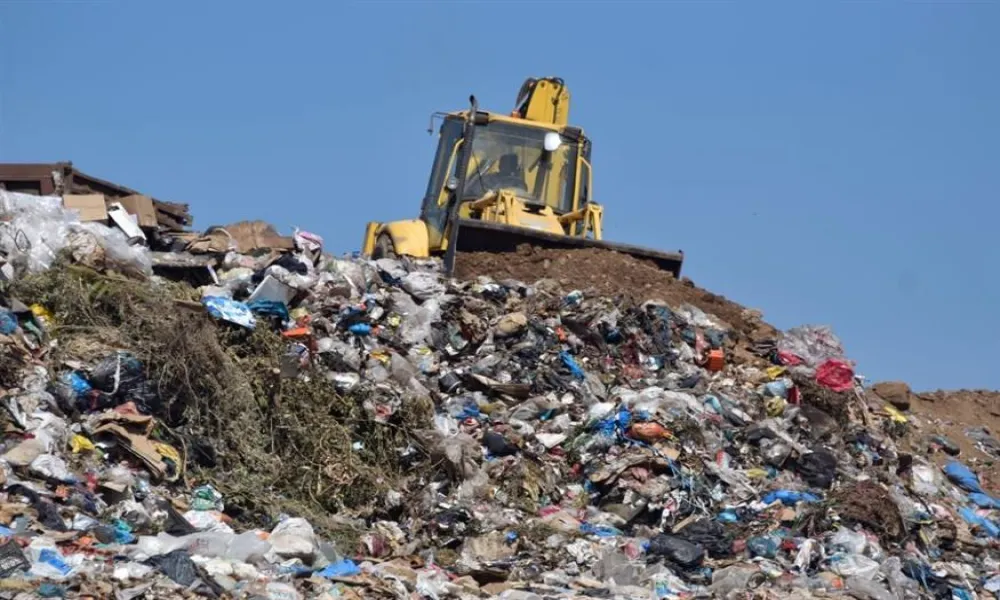



Waste management is emerging as one of the biggest and most complex challenges facing the Republic of Cyprus. At a time when the country faces serious environmental, and European, pressures, the need to shift away from a model based largely on landfill toward one built on waste management and the circular economy is becoming increasingly urgent.
Down to 10% by 2035
The director general of the Environment Department at the Ministry of Agricultural Development, Dr Costas Constantinou, spoke to Politis about the scale of the challenges facing the country, explaining the need to reduce waste, the planning for large scale treatment facilities, sorting at source, the "Pay As You Throw" scheme, the management of organic waste and the new infrastructure being promoted across Cyprus to handle different waste streams.
"Most waste needs to enter a new life cycle, either within the circular economy or as raw material that takes on a new life cycle, for example being converted into fuel," he says. Landfill sits at the end of the chain and should be the last resort.
According to the figures he sets out, the country must cover enormous ground in the coming years, from a landfill rate that currently averages 60% to 65%, to the European target of 10% by 2035. "We have a very long road ahead of us, the targets are extremely difficult to achieve, and 2035 is not far away," he stresses, particularly for projects of this scale that touch on the holistic management of waste.
Cyprus is not Scandinavian
The challenge facing citizens and the state is not simply about building new facilities or upgrading those already in operation. It touches on citizens' behaviour, the operation of local authorities, the cost to households, recycling, reuse, separate collection, the treatment of organic waste, investments worth tens of millions of euros in public or private funds and, ultimately, Cyprus' ability to meet its European obligations. "The European framework is the same across member states, but not everyone starts from the same point. Citizens' culture, practices and climate conditions differ. Scandinavia is one thing, the Mediterranean is another," Constantinou explains.
The comparison with Scandinavia is telling. In several northern European countries, sorting waste at source has for years been part of everyday life. Citizens are familiar with separating multiple waste streams, the climate helps with collecting organic waste without difficulty, municipalities have mature collection systems, and the treatment chain is more developed.
In Cyprus, by contrast, although this transition began almost two decades ago, it remains a work in progress. Citizens have not developed a sufficient recycling culture, one treatment facility is operating at its limits while another has failed, and the remaining supporting infrastructure has been slow to materialise.
Champions of rubbish
Closing the gap with European targets will take more than simply running the treatment plants better. First, the sheer volume of waste reaching them must be reduced.
And the gap between Cyprus and the European average in waste production is enormous. In 2024, Cyprus produced 688 kilograms of municipal waste per resident, compared with an EU average of 517 kilograms. That is a difference of 171 kilograms per resident, with Cyprus producing around 33% more municipal waste than the EU average.
And while the targets keep moving, things are getting worse, not better, year on year. According to the latest Eurostat data, published a month ago, Cyprus produced around 669,000 tonnes of municipal solid waste in 2024, compared with around 633,000 tonnes in 2023, an increase of 5.6% in a single year.
In 2024, 78.5% of the municipal waste treated in Cyprus was sent to integrated waste management facilities (OEDA) for treatment, of which 10% to 12% was sorted there and sent for recycling, while only 14.2% went to recycling directly and a further 4.4% to composting. In the EU, by contrast, the municipal waste recycling rate, which includes composting, reached 48.1% in 2024. At the same time, landfill use has been cut sharply at European level, to 22.5%, according to comparable 2023 figures.
The picture shows that the distance Cyprus has to cover becomes even clearer when set against the rest of Europe. Closing a gap of 10% to 12% could realistically be managed within 10 years, in line with EU obligations. Going from 65% to 10% in the same timeframe is a far harder question.
Sorting at source and waste fees
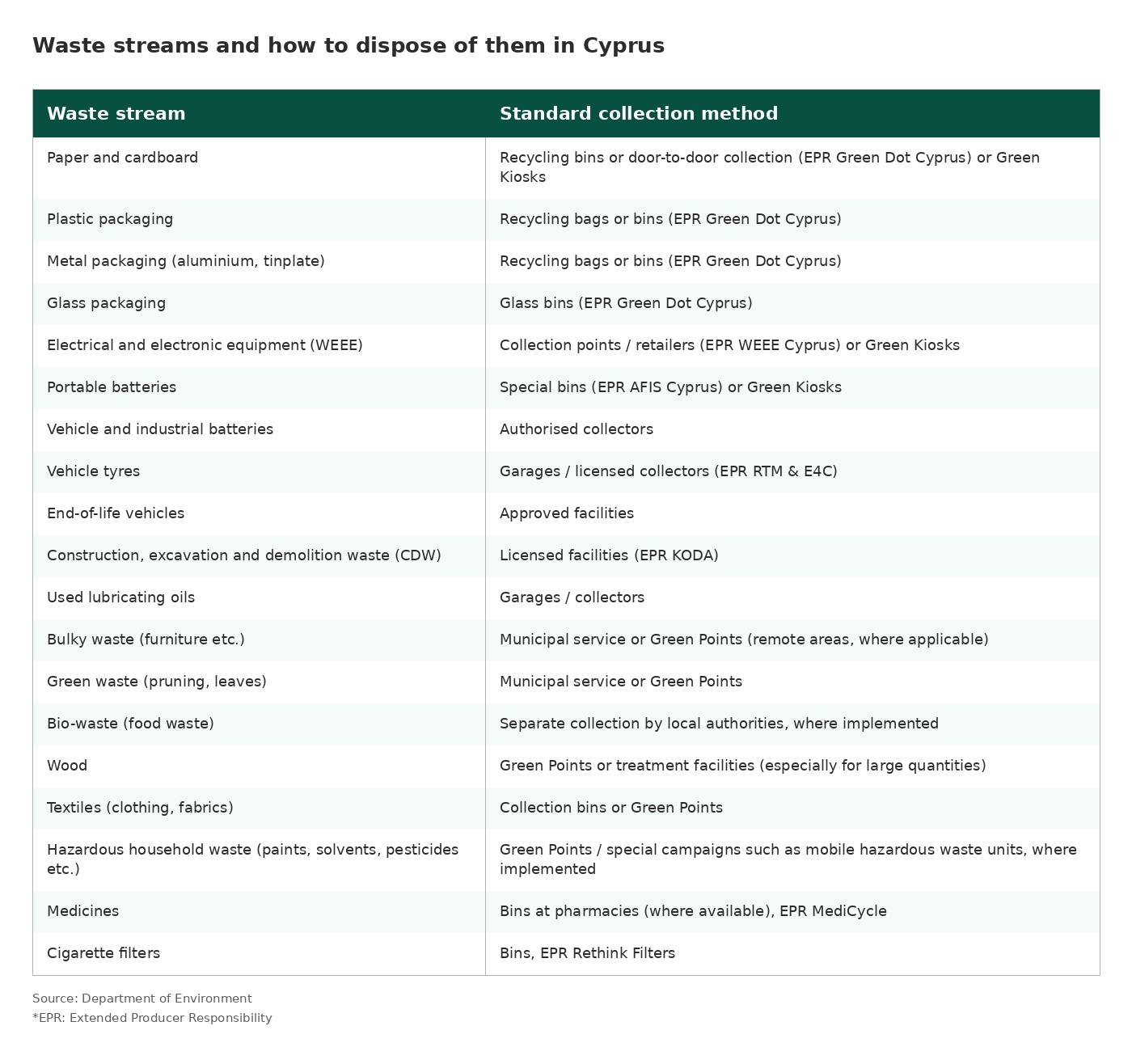
The amount of rubbish reaching OEDA facilities can be significantly reduced, Constantinou explains, the more sorting at source is strengthened and the more waste streams are diverted before they end up in the mixed waste bag and reach treatment facilities. Plastic, paper, metal, glass and of course organic waste, along with other categories, can all be separated from mixed waste, reducing the volume that requires treatment and, ultimately, landfill. The more effective sorting at source becomes, the smaller the quantities burdening the OEDAs, the easier it becomes to meet European targets, and the lower the cost of treatment. The more materials are separated at source, the less mixed waste needs to go through complex and costly treatment. Clean recycling streams, once collected, also gain economic value.
"The cost of management can only be reduced by reducing waste," the director general of the Environment Department stresses. The central message is that lower costs will not come from cheaper treatment. They will come from having less waste to treat in the first place.
Green Dot across all of Cyprus
One of the changes being pursued concerns expanding the geographic coverage of the Green Dot scheme. Today the system covers most urban areas and part of the suburban areas, but not the whole country.
"Our intention, as the collective Green Dot licence is renewed, a process that is under way and expected soon, is to achieve full geographic coverage of Cyprus." As Constantinou notes, the Green Dot licence expired and was extended precisely so that a number of pending issues could be clarified. "We are in the process of shaping the new terms based on today's data," he clarified, stressing that geographic coverage is only one of the shortcomings of the current licence.
The second issue is the collection targets themselves. The intention is to raise them, so that the collective system is required to intensify its efforts to gather larger quantities of recyclable materials. At the same time, Dr Constantinou points out, the quality of the materials collected also needs to improve. "Today, items that don't belong in the PMD stream often end up in those bags. A characteristic example is plastic toys. The presence of such materials increases sorting costs and reduces the potential value of the end product. For that reason, new public information campaigns are considered necessary."
The dead end with glass
Glass is a special case. At present, quantities collected through Green Dot are sent to the cement factory, where they are used as an additive in cement production. In other words, the glass does not return to the cycle of producing glass products.
At the same time, that facility cannot absorb all the available quantities, and the cost charged per tonne is described as high.
There is, however, private sector interest in a different approach. Specifically, as Constantinou reveals, a facility in Nicosia has applied for a licence to receive glass and then export it to a neighbouring country. For now, the application is blocked due to town planning issues that have arisen.
The case of glass also highlights a broader dimension of waste policy. Wherever a waste stream acquires economic value, the state believes the conditions should be created to mobilise private initiative and generate a sustainable economic activity.
We asked about paper recycling. "We have problems in almost every stream. It's just that in each case we face a particular difficulty. We are already in correspondence with the European Commission to meet the individual targets for each stream, because these targets keep moving," Constantinou said.
Green Points across the country
Another significant part of the strategy is the expansion of Green Points. Through the Recovery and Resilience Plan, new facilities have already been built or are under way, with around six or seven Green Points completed so far. A second phase of expansion is expected to be funded either through national resources or through a new Cohesion Policy Programme. The ultimate goal is full geographic coverage of Cyprus.
What is interesting, Constantinou notes, is that the attitude of local communities is also changing. "In the early stages there was resistance, as many residents saw Green Points as potential new dumping grounds. That image now appears to be gradually shifting. As citizens have seen in practice that these are organised and controlled sites, several communities have reached the point of requesting Green Points themselves."
The goal, then, is to create even more of them, making it easier for citizens to dispose of whatever they no longer need.
Green Kiosks and smaller infrastructure
For rural areas and smaller communities, so called Green Kiosks are also planned. These are essentially organised, access controlled containers, where residents can deposit specific categories of waste, such as paper, plastic, metal, textiles, small electrical appliances, batteries, light bulbs, clothing, books, toys and other small household items, everything a person would otherwise leave at a Green Point.
From there, the materials will be transported either to larger Green Points or directly to treatment facilities. At the same time, smaller Green Points are being planned at the level of community clusters, so that distance does not act as a disincentive for citizens. Proximity, Constantinou explains, is considered a critical factor for the system to work.
According to Environment Department statistics, by October 2025, 50 Green Kiosks had been installed in mountainous and remote areas across all districts of Cyprus that are not served by licensed waste collectors. This summer, a further 20 were expected to be installed alongside selected Green Kiosks, for the separate collection of bulky municipal waste in remote areas.
A second life for objects
The circular economy does not stop at recycling, however. Repair centres and reuse shops are being planned at Green Points. Items a resident no longer needs, but which remain functional or can be repaired, will be able to be reused rather than turned into waste. They can be repaired and resold, the director general of the Environment Department notes, adding that "the EU strongly encourages the purchase of second hand products, precisely because it extends the life cycle of materials and reduces the consumption of new raw materials."
At this stage, two reuse shops are operating on a pilot basis at the large Green Points in Malounta and Linou, since May 2025. These shops are set to expand to a total of 36 by 2028. Prices for items sold at the Repair and Reuse Centres and the wider network of reuse shops are estimated at 30% to 40% of the original price.
The dispute with Brussels
The open front currently facing Cyprus with the European Commission concerns the former dumpsites at Kotsiatis and Vati. "Their operation should have stopped many years before they actually closed," Constantinou explains, which is why the Commission launched proceedings against Cyprus.
At present, Kotsiatis has been fully rehabilitated, and the Republic of Cyprus has informed the European Commission accordingly. At Vati, by contrast, rehabilitation is still under way and is scheduled to be completed by 2028.
"The process is essentially a form of pressure on member states to make things move faster. To invest, to take measures to comply, so that these shortfalls don't lead to convictions and penalties. No financial penalty has been imposed yet, but the relevant process is under way," Constantinou concludes.
Read tomorrow: Dr Costas Constantinou, director general of the Environment Department, tells Politis about the current state of the waste treatment facilities at Kosia and Pentakomo and the Paphos landfill, the temporary arrangements being pursued as part of the final solution for managing mixed waste, who will pay for them, and when answers are expected on the final solutions that will guide Cyprus toward an environmentally sound and economically sustainable waste management model.