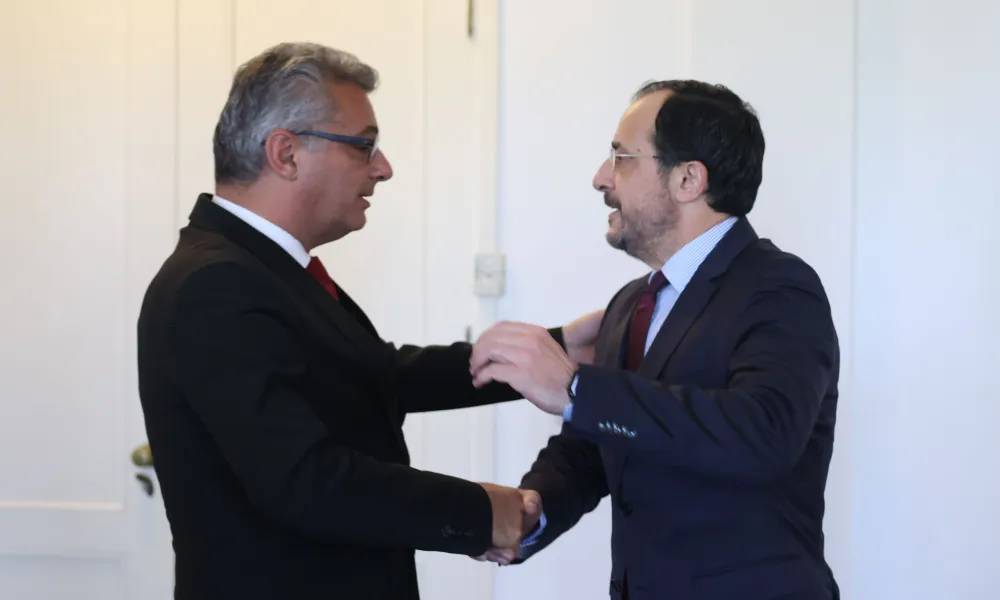

At today's bicommunal festival in Pyla, the image projected by the two leaders will undoubtedly be seen as a welcome, but purely symbolic gesture. Beyond the symbolism, however, the meeting itself serves to highlight the painful reality of the Cyprus problem. It functions as a reflection of the absence of political substance and decision-making, which is being replaced by both sides with a communications-based management of the deadlock.
Many subscribe to the view that any form of communication and contact has its value. There is no disagreement with that. The question, however, is how these contacts are reflected in their results, particularly when compared with the President of the Republic's repeated references to "serious developments", and whether these ultimately amount to yet another communications exercise designed for domestic consumption. This approach sustains the illusion of movement while the negotiation process remains mired in inactivity.
As has often been the case over time, the Greek Cypriot side invokes the convenient narrative of Turkish intransigence to explain the deadlock. Undoubtedly, the stance of Ankara and the Turkish Cypriot leadership is hard-line and frequently outside the agreed framework. However, the question that is carefully avoided is whether the Greek Cypriot leadership has genuinely accepted over the years that any settlement it agrees to will include political equality and meaningful power-sharing within a federal Cyprus.
Time is running dangerously short. The expected visit of María Ángela Holguín at the end of October appears likely to be her last. With her mandate expiring in December and, according to available information, coinciding with the end of the term of UN Secretary-General António Guterres, any renewal of her mandate appears highly unlikely.
Her mission, like the broader effort of the United Nations, continues to face obstacles in the form of a lack of common vision, disagreements over methodology and the inability to reach agreement even on basic confidence-building measures.
The United Nations has made it clear that it does not intend to become trapped in endless processes that yield no results. If political will is limited to verbal "new ideas" and symbolic handshakes, the prospect of a comprehensive settlement risks being lost altogether.
A joint appearance at a bicommunal festival in a mixed community may improve the atmosphere, but it does not produce a political solution. Without courageous decisions, acceptance of responsibility and a genuine embrace of federation, the destructive status quo will become further entrenched, leaving the Greek Cypriot side a spectator to its own deadlocks.