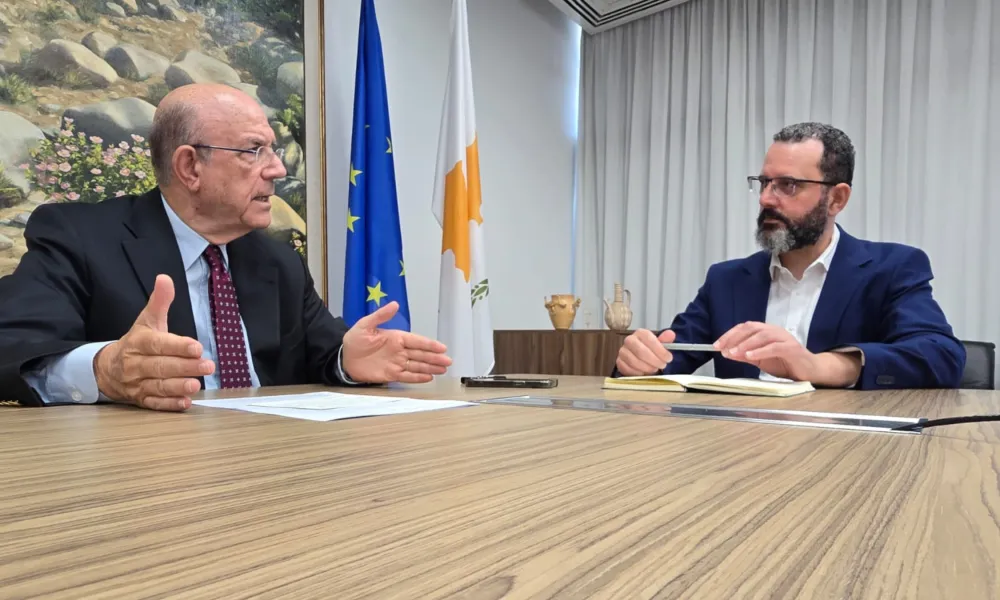

If a body with high standards is not established to manage the reserves of the Social Insurance Fund (SIF), it will not be possible in the long term to support higher pensions without increasing contributions or retirement ages, Finance Minister Makis Keravnos warns in an interview with Politis.
Keravnos identifies the creation of an independent, professional organisation to manage the reserves of the Social Insurance Fund, based on successful international models such as Norway's sovereign wealth fund, as a key condition for the sustainability of pension reform. He argues that without such a transparent investment mechanism, pension increases cannot be maintained in the long run without burdening workers or pensioners through higher contributions or retirement ages. He also notes that Cyprus's improved credit rating now allows the state to raise liquidity directly from international markets rather than borrowing internally from Social Insurance Fund surpluses.
At the same time, Keravnos places particular emphasis on strengthening the second and third pillars of pension provision, arguing that the credibility of provident funds and insurance schemes requires strict and independent supervision. In this context, he reveals that supervision of insurance companies will be transferred to the Central Bank of Cyprus from 2029, while a new legislative framework is being prepared for an independent supervisory authority for provident funds.
Pension reform aims to increase pensions without increasing retirement ages or contributions. New revenues are expected to come from other sources and from a new investment fund that will utilise reserves. Is the state ready to stop using Social Insurance Fund (SIF) surpluses for its current needs?
The Ministry of Finance is acting proactively. Today, the state pays hundreds of millions of euros annually, more than €300 million, for pensions, in addition to its contributions as an employer and significant interest on the SIF reserves that it uses. The state's contribution is already enormous and will largely continue.
At the same time, high employment levels ensure increased revenues for the fund. Therefore, the first phase of the reform, the transition period, is financially secured.
The critical issue for the future is the establishment of an independent investment organisation that will manage the reserves of the SIF, including debts that the state will gradually repay to it.
So a new legal entity will be created? Does it not concern you that SIF surpluses will no longer be counted towards financing government needs?
Not at all. We worked hard to improve the creditworthiness of the Republic of Cyprus through the international rating agencies. Instead of the state borrowing internally from the SIF, it now has the full ability to obtain financing directly from international markets.
In my view, what is needed is an investment organisation with absolute transparency, credibility and professionalism, operating according to the standards of successful international funds such as Norway's.
Is this organisation already under official consultation?
Yes, discussions have started. If this mechanism is not established, it will not be possible in the long term to support pension increases without increasing contributions or retirement ages. The Ministry of Labour has already invited experts from the International Labour Organization (ILO), while we at the Ministry of Finance will also make use of specialised advisers.
Social partners are seeking participation in this organisation. What is your position?
My position is clear: this organisation must be fully independent, absolutely professional and transparent, following international standards of management.
Regarding the second pillar and provident funds: is the creation of a Single Supervisory Authority back on the table?
Both I and the Ministry of Finance are unequivocally in favour of a single, independent supervisory authority, which is also recommended by European institutions.
The conditions are now mature. It has already been agreed that the Central Bank of Cyprus will assume supervision of insurance companies from 2029, as it has the appropriate framework and expertise.
As for provident funds, I believe the time has come for a new bill providing for an independent supervisory authority. The pension system cannot rely exclusively on the SIF. It requires meaningful support from the second and third pillars, namely provident funds, occupational and insurance schemes, and their credibility can only be secured through strict and independent supervision.
Employers are seeking incentives, such as state funding or tax relief, to encourage employee participation in provident funds. Are there any plans for state support?
There are no concrete decisions. It is becoming standard practice that, with every reform, various stakeholders request additional financial incentives.
The greatest incentive is the benefit of the reform itself for society and for insured persons. We should also not forget that employer contributions to provident funds are already deductible from income tax as a business operating cost. Therefore, there has been no discussion about providing further state incentives.
The GSI
On the Great Sea Interconnector (GSI), there has been movement with a new investor, while technical issues such as seabed surveys remain outstanding. Does the possibility remain open for the Republic of Cyprus to participate as a shareholder in the project, and under what conditions?
At present there is no final government decision. Nor could there be unless a complete and clear picture is formed regarding the project, its total cost and all aspects of such a complex undertaking.
I fully agree with the joint statement by the Prime Minister of Greece and the President of the Republic of Cyprus that there is a recognised need to update the studies, as economic and technical parameters have emerged that must be reassessed. That evaluation has been assigned to the European Investment Bank (EIB).
One counterargument is that the entry of a giant such as Meridiam as a shareholder is proof of the project's viability. Why would a company of that size invest in a non-viable project?
Without knowing the internal details of the financial arrangements, Meridiam agreed to join the project implementation vehicle in cooperation with ADMIE. We do not yet know the precise value of the transaction or the company's specific intentions.
It is certainly a positive indication that a major European investment group has expressed interest. This development may pave the way for other investors, whose participation is necessary for the implementation of the project. As for reservations that have been expressed from time to time regarding viability, these have now been confirmed and elevated for examination at the highest level by the leaders of Greece and Cyprus.
Depositors affected by the bail-in
Regarding depositors affected by the bail-in and the National Solidarity Fund: is there room for compensation payments to continue?
There was a pre-election commitment and the government is honouring it within the state's fiscal capabilities.
We implemented an initial scheme worth €100 million. So far, approximately €72 million has been paid out. The remaining €28 million has not yet been disbursed because many beneficiaries had not provided complete information, such as IBAN details.
It has been decided that payment of these €28 million will be completed by the end of the year for those who have already submitted the necessary information and for those who will do so. At the same time, the design of a new scheme for 2027 is under consideration.
The budget continues to include a standing commitment for state support of the fund amounting to €50 million per year.