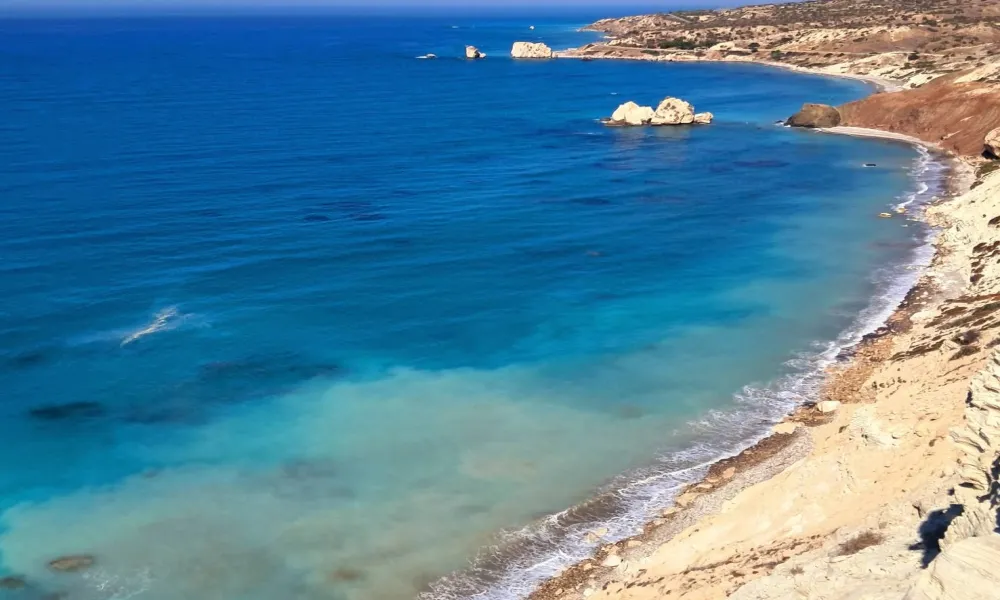

A fresh allegation concerning environmental conditions at Petra tou Romiou has sparked concern after environmental activist Andreas Evlavis published photographs claiming to show sewage in the area.
In a social media post, Evlavis shared images from the site and alleged that sewage had appeared even at Petra tou Romiou, writing: "Sewage even at Petra tou Romiou! Today's images! The sewage is in the second photo!"
The allegation raises obvious questions, particularly given that Petra tou Romiou is one of Cyprus's most recognisable and heavily visited natural and tourist attractions.
Located on the south-western coast of the Paphos district, Petra tou Romiou is a site of significant natural, cultural and mythological importance, as it is traditionally associated with the birthplace of Aphrodite.
Environmental Significance
The issue is especially significant from an environmental perspective because Petra tou Romiou is an officially designated bathing-water site.
In official environmental documentation of the Republic of Cyprus, the area is listed as "Petra tou Romiou", with the Department of Environment serving as the competent authority.
Previous Concerns
The latest allegation does not emerge in a completely unfamiliar environmental context.
Evlavis has previously highlighted environmental problems in the wider Petra tou Romiou area. As far back as 2019, he publicly reported issues involving large quantities of rubbish that had washed onto a nearby beach.
The area has also been at the centre of discussions over the need for stronger environmental protection and improved management of a site that attracts substantial visitor numbers throughout the year.
Need for Investigation
If the material shown in the photographs is indeed sewage, key questions arise regarding its source, how it reached the area and whether it poses a risk to the marine environment or swimmers.
The photographic evidence alone cannot establish either the origin or composition of the material.
For that reason, an immediate inspection by the relevant authorities will be crucial, along with the collection and laboratory analysis of samples should this be deemed necessary.
Questions for Authorities
The issue is particularly sensitive because any pollution incident at one of Cyprus's most iconic locations is not only an environmental matter but also one that could affect the island's image as a tourist destination.
Petra tou Romiou remains a landmark location regularly featured in official tourism and environmental references as an area of exceptional value.
Attention is now likely to focus on whether the competent authorities investigate the allegation and provide answers to several key questions:
- Is the material shown in the photographs actually sewage?
- What is its source?
- Has the sea been affected?
- Have inspections and sampling been carried out?
- What measures are being taken to prevent a recurrence?
For a site widely regarded as a symbol of Cyprus, the protection of its natural environment cannot be treated as a secondary concern.