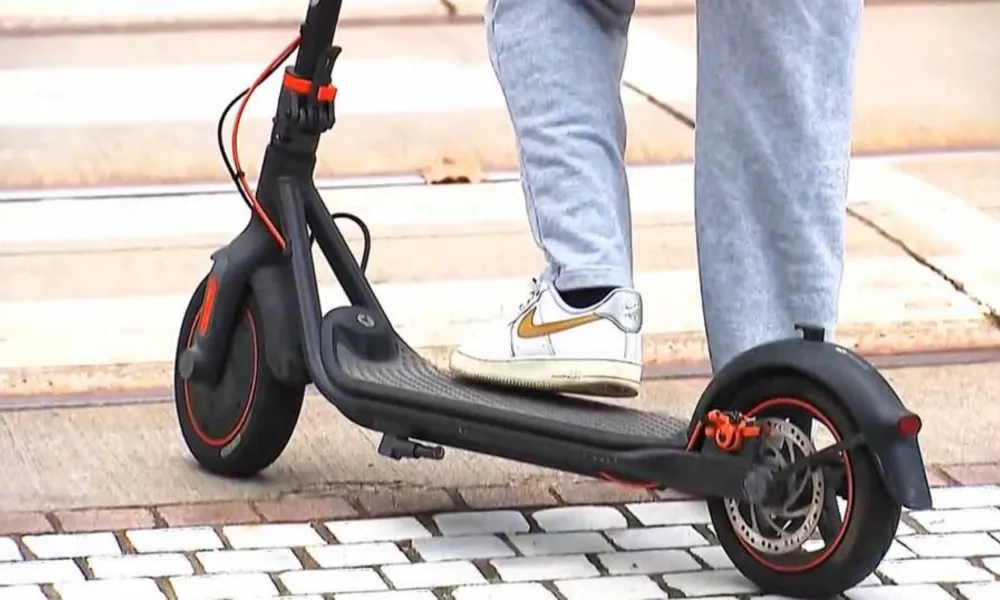

Transport engineer and University of Cyprus associate professor Dr Loukas Demetriou has spoken out against banning electric scooters and bicycles, arguing that micromobility should be viewed as part of the solution to traffic congestion rather than part of the problem.
Speaking on Politis 107.6 & 97.6 during the programme Morning Briefing with Katerina Eliadi, Demetriou said the use of alternative modes of transport should be encouraged to reduce dependence on private cars.
‘Roads do not belong only to cars’
Demetriou stressed that motorists need to recognise they are not the only users of the road network.
According to him, the mobility hierarchy places pedestrians first, followed by cyclists, micromobility users and public transport, with private cars coming last.
“Drivers should not react. They are not the only ones on the road,” he said.
“The car cannot have everything, especially at the expense of young people who want to move around using different means.”
Education rather than bans
While acknowledging that some young people engage in dangerous behaviour on scooters and bicycles, Demetriou argued that the response should be education, awareness campaigns and enforcement rather than broad prohibitions.
“Should we ban their use? I don't think that is the solution,” he said, noting that unsafe behaviour is also common among car drivers.
He also referred to gatherings of young people with bicycles and scooters along Larnakos Avenue, describing them as positive provided safety rules are respected.
He suggested the creation of clubs or associations to help organise young users and promote safe riding practices.
At the same time, he said schools and families should play a greater role in road-safety education and suggested that authorities could consider temporarily confiscating bicycles or scooters in cases of dangerous behaviour.
30 km/h speed limits in city centres
Demetriou proposed introducing a 30 km/h speed limit in city centres to allow safer coexistence between cars, bicycles and scooters.
He said lower speed limits would encourage more people to choose alternative forms of transport.
‘Cycle lanes are not needed everywhere’
Addressing infrastructure needs, Demetriou acknowledged that further investment is required but said cycle lanes do not need to be built on every road.
He argued that dedicated cycle lanes are most useful in areas experiencing significant traffic pressures and supported a mixed-use approach to road space.
“Roads should be used by everyone. The car must wait,” he said.
He added that suitable infrastructure also includes shade, trees, rest areas and a pleasant urban environment, stressing that cities should not wait until every project is completed before promoting micromobility.
‘Leave the car behind and experience the city’
Demetriou described the promotion of micromobility as an effort that could take on a national dimension, helping reduce dependence on private vehicles.
“Our hope is to move away from the car and experience our city on a bicycle or on a scooter,” he said.
He also rejected the argument that Cyprus' high temperatures should discourage cycling, pointing to Northern European countries where bicycles are widely used despite challenging weather conditions.