

"I have deep respect for EDEK and its history [...] I am a person in favour of an open economy, with social democratic views on social justice and transparency."
"We must stop viewing confidence-building measures as a bargaining process."
"More generous outreach to our Turkish Cypriot compatriots. They should feel that the Republic of Cyprus is their home too, and that Cyprus is our common homeland."
"Good relations with the United States, with Israel and with all the countries of the region, yes. One-dimensional alignment, no."
"The benefits of growth were not shared fairly [...] Indicators are a means, not an end."
"The Presidency of the Republic is a very serious matter. It requires commitment, vision and strategy."
"There were ambiguities and inconsistencies regarding the basis of the solution, and management of the Cyprus issue in terms of communication and domestic consumption rather than strategy."
The key to restarting negotiations is in our hands
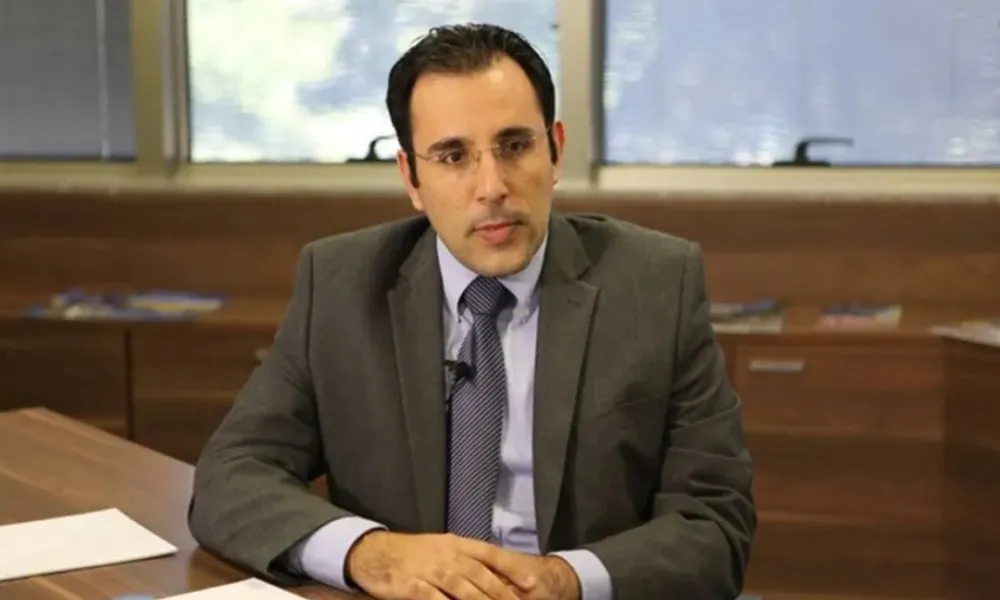
Tassos Yiasemides has recently been at the centre of discussions surrounding the 2028 presidential elections, as a possible centre-left candidate who could attract the support of AKEL, ALMA, EDEK and potentially other political formations. The well-known economist, who has built a strong public presence through his interventions and analyses on the Cypriot economy, was invited by Politis to comment on a broader range of political issues, from the Cyprus problem and foreign policy to corruption, housing and the welfare state.
Tassos Yiasemides was born in 1979 to parents who were teachers, with family roots in Paphos and the occupied village of Stylloi in the Famagusta district. He has two siblings, Andreas (CEO of PwC) and Marina (a surgeon in London specialising in cancer treatment). He is a member of the board of directors of KPMG Cyprus. He studied Accounting and Finance at the University of Warwick. He joined KPMG Cyprus as an auditor in 2002 and became a board member in 2013. He holds the Advanced Competency Certificate and the Anti-Money Laundering Certificate of the Cyprus Securities and Exchange Commission. He is a licensed insolvency practitioner and a member of the board of the Cyprus Red Cross.
Cyprus issue
Mr Yiasemides, we have heard you analyse economic matters on many occasions, but we do not know your positions on the Cyprus issue, which remains in a prolonged stalemate. Why have we reached the current deadlock?
The Cyprus issue did not stall on its own. After the collapse of Crans-Montana in 2017, which was the only time we came so close to a solution, nine whole years were lost. The primary responsibility lies with Turkey, which attempted to change the basis of the solution through its "two-state" position, continues the occupation and creates new faits accomplis, such as in Varosha. At the same time, there were ambiguities and inconsistencies regarding the basis of the solution, and management of the Cyprus issue in terms of communication and domestic consumption rather than strategy. Time is not neutral. It works in favour of partition and faits accomplis. Every passing year entrenches the occupation and drives the two communities further apart.
We are on the verge of Antonio Guterres leaving his post as UN Secretary-General. Did he handle the Cyprus issue correctly and did President Christodoulides make proper use of the time available to him?
The election to the Turkish Cypriot leadership of a leader who has declared his commitment to a federal solution, together with the personal involvement of the Secretary-General, created a genuine window of opportunity. It was not utilised. Instead of substantive negotiations on the basis of the Guterres framework, we had informal meetings, communiqués without reference to the agreed basis, and a lengthy negotiation over crossing points that was not completed either. The next Secretary-General will be much more cautious about investing political capital in Cyprus.
"It is in our hands"
Is there anything our side can do to unlock the negotiation process and restart talks?
Yes, and it is in our hands. First, a clear public commitment that we will resume from where we left off at Crans-Montana, on the basis of the Guterres framework and the convergences. Second, we must stop viewing confidence-building measures as a bargaining process. The operation of new crossing points and cooperation in health, the environment and energy build trust among ordinary people from the two communities. Third, utilisation of the European Union: EU-Turkey relations are leverage that should be linked to Ankara's return to the negotiating table on the agreed basis. Fourth, a timely and methodical approach to the new Secretary-General so that the Cyprus issue is not lost during the transition. More generous outreach to our Turkish Cypriot compatriots. They should feel that the Republic of Cyprus is their home too, and that Cyprus is our common homeland. Furthermore, we should seek discussion of the Cyprus issue at an official European Council summit, with the aim of adopting a package of principles for a Cyprus settlement based on UN decisions and EU principles and values.
Clearly in favour of a bizonal, bicommunal federation
Are you clearly in favour of a bizonal, bicommunal federation solution, based on UN resolutions and the agreed framework?
A federation is already an unavoidable historical reality through the Makarios-Denktash and Kyprianou-Denktash high-level agreements. Bizonality is acceptable to the extent that it is compatible with international law and the principles and values of the European Union. A bizonal, bicommunal federation with political equality, as defined by Security Council resolutions, with a single sovereignty, a single international personality and a single citizenship, in full compatibility with the European acquis. It is the only solution with international legitimacy and the only realistic alternative to permanent partition. A solution that would definitively close the chapter of invasion and occupation. Without guarantees and intervention rights for third parties, with the withdrawal of Turkish troops and with respect for the human rights of all Cypriots. It is not a concession. It is the basis on which Greek Cypriots and Turkish Cypriots can live in security and dignity in our common homeland.
Do you believe the convergences achieved during the negotiations should be preserved as the basis for a restart, or are there points that should be renegotiated?
The convergences are an achievement built over decades and must be preserved. If we reopen matters that have already been agreed, the other side will reopen its own issues as well, and we will end up much further back than we were in 2017. The Guterres framework already provides for replacing the outdated guarantees system with a new security arrangement, and links together the territorial, property, governance and equal-treatment issues. Matters that remain unresolved should be discussed within the negotiation process, not as preconditions. There we will insist on a functional federation, compatible with the EU, and on the complete withdrawal of occupation troops.
"Yes" or "No"
How did you vote in 2004? "Yes" or "No"? Based on today's realities, would you vote the same way?
The majority of our people in 2004 did not vote against reunification. They voted against a plan which, as it stood at the time, did not provide sufficient guarantees regarding implementation and security. That was because it constituted a dysfunctional model of solution, with deviations from the acquis communautaire, violations of fundamental freedoms and human rights, and retention of outdated guarantees and related guardianship arrangements. The lesson of 2004, however, is that the "No" should have led to a better solution, and that did not happen. Twenty-two years later, the occupation continues and the faits accomplis continue to multiply. Today, the question is not the Annan Plan. The question is whether we will have another opportunity for a solution. Any plan will be judged by one criterion: whether it reunifies the country and safeguards the security, functionality and rights of all Cypriots.
Foreign policy
Do you agree with President Christodoulides' foreign policy? Strengthening our relations with the United States and deepening our relations with Israel?
Cyprus is a member state of the European Union and its compass must be international law and UN resolutions. That is our strongest weapon against occupation. Good relations with the United States, with Israel and with all the countries of the region, yes. One-dimensional alignment, no. Cooperation in energy, research and the economy is legitimate. Militarisation of relations and silence in the face of blatant violations of international humanitarian law are not. A country that asks the world to condemn the occupation of its territory cannot apply double standards. We need a multidimensional foreign policy that keeps Cyprus out of other people's wars. At the same time, as a country facing the continuing problem of invasion and occupation, we should seek the best possible relations with the widest possible circle of countries and international organisations, always on the basis of reciprocity and the principles of international and European law. In other words, a multidimensional foreign policy serving our national interests.
How do you view Cyprus' role in the Eastern Mediterranean region?
A bridge, not a bridgehead. Cyprus can be the most stable point of the European Union in a troubled neighbourhood: a hub for humanitarian aid, shipping, healthcare, education, energy and entrepreneurship, with good relations with everyone. And a reunited Cyprus would be an even stronger factor for stability.
GSI
Will the Cyprus-Greece electricity interconnection (and at a later stage with Israel) reduce electricity prices? Is the GSI a useful and necessary project?
The interconnection is a project of strategic importance. It ends our energy isolation, allows greater use of renewable energy sources and strengthens energy security. Will it reduce prices? It may, but not automatically. It depends on the cost passed on to consumers, whether there is genuine competition in the market, and on energy storage capacity. The problem today is not the project itself, but its management. There is a lack of clarity regarding the final cost and the benefit to citizens, its geopolitical protection and who pays if delays occur. Yes to the project, but with a published cost-benefit study, full transparency and clauses that protect consumers and taxpayers. Profits cannot be private while risks are public.
Economy
Is the Cypriot economy on the right track? What are its most serious structural weaknesses?
The economy is performing well. It has one of the highest growth rates in the eurozone, budget surpluses, reduced public debt and credit-rating upgrades. This is an achievement first and foremost of the country's businesses and workforce. It is resilient in the short term, but structurally vulnerable. It is an "externally driven" economy, dependent on tourism, real estate, the inflow of foreign companies and imported energy, with a persistent current account deficit.
Its most serious weaknesses are low productivity, bureaucracy and a slow justice system that burden every entrepreneur, expensive energy, a lack of long-term planning in water, energy and waste management, and widening inequalities.
Numbers are prospering...
Why are the positive economic indicators not translating into improvements in people's financial situation and standard of living?
Because the benefits of growth have not been shared fairly. Rents and housing prices have risen much faster than wages, inflation in essential goods and energy has eroded income gains, and a large proportion of workers remain without the protection of collective agreements.
Indicators are a means, not an end. A state that respects its citizens should create conditions that ensure four basic things for them: education as a space for creativity and not merely the transfer of knowledge, healthcare, housing, and a better quality of life and everyday experience.
Open economy
Does Cyprus need to change its development model?
I am in favour of an open economy, entrepreneurship, investment and attracting companies. Entrepreneurs who take risks, create jobs and pay taxes should feel that the state is their ally, not an obstacle.
We do not need to dismantle what works. We need to add technology, which already accounts for more than 10% of GDP, a green transition based on renewable energy and storage, research, healthcare and education as exportable services, a modern primary sector, and value-added manufacturing.
The backbone of the economy is small and medium-sized enterprises. They need cheaper access to financing, less bureaucracy, faster licensing procedures and support for innovation and exports.
Why has this not happened? Because every government thinks in terms of a five-year horizon rather than a generational one, and because bureaucracy turns every productive investment into an obstacle course.
The objective should be simple: more investment and more entrepreneurship with multiplier effects, delivering benefits that reach everyone.
Housing
What is the realistic way to address the housing problem without undermining investment activity?
Policies aimed at attracting capital, companies and specialised personnel helped drive the economic recovery and should continue. The problem was not the direction. It was the speed and the absence of planning for the side effects.
All these policies generated demand for housing and, because supply responds slowly, the result was rising prices. There was never a housing impact assessment before decisions were made. We measured how many companies arrived and how much revenue they generated, not where people would live.
And the state's response was reactive rather than preventive. Rent subsidies without new housing supply simply end up inflating prices.
The realistic path is mandatory and publicly available housing impact assessments for every investment-attraction policy. At the same time, supply-side measures are needed: fast-track permits, utilisation of state land for affordable and social housing, strengthening the Cyprus Land Development Corporation, incentives to bring vacant homes back onto the market, targeted support for young people, a rental registry and a regular housing index.
Education
Is public education meeting the needs of a modern society and economy?
Public education has excellent teachers but a system that does not allow them to perform to their full potential, while families pay for private tutoring to fill the gaps.
Schools must become places of creativity and not merely centres for the transfer of knowledge.
The changes I propose include curricula that emphasise critical thinking, digital skills and foreign languages, strengthening technical education in partnership with businesses, public pre-primary education and all-day schooling, support for children with special needs, and lifelong learning.
Reforms are implemented with teachers, not against them.
Pensions
Is there a way to provide decent pensions for everyone from today while keeping the system sustainable?
Yes. An effective and fair pension system is not merely an economic mechanism. It demonstrates how a society understands social justice, intergenerational solidarity and respect for those who worked throughout their lives.
Cyprus spends around 6% of GDP on pensions, compared with almost 10% across the EU, while roughly one in three people over the age of 65 is at risk of poverty.
Dignity today means strengthening low pensions with the aim of gradually reaching the poverty threshold, correcting injustices such as those affecting widows, and providing regular cost-of-living adjustments so pensioners do not lose purchasing power.
Sustainability tomorrow means ending state borrowing from the Social Insurance Fund through a repayment timetable, ensuring professional and independent management of reserves with transparency, independent audits and participation by employees and employers, and maintaining a balance so that younger people are not contributing to a fund from which they fear they will never receive anything.
There should also be a digital platform where every insured person can see their contributions and the pension they can expect to receive.
Sustainability and dignity are not contradictory concepts.
Provident Fund for All
Yes or no to a Provident Fund for all?
Yes. We need a three-pillar system: a public basic pension that guarantees social protection, provident funds financed by employer and employee contributions, and personal savings products for those who wish to save additionally.
The first pillar alone is not sufficient, and voluntary participation has mainly excluded low-paid private-sector workers.
Coverage should be universal, but introduced gradually rather than through an abrupt obligation. Initial contributions should be low and increase over a decade so that the cost does not fall on current wages or overwhelm small and medium-sized enterprises, which require support during the transition.
The fund should be transferable when changing employers, provide the option of a monthly pension rather than only a lump-sum payment, and consolidate hundreds of small funds into a limited number of professionally managed schemes.
Ready for 2028?
Your name is being widely discussed as a possible candidate for 2028. Are you ready to take on the role of candidate for the Presidency of the Republic?
You know, the Presidency of the Republic is a very serious matter. It requires commitment, vision and strategy.
It is important to remain connected to "the marketplace", to the real needs of entrepreneurs, investors, workers and citizens, especially amid today's challenging realities.
New ideas, political courage and initiative are needed. Citizens want to hear proposals that they can understand and that are practical, with accountability rather than obsession with the past.
That should be the framework of an election campaign, although it is understandable that, as a political culture, we may still be some distance away from that.
There is nothing specific for me to comment on. I see and read what is being written. If something arises, we will see.
Which parties or political groupings have approached you so far?
There have been no official discussions. I speak and interact with many people, whether socially or through my work, from different backgrounds and with different views.
I listen carefully to their concerns about the economy, the Cyprus issue, housing and everyday life.
These conversations are valuable because they reveal society's real problems.
Are you an EDEK member?
I have deep respect for EDEK and its history, for its struggles for independence, democracy and social justice.
I am a person of the open economy, with social democratic views on social justice and transparency.
I believe in an economy that encourages entrepreneurship and investment, and in a state that ensures the benefits reach everyone.
Should EDEK remain in government or leave?
That is a matter for EDEK's collective bodies and its new leadership.
EDEK has a history, values and people who can make a meaningful contribution to the country.
But, as Odysseas Elytis said, "for the sun to turn, much work is needed."
And I would add: more fellow travellers.
"Whoever is implicated must go"
Asked whether "we have a real picture of the extent of corruption in Cyprus", Tassos Yiasemides responded negatively.
"No, we do not have the full picture, and that is part of the problem. What we know came mainly from reports by the Audit Office, investigative journalism and foreign media, not from the institutions that were supposed to detect it," he said.
He added that "when the response is delay or cover-up, people rightly believe that we are seeing only the tip of the iceberg."
What kind of corruption do we have in Cyprus?
Corruption is not always found where we look for it. It is usually not the envelope in the drawer or the illegal transaction.
It is a system of favours, mutual protection and abuse of power that often operates beneath the surface.
Conflicts of interest, benefiting the few through licences, tenders and appointments, personal connections as a way of life and, above all, impunity.
This is institutional corruption.
Institutions that are supposed to oversee power end up shielding it.
And the first to pay the price is the honest entrepreneur who has to compete on unequal terms.
How can corruption be reduced?
First and foremost through digitalisation.
Wherever there is human intervention and discretionary power, there is room for favouritism and corruption.
Full computerisation of state procedures, licensing, tenders and approvals, with electronic submission, objective criteria, automatic order of priority and a digital trail for every decision, reduces interference to a minimum.
Citizens and entrepreneurs should not need "connections".
At the same time, independent institutions are needed: separation of the roles of Attorney-General and Director of Public Prosecutions, an Anti-Corruption Authority with its own criminal investigators, a strengthened Audit Office and transparency in party financing.
And one simple rule: whoever is implicated must go.
Has our country managed to regain its credibility and prestige abroad? Are we regarded as a good destination for investment?
To a large extent, yes.
Credit rating upgrades confirm this, and Cyprus is now an attractive destination for investment and international companies, particularly in technology and services.
This is an achievement that must be protected and expanded.
However, we still attract many investments in real estate and fewer in production, research and innovation.
The increase in corporate tax to 15% and the foreign investment screening mechanism align us with international standards and strengthen our credibility.
Now we must compete on quality: fast justice, simple procedures, stable and predictable rules, and a highly skilled workforce.
That is what serious investors are looking for.