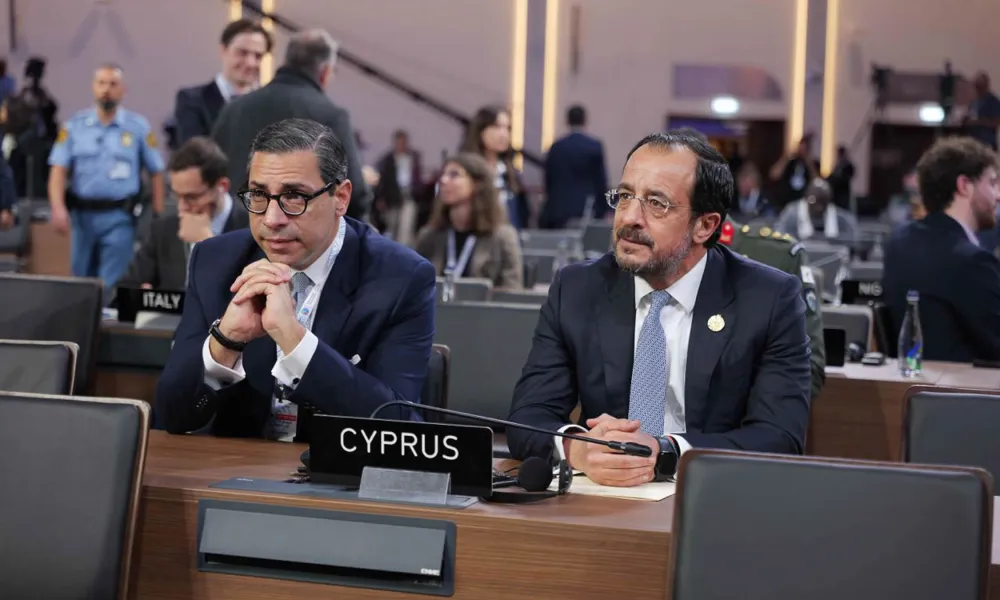



The reported message from Brussels is becoming harder to dismiss as speculation. Greek Cypriot President Nikos Christodoulides has said publicly that progress in relations between Türkiye and the European Union can happen only alongside progress on Cyprus, specifically the resumption of negotiations from where they broke down at Crans-Montana in 2017. Greek Cypriot media report that European Commission Executive Vice-President Raffaele Fitto, who is also the EU’s Cyprus emissary, will take a proposal to Ankara: discussions on modernising the Customs Union could begin if Cyprus talks resume, while progress could also open a path for Türkiye to join the proposed “Made in EU” scheme.
The terms have not been published as a formal agreement. But the Greek Cypriot leadership has stated the political condition, and its media have reported how that condition could be linked to trade. Ankara should take the message seriously and insist on clarity about what is being offered, what Türkiye is expected to do and how progress will be judged.
“Made in EU” is still a proposed framework, not a benefit Türkiye has been promised. The plan could shape access to public procurement and industrial support within the bloc. The reported possibility of Turkish participation is therefore economically significant, but it remains only a possibility. The details—what access would mean, which sectors would be covered and whether Turkish firms would receive treatment comparable to European producers—are crucial.
Why many Turks may call it indecent
Many Turks may see the reported linkage as an indecent proposal: a major economic interest made conditional on restarting negotiations within a framework whose terms remain contested, while Turkish Cypriot demands for political equality and effective participation remain unresolved.
That reaction has a history. In 2004, Turkish Cypriots voted in favour of the United Nations Secretary-General Kofi Annan’s settlement plan; Greek Cypriots rejected it. The Republic of Cyprus joined the European Union that year. The European Commission later proposed a direct-trade regulation to ease the Turkish Cypriot community’s economic isolation, but the measure was never adopted. The contrast between the Turkish Cypriot “yes” vote and the failure to deliver direct trade remains a powerful source of distrust.
This history explains the likely public reaction. It does not, by itself, determine what Türkiye should do now. Diplomacy is not a referendum on past disappointments; its purpose is to advance interests in the conditions that exist today.
A trade relationship that needs repair
The present Customs Union has been in force since 1996. It covers industrial goods, but excludes most agriculture, services and public procurement. Türkiye must align with the European Union’s common commercial policy in areas covered by the agreement, yet Ankara has no seat at the table when the EU negotiates trade agreements with third countries. Those agreements do not automatically extend to Türkiye, even though the Customs Union can require Türkiye to open its market to the partners concerned. The European Parliament’s research service has identified this asymmetry as a key weakness of the current arrangement.
The comparison with some of the EU’s newer agreements is sobering. The EU agreements with Chile and Vietnam cover services and public procurement. The Vietnam agreement also provides for the elimination of 99 percent of tariffs and wider access to services and procurement markets. The EU–South Korea agreement addresses non-tariff barriers in key sectors and includes provisions on services, investment and government procurement. These agreements differ in scope, and Türkiye already has tariff-free access for covered industrial goods. The point is not that every partner enjoys better terms in every respect. It is that some newer agreements provide broader, more modern coverage than the framework governing Türkiye’s deep economic integration with Europe.
That deficiency must be corrected. A proper upgrade should extend the relationship to services, agriculture and public procurement; address non-tariff barriers; and give Türkiye a meaningful role when EU trade agreements affect Turkish interests. If a substantially upgraded Customs Union cannot be achieved, Ankara should examine a comprehensive trade agreement that offers reciprocal, enforceable access across a wider range of sectors.
This is not a demand for special treatment. It is a demand to modernise an arrangement that has become unbalanced. The European Commission proposed an upgrade in 2016, including the extension of bilateral trade relations to services, public procurement and sustainable development. The Council has not authorised negotiations. The delay has left Turkish businesses exposed to a changing European trade policy without a corresponding way for Ankara to shape it.
Cyprus talks need a credible basis
There are legitimate reasons for the EU to discuss Cyprus in the context of its relations with Türkiye. But the question is whether economic cooperation should be made conditional on a political sequence that one side regards as settled while the other still sees fundamental issues unresolved.
Restarting talks from Crans-Montana cannot mean asking the Turkish Cypriot side to return without addressing political equality, effective participation and safeguards against an indefinite process that ends with the status quo intact. These are not details to postpone until later. They are central to whether negotiations can be credible and whether the Turkish Cypriot community will see a reason to invest in them.
The European Union can support the United Nations-led process, but it cannot easily be regarded as a disinterested mediator when the Republic of Cyprus is one of its member states. This makes transparency about the EU’s role and conditions especially important. If Brussels uses economic cooperation as an incentive, the terms should be explicit, reciprocal and available through a fair process.
A record that breeds scepticism
Brussels should understand why many Turks approach its assurances cautiously. In 2000, 14 EU member governments imposed diplomatic measures against Austria after the far-right Freedom Party entered a coalition government. The measures did not prevent the elected coalition from taking office, and Jörg Haider himself did not become chancellor. During the euro crisis, financial pressure and European institutions narrowed the choices available to governments in Greece and Italy.
More recently, the General Court of the European Union annulled the European Commission’s refusal to provide text messages between Commission President Ursula von der Leyen and Pfizer chief executive Albert Bourla, finding that the Commission had not given plausible reasons for not holding them. These episodes do not prove that every EU action is hypocritical. They do explain why Brussels cannot expect its claims to fairness and accountability to go unquestioned.
Interests must guide the response
Lord Palmerston, the British statesman, told the House of Commons in 1848: “We have no eternal allies, and we have no perpetual enemies. Our interests are eternal and perpetual.” The principle is relevant here. Emotions and collective memory matter because they shape public trust and the political room leaders have to manoeuvre. But they should inform policy, not replace it.
Ankara should neither accept a vague offer on trust nor reject a potentially valuable opening simply to register its displeasure. It should demand a comprehensive, enforceable trade upgrade; fair treatment under the “Made in EU” framework; and a Cyprus process that recognises Turkish Cypriot political equality from the outset. Any economic steps should be specific, reciprocal and measurable, rather than a promise to begin discussions at some later stage.
The reported offer may be inadequate as presented. The test for Turkish diplomacy is whether it can be turned into concrete gains without sacrificing core interests. If the terms remain vague or one-sided, Türkiye should say so plainly. If a fair trade arrangement and a credible negotiating framework can be secured together, Ankara should be ready to pursue them. Palmerston’s point was not that principle is irrelevant. It was that states must judge their choices by what those choices achieve.