
Keeping a home organised may have less to do with constant deep cleans and more to do with small routines that prevent clutter from building up.
Professional organisers recommend creating simple systems for the things that regularly enter, move around and leave the home. The aim is not perfection, but a space that remains manageable without requiring a huge tidying session every few weeks.
Here are 12 practical habits they use in their own homes.
1. Do two 15-minute resets each day
Diane Lowy, founder of New York at Home, calls these “farm chores”: around 15 minutes of basic household tasks once or twice a day.
That might mean loading the dishwasher, folding clothes, recycling packaging or returning items to the rooms where they belong.
A short reset in the morning and another before bed can prevent small jobs from developing into a much larger mess.
2. Make everyday storage attractive
Organisation does not have to mean hiding everything.
Lowy recommends making mundane household tasks more enjoyable by choosing practical objects that you also like looking at, whether that is an attractive basket for dog toys, a good-looking broom or neat containers for ingredients.
If everyday systems are pleasant and easy to use, maintaining them can feel less like a chore.
3. Rotate your wardrobe seasonally
When wardrobe space is limited, professional organiser Faith Roberson recommends a seasonal clothes swap.
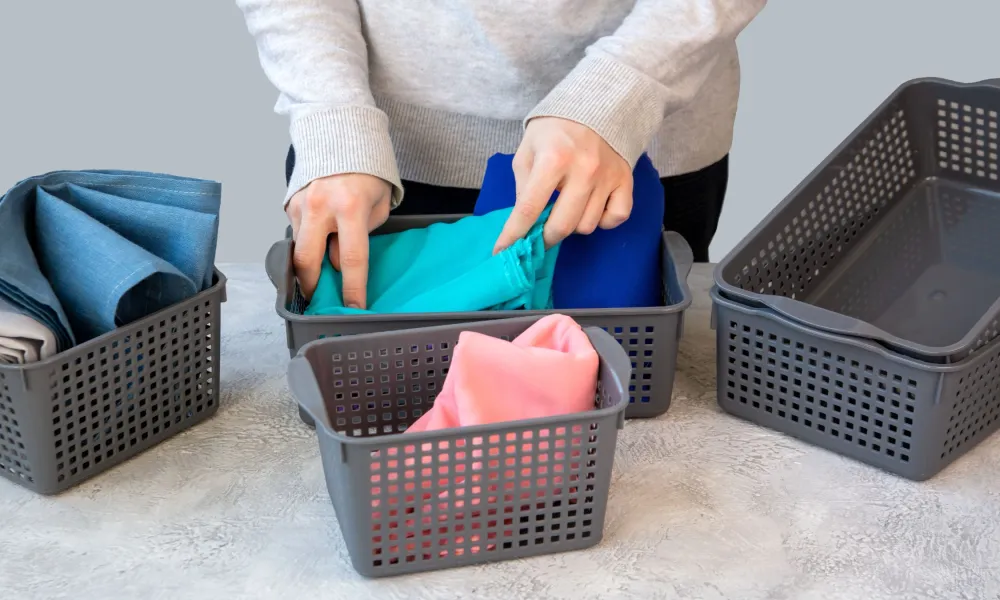
Store winter clothes during summer and vice versa, preferably in designated fabric boxes or containers.
The changeover also provides a natural opportunity to reconsider what you actually wear rather than allowing unused clothes to remain in the wardrobe indefinitely.
4. Use turntables in awkward spaces
A Lazy Susan or rotating organiser can make products at the back of cupboards and refrigerators easier to see.
Roberson uses them not only for condiments and laundry products but also for vitamins, keeping things she needs to remember within sight.
The principle is simple: if you can easily see and reach something, you are more likely to use it.
5. Declutter little and often
Instead of waiting for a major annual clear-out, make decluttering part of your normal routine.
Roberson, for example, clears and wipes down her refrigerator before grocery shopping. When changing wardrobes for a new season, she reassesses clothes before putting them away.
She also keeps a list of items that genuinely need replacing, helping her shop with intention rather than buying impulsively.
6. Keep only what you can maintain
Roberson's rule is straightforward: “Keep what you can care for.”
If laundry is constantly overwhelming, cupboards cannot contain what you own, or damaged possessions remain unrepaired for months, you may simply have more belongings than you can realistically maintain.
Continually reorganising possessions you neither need nor use does not solve clutter. Reducing their volume does.
7. Create an exit zone
Getting things into the house has become extremely easy. Getting them out often requires more effort.
Lowy recommends establishing a designated “outgoing” area near the door for clothes heading to the tailor, shoes needing repair, donations, returns and anything that needs to leave the house.
Having one place for outgoing items makes it less likely that they will disappear into cupboards or become permanent piles.
8. Give everyone in the family a role
In a busy household, organisation works better when it is not one person's responsibility.
Jen Martin, founder of Reset Your Nest, uses labels so her four children know where belongings should go.
Her children also help transfer frequently used groceries such as cereal and rice into storage containers and add favourite foods to the shopping list when supplies run low.
Simple systems allow children to participate rather than relying on a parent to constantly tidy after everyone.
9. Regularly reassess children's toys
Children can accumulate toys remarkably quickly, particularly because many arrive as gifts.
Professional organiser Beth Penn recommends regularly clearing out unwanted toys before they become fully absorbed into the household.
Keeping a temporary holding area for questionable items can help. Once it fills, the contents can be sorted for donation, recycling or disposal.
For older children especially, involving them in deciding what they have outgrown can also make decluttering part of their own routine.
10. Make organising a little more fun
Not every label has to say “socks” or “stationery”.
Organiser Ryan Eisland uses funny, highly specific labels in her family home to identify categories while adding personality to the system.
Storage itself can also reflect the person using it. Vintage baskets, unusual boxes or containers that fit someone's personal style can make an organised room feel lived-in rather than clinical.
11. Control incoming mail and packages
Organisation is not only about the possessions already inside your home.
Post, paperwork and deliveries can quickly create new clutter if there is nowhere for them to go.
Penn recommends creating a dedicated system for documents awaiting action. She uses transparent pouches inside a kitchen cabinet door, allowing paperwork to remain out of sight while still being visible whenever the cabinet is opened.
The important point is to give incoming paperwork a temporary destination rather than allowing it to become another pile.
12. Forget about perfection
Perhaps the most realistic organising rule is to aim for progress rather than an immaculate home.
Penn uses the phrase “I’m moving the needle” to remind herself that even a few minutes spent putting things away makes a difference.
Picking up several items before bed or clearing one small surface may not transform your home, but it can prevent tomorrow's disorder from becoming more difficult to handle.
An Instagram-perfect house may be possible with unlimited time or professional help, but it is not a practical standard for most families.
Real organisation should make everyday life easier, calmer and more functional, rather than creating another impossible standard to meet.
Source: House Beautiful