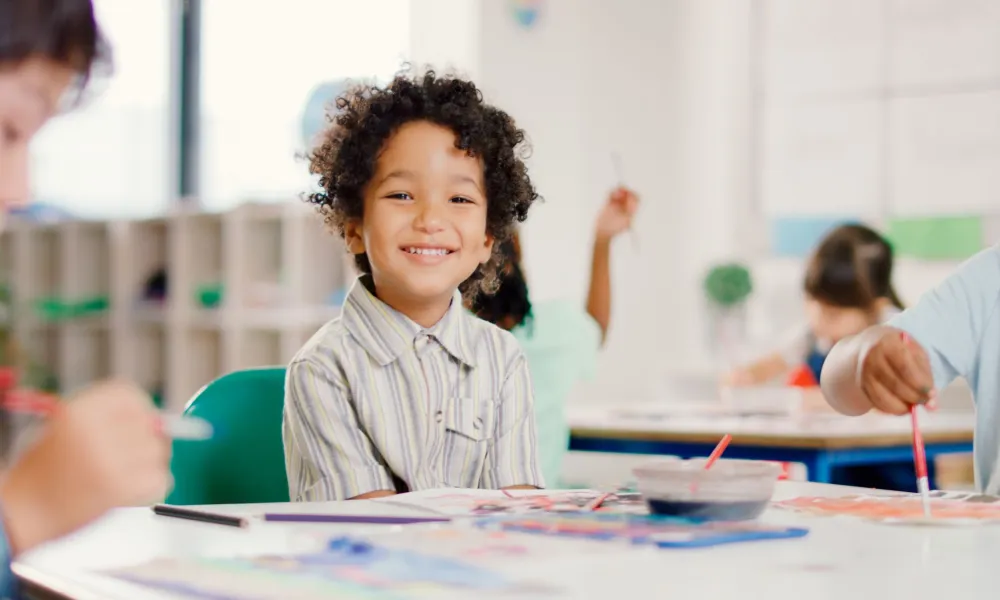

The desire to feel that our efforts have meaning and lasting value may emerge as early as age four, according to new research examining what motivates children and adults to put effort into a task.
Researchers found that participants were considerably more willing to build a puzzle when they knew their finished creation would be kept rather than immediately taken apart.
The findings suggest that even a small indication that someone’s work will endure can affect whether they believe the effort is worthwhile.
The research involved 604 children aged four to nine and 582 adults in the United States and consisted of four experiments.
It was led by Fan Yang, a research associate professor of psychology at the University of Chicago, and Yilin Liu, now a doctoral student at the University of Texas at Dallas.
Why keeping their creations mattered
Rather than exploring major questions about purpose or meaning in life, the researchers investigated whether significance could influence behaviour in something as simple as a children’s game.
In the first experiment, participants were shown two versions of a puzzle involving coloured pieces assembled into a heart.
In one version, the completed heart was placed in a box and preserved. In the other, a machine immediately took it apart.
When children were asked which game was better, around 70% chose the version in which the heart was kept. Around 80% of adults made the same choice.
When participants were subsequently asked which game they actually wanted to play, approximately 80% of children chose the version that preserved their work, compared with between 83% and 90% of adults.
Importantly, nobody was told why the hearts would be kept, how long they would remain there or whether participants would ever see them again.
The simple knowledge that their creation would survive was enough to influence their decision.
“It’s almost like air. We actually really need it,” Yang said of the desire to feel that effort matters.
Would children pay to preserve their work?
The researchers then introduced a cost.
Children could choose between playing one game for free or giving up a sticker to play the alternative.
When both games preserved the finished hearts, 85% of children and 89% of adults chose the free option.
But when only the game requiring payment preserved the heart, children divided almost evenly, with half willing to sacrifice their sticker. Among adults, the proportion choosing the free game dropped to 62%.
To determine whether participants simply preferred seeing objects remain intact, another group watched an animation in which puzzle pieces moved by themselves rather than being assembled by the participant.
Under those circumstances, preserving the finished shape made little difference. Most people still selected the free option.
The researchers therefore concluded that the effect depended on personally creating something.
“It has to be something they personally create for them to really care about it,” Yang said. “It’s not just a basic preference for seeing things remain intact.”
Effort dropped when the work would disappear
A third experiment looked directly at how much effort participants were prepared to make.
Before each round, children were told whether the heart they created would be kept or dismantled.
They could then either assemble the puzzle or take an easier route and simply drop the loose pieces directly into the box.
When participants knew the completed heart would be saved, more than 80% of children chose to build it, regardless of age.
When it would be dismantled, around 60% of younger children still chose to build it, but the proportion fell to 41% among older children.
Adults responded even more strongly. When their work would be preserved, 83% built the heart. When it would be dismantled, only 34% did so.
The findings suggest that, particularly as people get older, knowing that their efforts will quickly be undone may reduce their willingness to do the work in the first place.
Can enjoyment compensate?
The final experiment examined whether enjoying an activity could compensate for knowing that its result would not last.
Some children were shown a smiling emoji and explicitly told that the purpose of the game was for them to have fun.
Among those children, 85% chose to build the puzzle, compared with 69% of children who did not receive the same encouragement.
Adults showed a similar increase.
However, people were still more willing to build a heart that would be preserved than one destined to be dismantled.
The researchers concluded that enjoyment and significance both influence motivation, with one relating to the experience of carrying out the task and the other to what ultimately happens to the result.
“One is about the fate of the outcome, the other is about the process. We as humans probably care about both,” Yang said.
What could this mean for parents?
The research tested only one particular form of significance: whether a physical creation was preserved.
In everyday life, there may be other ways of showing children that what they make matters. These could potentially include displaying a drawing, photographing something they created, giving it a name or simply taking the time to notice it, although those possibilities were not tested in the study.
Yang said the research has changed how she responds to her own children.
“Whenever my kids show me anything, no matter how busy I am, because of these findings, I remind myself, ‘Just look at it,’” she said.
Limitations and unanswered questions
The children who participated came from families registered with a university in the US Midwest, meaning the findings may not necessarily apply in the same way across different cultures.
The researchers noted that culture can influence how people understand themselves and the value of their efforts.
The activities used in the experiments were also already relatively enjoyable. The authors said that a small sense of significance may not be enough to motivate people to complete work they strongly dislike.
It also remains unclear whether people eventually become accustomed to seeing their work preserved and stop noticing its significance.
The researchers hope to investigate whether the effect appears among children from other cultures and how the more temporary nature of interactions and creations online may affect the same psychological need.
For adults, Liu suggested the findings could also have implications for motivation at work.
Rather than only asking how to make a job more enjoyable, people might consider where their work goes, what remains because they did it and who or what ultimately benefits from it.
Most of the researchers’ plans were registered before the data were collected, and their data and research materials are publicly available.
The full study was published in Psychological Science, a journal of the Association for Psychological Science.
Source: earth.com