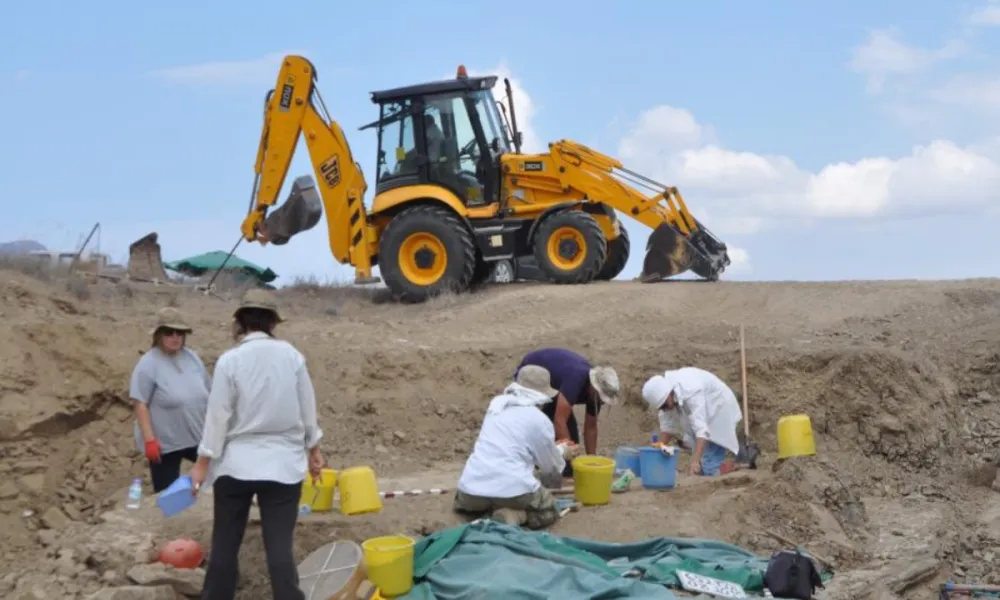

The remains of missing persons were discovered this week at three of eight sites currently being excavated by the Committee on Missing Persons in Cyprus (CMP).
Remains belonging to one person were found at Agios Georgios Spatharikou and another at Kalo Chorio Kythreas, while remains belonging to two people were discovered in Lapithos.
Greek Cypriot member of the CMP Leonidas Pantelides said during a meeting of the 100-member Advisory Body of the Pancyprian Organisation of Relatives of Missing Persons that excavations are currently taking place at Assia, Lapithos, Exo Metochi, Neo Chorio Kythreas, Livadia Famagusta, Gerolakkos, Agios Georgios Spatharikou and a military area in Karavas.
Excavations in military areas
Regarding excavations in military areas, Pantelides said that following pressure, restrictions concerning the 25-metre area had been relaxed.
The issue was also raised with the UN Secretary-General during his visit to Cyprus at the end of July.
Pantelides also clarified figures concerning the official list of 2,002 Greek Cypriot and Turkish Cypriot missing persons.
He said the figure for Greek Cypriots on the official list is not 1,619, but 126 names fewer, explaining that confusion frequently arises between the number of people whose remains have yet to be located and the number already identified.
To date, 1,082 people have been identified, comprising 765 Greek Cypriots and 317 Turkish Cypriots.
A further 745 Greek Cypriots and 175 Turkish Cypriots remain unaccounted for.
During 2026, 20 people have been identified, compared with 12 in 2025.
“There are still major cases involving mass graves that have not been located. We hope we are getting closer with every effort,” Pantelides said.
He added that access is being sought specifically to the 1974 Turkish military medical corps records, concerning the unit that carried out collective burials, rather than to the military’s operational records.
Missing persons remain a state priority
Presidential Commissioner Marios Hartsiotis said establishing the fate of missing persons remains a paramount humanitarian and national obligation for the state, “an obligation that does not expire with the passage of time”.
He said President Nikos Christodoulides’ policy is to continue and intensify efforts at local, European and international level.
According to Hartsiotis, the President systematically raises the issue with the European Union, United Nations and foreign leaders, seeking substantive cooperation from Turkey, the removal of obstacles to investigations and exhumations, and access to Turkish military information and archives.
Hartsiotis said his office has prioritised appropriate infrastructure, continuous and substantive information for relatives and concrete action in the field.
The Cabinet has approved a specific building for the creation of a permanent Anthropological Laboratory of the Republic of Cyprus.
Ossuary and relatives’ gathering space planned
Plans are also advancing for an ossuary for the dignified preservation of remains of identified and unidentified missing persons and fallen individuals, along with an area where relatives can visit and gather.
The plans include a small church and a suitable space where families can gather and pay tribute to their loved ones.
Work is also progressing on an official registry of the children of missing persons.
Regarding communication with relatives, Hartsiotis said he holds monthly meetings with the Pancyprian Organisation of Relatives of Undeclared Prisoners and Missing Persons and the Panhellenic Committee of Missing Persons.
Files concerning individual missing persons are also being made available to their relatives.
Assia among difficult cases
Hartsiotis said initiatives are being undertaken at local and European level concerning particularly difficult aspects of the missing persons issue, including the case of those missing from Assia.
The objective is to increase attention on such cases and pressure for substantive answers and progress.
He also announced that annual public presentations will be held outlining all actions taken to establish the fate of missing persons.
The first will cover the period from 1 January to 31 December 2026.
€1m for specialised genetic testing
Hartsiotis said the Cabinet approved €1 million last April to begin specialised genetic testing on remains of Greek nationals killed or missing since 1974.
The remains had previously been treated with chemicals, preventing identification through conventional techniques.
The process began in June 2026 through the Cyprus Institute of Neurology and Genetics, using Massively Parallel Sequencing.
The institute has also received the fifth phase of small skeletal samples belonging to Cypriots and Greek nationals from the Lakatamia Military Cemetery, with hopes that further identifications will be possible.
“We need information. We need access to archives and evidence. We need substantive cooperation from Turkey and the occupying power,” Hartsiotis said.
He added that every piece of information withheld could deprive a family of the answer it has been waiting for for 52 years.
Hartsiotis said his office remains open to any relative wishing to examine the file concerning a missing member of their family.
House committee calls for every scientific tool to be used
Nikos Kettiros, chairman of the House Committee on Refugees, Enclaved Persons, Missing Persons and Adversely Affected Persons, said establishing the fate of the last missing person is both an obligation of the state and a shared responsibility.
He said the committee closely monitors investigations and identifications and insists that every available scientific and technological capability be used.
Among its priorities are establishing the permanent anthropological laboratory, creating the registry of children of missing persons and supporting the parents and spouses of those killed or missing.
Kettiros stressed that the passage of time could not become an excuse for inaction and that every piece of information, testimony or archival material should be examined without delay.
He said the committee’s new membership would soon visit the CMP anthropological laboratory and also stressed the need to complete the registry of relatives of missing persons.
Relatives say issue cannot be compromised
Nikos Sergides, president of the Pancyprian Organisation of Relatives of Missing Persons, said findings from exhumations demonstrate what he described as Turkey’s treatment of prisoners.
He said the issue concerns human life and dignity and leaves no room for compromises or concessions.
“Yes, we failed to achieve a substantive and effective investigation as provided for by international law, but as an organisation we are entitled to be proud that through our position we have ensured that, 52 years later, the issue of Cyprus’ missing persons still exists and continues to concern the international community,” Sergides said.
Referring to the CMP, he said the organisation recognises both its work and the difficulties it faces, but disagrees with claims that it has performed miracles.
He expressed concern that overstating its achievements could undermine efforts to improve its work and provide excuses to those who refuse to cooperate genuinely.
Sergides also alleged that Turkey has sought over the past three years to close the missing persons issue, on the grounds that investigative possibilities have been exhausted.
He recalled the joint intervention by Cypriot and Greek organisations in Strasbourg during discussions at the Council of Europe Committee of Ministers concerning Turkey’s compliance with relevant judgments of the European Court of Human Rights.
He also referred to the demands of relatives concerning the families of missing persons.
Athens-Nicosia coordination ‘our strongest weapon’
Maria Kalbourtzi, president of the Panhellenic Committee of Parents and Relatives of Undeclared Prisoners and Missing Persons from the Cyprus tragedy, said joint efforts, meetings with the political leaderships of Cyprus and Greece and interventions at international forums demonstrate that coordination between Athens and Nicosia “is our strongest weapon”.
“We, the next generation, remain standing. We are not asking for revenge. We are asking for the obvious, the inalienable right of every human being: the truth,” she said.
Kalbourtzi called for the fate of every remaining missing person to be established and for them to receive the dignity and rest she said they had been denied for decades.
Proposal for UN-supervised humanitarian cooperation
Neoclis Neocleous, president of the Organisation of Relatives of Cypriot Missing Persons in the United Kingdom, proposed a system of “humanitarian cooperation” under UN supervision, operating through a secure mechanism and strict confidentiality protocol.
The proposal would allow Turkey to share information with the CMP concerning locations, maps and descriptions of terrain.
Under the proposal, no sensitive documents would leave Turkey, no responsibility would be attributed and no legal risk would arise.
Only coordinates and non-sensitive information about locations would be shared, while the United Nations would guarantee confidentiality.
The process would be handled by a team comprising CMP members, a UN official and a representative of the Turkish archives.
The arrangement could initially operate on a pilot basis and be renewed depending on its success.
‘Do not become tired or lose hope’
Charis Symeonides, president of the Committee of Relatives of Missing Persons from the 1963-1964 period, urged families not to become tired or lose hope.
He recalled the longstanding Greek Cypriot position that there can be no solution to the Cyprus issue without establishing the fate of the last missing person.
Symeonides also praised the President of the Republic for raising the missing persons issue as a confidence-building measure.
Source: CNA