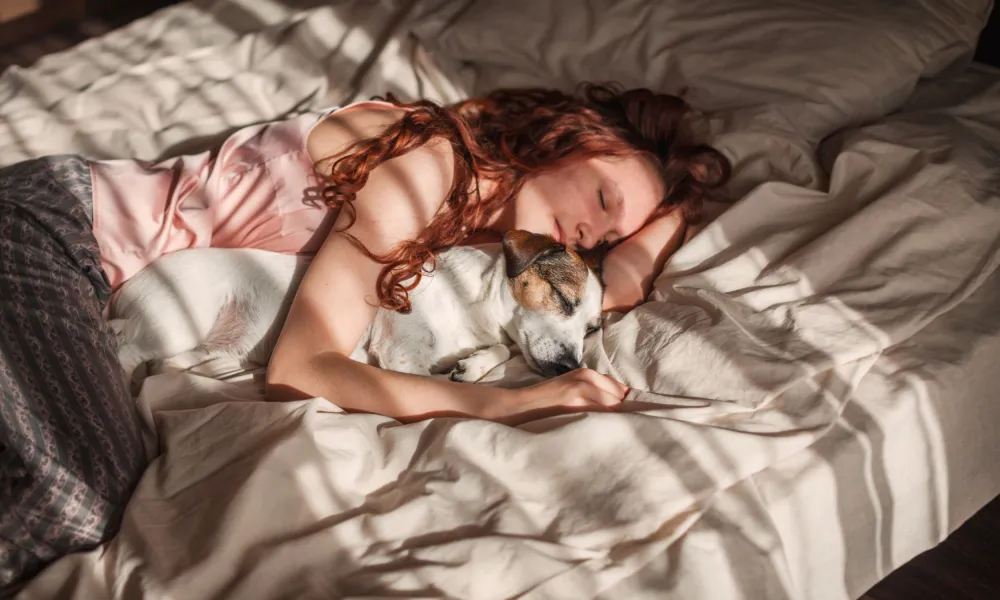

It starts innocently enough. The dog hops up “just for a minute” during a thunderstorm, or the cat claims the spare pillow one cold night, and before long the bed belongs to them. You are far from alone. In one recent survey-based study, about half of participants said they co-slept with their pets, defined as sharing a room with them for at least part of the night. The question is whether it is doing your sleep any favours.
What the research shows
The evidence points both ways. That same study found that people who co-slept with pets had poorer sleep quality and more insomnia symptoms than those who did not. The culprit seems to be the dog, with the researchers finding evidence of a negative effect on sleep for people sharing a room with dogs, but none for cats. Strikingly, 93% of those who co-slept with pets believed their animals had a positive or neutral effect on their sleep. The researchers suggest pets can be a source of nighttime noise, heat or movement that makes it harder to fall or stay asleep.
Not every study agrees. Researchers at the Mayo Clinic in Phoenix monitored 40 adult dogs sleeping in their owners’ bedrooms and found both humans and dogs slept satisfactorily, with people sleeping slightly better when the dog was off the bed. A survey of women published in the journal Anthrozoös went further, with its lead author saying dogs commonly rate as better bed partners than cats. Cats have their own reputation, and one researcher suspects they may be more disruptive because they tend to be more active at night.
The catch with the numbers
Most of this research is based on surveys, which cannot prove that pets cause bad sleep. The authors of the Scientific Reports study acknowledge this, while noting some evidence that it could be the case. Another factor is who else is in the bed. That study did not assess whether participants were also sharing their bed with a partner or child, and anyone who has slept beside a restless spouse knows humans can be just as disruptive.
How to make it work
If you decide the cuddles are worth it, a few habits help. Experts recommend a mattress large enough for you and your pets, washing your bedding regularly and keeping a consistent bedtime routine. Small dogs and cats that burrow under the covers can also raise your body temperature, which can disrupt your sleep, and one sleep specialist suggests trying it for just a couple of nights before committing, so your pet does not come to expect it. If you would rather reclaim the bed, training is the answer. Rewarding a dog with treats or a clicker every time it goes to its own bed should work within a couple of nights, as long as you stay consistent.
Some animals are better left out altogether. Very young or very old dogs that do not sleep through the night, sick pets and reactive animals that may lash out when startled awake are best kept in their own beds, and many exotic pets have specific health and safety needs that require them to stay in an enclosure. And if you are sleeping badly, the simplest experiment is to close the bedroom door for a week and see what changes. As one researcher put it, separating your pet from your bed is worth trying if you are having trouble sleeping.
Source: The Conversation via Live Science and The New Daily