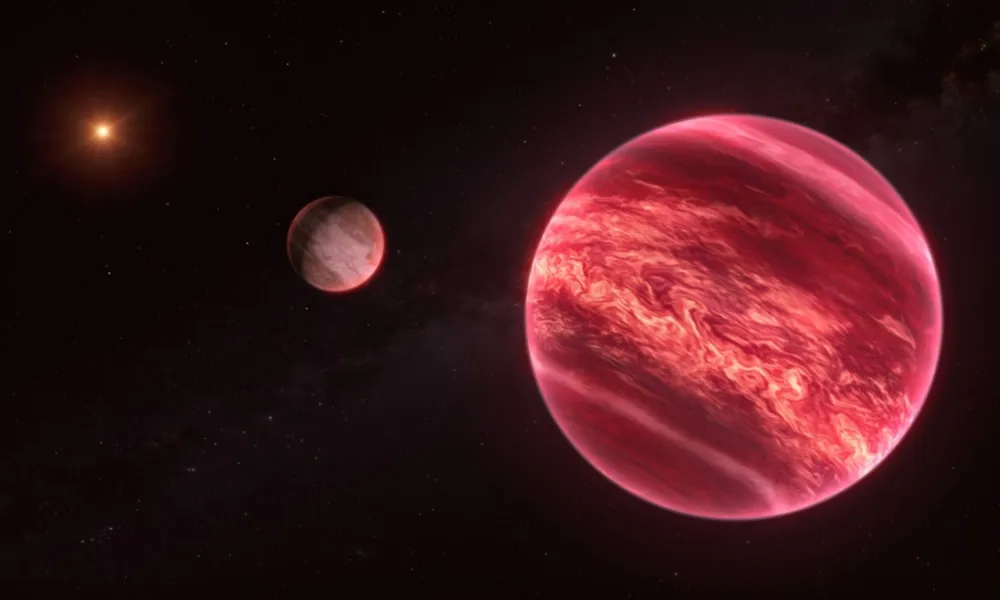

Astronomers may have detected the first known moon beyond our Solar System. Unlike the moons we know, the object does not orbit a planet. Instead, it circles a brown dwarf, an object that lies between a planet and a star.
The system, called CD-35 2722, consists of a star roughly half the Sun's mass, a brown dwarf more than 30 times the mass of Jupiter, and a newly identified companion at least as massive as Jupiter.
Scientists describe the object as an exosatellite, or moon outside the Solar System, although its size blurs the distinction between a moon and a planet.
"This system is somewhat hard to define using Solar-System-based words like 'planet' and 'moon'," said lead author Kevin Hoy, a student at the European Southern Observatory (ESO).
Brown dwarfs already occupy a grey area in astronomy, forming like stars but lacking the mass needed to sustain nuclear fusion.
The discovery was made using the CRIRES+ instrument on ESO's Very Large Telescope. Rather than observing the object directly, researchers detected its presence through subtle gravitational effects on the brown dwarf.
"This system is truly unique and represents a breakthrough: the first plausible detection of an exosatellite," said Alice Zurlo, director of the Millennium Nucleus of Young Exoplanets and their Moons (YEMS).
Astronomers have discovered more than 6,000 exoplanets, but confirming moons beyond the Solar System has proved far more difficult. If verified, the finding could open the door to the discovery of many more moon-like worlds with future observatories, including ESO's Extremely Large Telescope.
The study was published in Nature.
Source: Earth.com