
Cyprus's three main teachers' unions have warned that public schools risk being left without adequate staff from September 2027, escalating their dispute with the Ministry of Education over the new Teacher Appointment System. POED, OELMEK and OLTEK made the warning at a joint press conference on Monday, only hours after Minister of Education, Sport and Youth Athena Michaelidou issued a firm statement defending the reform.
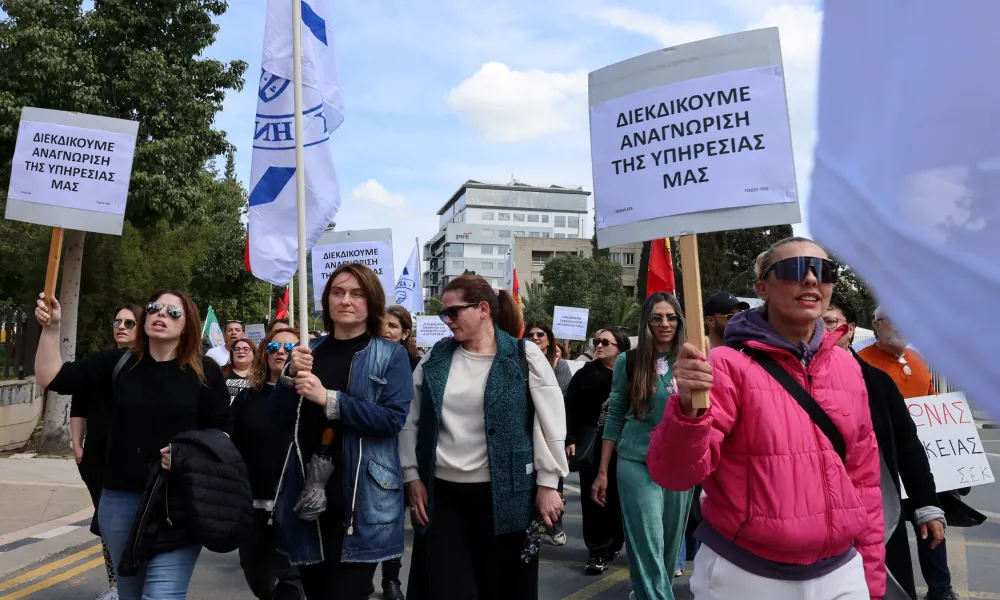
The unions confirmed that their protest outside the Presidential Palace on 8 October will go ahead as planned, calling on teachers and the wider public to attend in large numbers.
Minister's position ahead of revised proposal
The unions' intervention came on the same day Ms Michaelidou stated that industrial action should not come before the evaluation of the updated proposal, which will be delivered to the organisations on Tuesday.
The minister said dialogue cannot function as "an alibi for stagnation or backsliding", adding that a number of the unions' demands have already been taken into account.
Staffing concerns after the transitional period
The unions' central concern relates to how schools will be staffed once the transitional period of the current system ends.
POED, OELMEK and OLTEK question which teachers will cover needs from September 2027, arguing that these are several times greater than the number of people currently on the list of appointable candidates in fields such as primary education, Greek philology and mathematics.
The organisations spoke of "a visible risk" that some schools will be left without sufficient teaching staff, describing as dangerous any move to introduce changes before ensuring the system can meet the actual needs of public education.
They also pointed to the Optional All-Day Primary Schools, noting that for the past three years these have been staffed exclusively from the list of appointees. They further noted that part-time contract staff, who cover a significant share of needs, do not appear in the working document submitted last July.
Opposition to the closed register
The unions stated that they firmly oppose the creation of the so-called "closed register".
According to the organisations, a register offering only temporary appointments, with no prospect of permanent posts, cannot be accepted, as it risks creating a category of teachers who remain in prolonged employment insecurity.
The unions also stated that any attempt to correct distortions in the appointability examinations must not come at the expense of those who have sat the exams up to and including 2025. They argue that placing teachers examined under the current system on the same list as those examined under a new model with a different philosophy raises issues of equal treatment.
Delays since the 2015 legislation
The three unions attributed political responsibility for the fact that the issue remains unresolved almost a decade after the relevant legislation was passed.
They stated that it had been known since 2015 that the transitional period had an expiry date, and that problems and distortions had already become apparent in the meantime without, as they put it, comprehensive planning being put in place in time.
The organisations also referred to the opinion of the Law Office of the Republic. They recalled that in September 2024 the Ministry had announced it was awaiting answers to a series of questions, noting that two years later the exact content of the response has not been made public.
Next steps in the process
Ms Michaelidou has already made clear that the government does not intend to abandon the reform. In a written statement released on Monday morning, she said the current framework had been described as outdated as early as 2015, and that the new model must recognise experience while also giving younger teachers real opportunities to enter public education.
On Tuesday, 6 October, the Ministry will present the updated proposal to the unions. Their positions will then be requested again in writing, and the Ministry has stated it is ready to discuss final arrangements should disagreements remain. The finalised proposal will undergo legal vetting by the Law Office of the Republic, go before the Council of Ministers and then be submitted to the House of Representatives.
Despite the minister's message that industrial action is preceding the evaluation of a proposal not yet presented, the three unions did not soften their stance on Monday. They repeated their call for Thursday's protest, stating that while confrontation is not, in their words, an end in itself, any arrangement they consider unfair to teachers will meet with their reaction.