
No one can know today whether Annita Demetriou would make a good President of the Republic. Usually, that becomes clear only after someone takes office, by which point it is rather late to ask for a refund.
What we can know are certain things already recorded in the political history books.
Demetriou was elected an MP in 2016. She was re-elected in 2021 and again in 2026. She became Speaker of the House in 2021 and was re-elected in 2026. In between, she was elected president of DISY in 2023 with 69.18% of the vote.
Whatever anyone thinks of her abilities, she seems to have one irritating habit: whenever she stands for election, she wins.
Foullis
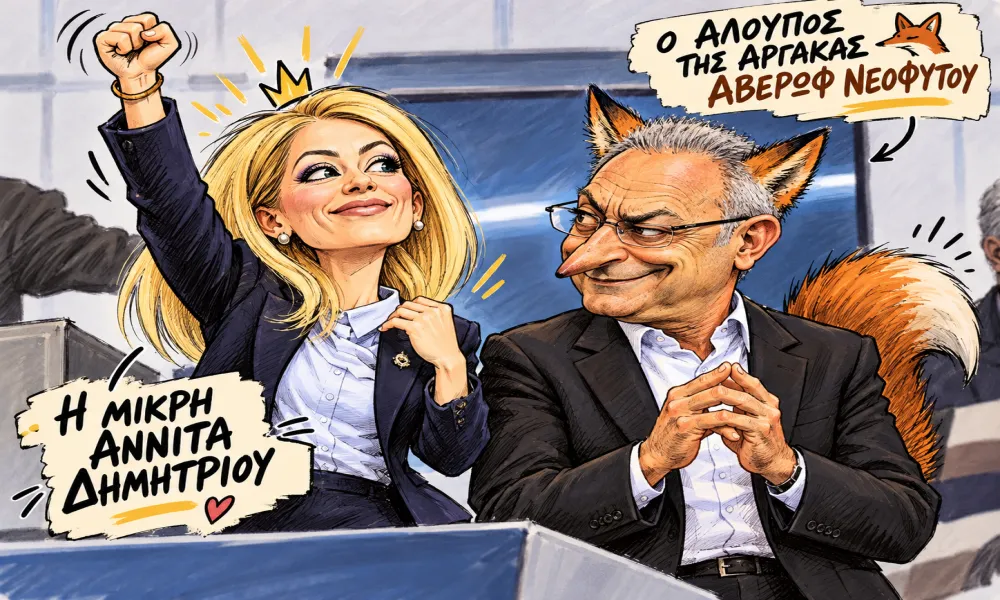
At this point enters Averof Neophytou, challenging that narrative.
In recent days, the mere mention of Annita's name appears enough to provoke a reaction. The article jokingly imagines him standing outside his large house in Argaka, hurling stones into the sea in frustration.
From Neophytou's perspective, the complaint is simple: how can a politician whom he considers to have supported throughout her rise now challenge him?
According to this view:
- Annita became an MP because of Averof.
- Annita became Speaker because of Averof.
- Annita became DISY leader because of Averof.
- DISY achieved 27.1% in the 2026 parliamentary elections because of Averof.
- Annita was re-elected Speaker because of Averof.
Taken to its logical conclusion, the article jokes that readers may soon be told Averof helped her choose her university studies and even arranged her marriage.
The inconvenient truth
The author argues that Neophytou's version leaves out important details.
When Demetriou was first elected in 2016, Averof had reportedly preferred another candidate, Yiannakis Yiannaki, for the position.
At the time, according to the article, DISY spokesman Prodromos Prodromou had argued that "politics is not a catwalk".
Demetriou nevertheless went on to become one of the strongest political figures in Larnaca.
Regarding the 2021 House presidency, the article claims Neophytou initially pursued other options before Demetriou eventually emerged as the successful candidate.
The same interpretation is applied to the 2023 DISY leadership race.
Following his defeat in the presidential election, Neophytou resigned as party leader and sought a route back to legitimacy through an internal election.
According to the author, it was Neophytou who encouraged Demetriou to enter the contest because of her popularity.
She won decisively, but the article argues that Neophytou appeared to regard that victory as partly his own, expecting continued loyalty in return.
Who owes whom?
According to the article, that expectation lies at the centre of the current dispute.
As DISY leader, Demetriou kept the party in opposition after the 2023 presidential election rather than accepting participation in government.
The author suggests this decision effectively sidelined Neophytou and prevented him from retaining influence through government appointments.
The result is what the article portrays as a long-running argument over political credit:
- Who helped whom?
- Who owes whom?
- Who saved whom?
- And, most importantly, when does the debt expire?
The latest chapter
The latest confrontation emerged following Demetriou's re-election as Speaker of the House.
Neophytou publicly claimed that a close associate of Demetriou had sought his assistance for her re-election and linked that support to the 2028 presidential race.
Demetriou's camp and the DISY leadership rejected suggestions that any such arrangement existed.
DISY deputy president Onoufrios Koullas acknowledged Neophytou's contribution but stressed that the party's 2028 presidential candidate would be chosen by party members through the established process.
Democracy
The article ultimately arrives at a simple conclusion.
Neophytou wants to run for president again. That is his right.
Demetriou also wants to seek the nomination. That is her right.
DISY has rules, procedures and members. The party, the author notes, presumably has rights as well.
There is a certain irony in the situation.
Neophytou spent years rising to and retaining the party leadership without serious opposition. Demetriou, by contrast, won the presidency of DISY through a contested election.
Now, the politician accustomed to reaching the top unchallenged finds himself facing a party leader effectively saying:
There is a process. There are candidates. There are party members.
Set up the ballot box and let them decide.
The author concludes that Neophytou has every right to seek DISY's presidential nomination for 2028, but should do so through the party's democratic procedures and without pushing the party towards division.