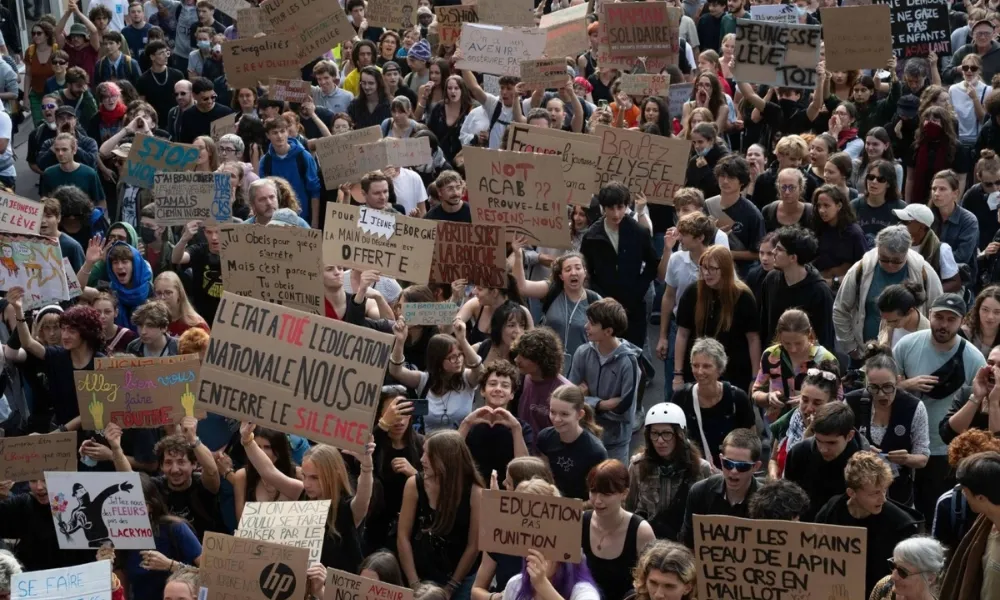

A Reuters investigation has documented 28 cases of injuries from police violence against students during the recent protests in France, raising serious questions about the use of “less-lethal” weapons by the country’s police forces. Fifteen of the cases are among those being investigated by the General Inspectorate of the National Police (IGPN). Among the injured are minors who have lost their sight or suffered damage to it, and a 15-year-old who lost his hand, probably as a result of a stun grenade.
The developments have revived calls from human rights organisations and politicians for a ban on plastic bullets and other dangerous crowd control weapons.
The case of a 14-year-old in Saint-Ouen-l’Aumône
One of the cases at the centre of public debate is that of Eden, a 14-year-old who suffered a fractured jaw and multiple broken teeth after being hit in the face at close range by a tear gas grenade.
According to Eden’s family and their lawyer, Elsa Marcel, the 14-year-old was sitting on a wall looking at his phone, a few metres from a demonstration in Saint-Ouen-l’Aumône, when a police officer approached him.
The lawyer said the officer struck him with a baton, and the teenager reacted by kicking him. According to the prosecutor’s office, a second officer then fired a tear gas grenade at him from a Cougar-type launcher, which hit him in the face.
“He shot him in the mouth and left him lying on the ground, without even calling the emergency services,” Marcel said.
The family has filed a complaint for attempted homicide and asked that the teenager’s surname not be disclosed to protect his privacy.
Vitres et matériel informatique cassés ou volés, pièce incendiée : les images des dégâts dans un lycée de Lormont Un établissement proche de Bordeaux a été en partie «saccagé», jeudi 8 octobre, lors d'une intrusion jeudi en marge de la mobilisation lycéenne, provoquant plusieurs centaines de milliers d'euros de dégâts, avant que des violences interviennent en centre-ville après la manifestation.
— Le Figaro (@Le_Figaro) October 9, 2026
Formal investigation into the officer
On Tuesday, eight days after the incident, the officer was placed under formal judicial investigation for assault by a public official resulting in permanent disability or disfigurement.
The police declined to comment, citing the ongoing investigation. In a statement, the prosecutor’s office said the student had confronted the officers and that they had tried to push him back.
Eye injury in Argenteuil
A similar case concerns a 16-year-old in Argenteuil, a suburb of Paris. He was injured in the left eye by police fire while returning home after finding that his school was closed.
His lawyer, Sofia Kerba, told Reuters it was unclear whether he had been hit by a plastic bullet or another object. She said there is a risk of permanent damage to his sight.
Le mouvement des lycéens approuvé par 54 % des Français, selon un sondage ➡️ https://t.co/VEh8bPz3d3 https://t.co/xN6an7W3Nc
— Le Parisien (@le_Parisien) October 10, 2026
Video examined by Reuters shows the student bleeding from the eye. According to the police account, cited by the prosecutor investigating the case, the injured teenager “appeared to match” one of two young people who had fired fireworks at officers, who responded with plastic bullets.
28 cases documented
The Reuters investigation was based on interviews and a review of legal documents. It recorded 28 cases of injuries from police violence involving plastic bullets, stun grenades, tear gas, batons and charges by mounted police.
In two cases, people lost their sight or suffered eye injuries from plastic bullets.
In another case, a 15-year-old in Lens lost his hand, probably as a result of a stun grenade, according to Interior Minister Laurent Nuñez. Following the incident, the minister suspended the use of those grenades pending the outcome of the investigation.
Interior minister’s figures
In a radio interview on Wednesday, Nuñez said that around 200 students have been injured. He maintained, however, that their injuries were rarely caused by police action.
“Our primary role is, of course, to protect high school students,” he said.
The authorities say the violence has not been limited to police operations. According to official figures, 700 police officers have also been injured, schools have been set on fire or looted, and teachers and members of the public have been attacked. Arrests stand at 6,877, most of them minors.
France an exception in Europe, researcher says
Sebastian Roché, a policing specialist at the French National Centre for Scientific Research (CNRS), described France as an exception in Europe in its use of such weapons and the number of people injured.
“We have four irreversible injuries in 12 days, and those injured are minors,” he said. He added that the level of violence was unprecedented in modern French history.
Roché said the use of plastic bullets and stun grenades to police public gatherings is particularly widespread in France compared with other European countries. He noted that such weapons are generally not used for public order policing in Britain, Italy and Germany, with the exception of Hamburg, while in Spain they have caused fewer injuries.
Political tensions ahead of 2027
The police response to the protests has fuelled public anger. It has also strengthened support for a protest movement that reflects deeper discontent with the government of President Emmanuel Macron ahead of the 2027 elections.
Prime Minister Sébastien Lecornu has described the protests, which are linked to conditions in schools and have lasted more than two weeks, as the most violent in decades.
Calls for a ban and police response
Amnesty International, other human rights organisations and politicians have called for a permanent ban on “less-lethal” weapons, pointing to the risks they pose to the physical safety of protesters.
The Mayor of Saint-Denis, Bally Bagayoko of the left-wing party La France Insoumise, joined the protests in his city. He said his aim was to protect young people from police violence.
“We must withdraw the use of plastic bullets and aim for zero injuries among students. That will allow us to de-escalate tensions,” he said.
Thierry Clair, a police union representative, took the opposite view. He described serious injuries, such as those suffered by Eden and the 15-year-old who lost his hand, as tragedies, but said they did not justify calling police practices into question.
In his view, the problem stems mainly from the intensity of the violence used by some young protesters and the escalation of clashes.
“How do we respond when people move towards confrontation? If we abolish intermediate means of force, all we will have left is lethal force. That is simply unthinkable,” he said.
With information from Reuters and ERT