

Cyprus has more game companies, more games revenue and more mobile game installs per person than any other country in the world, according to the first national measurement of the island's game development industry. The Cyprus Video Game Industry Report 2025 was published on 17 August 2026 by CYGMA, the Cyprus Game Makers Association. It puts the sector's contribution to the Cypriot economy at €1.15 billion in 2024, or 3.3% of GDP. The same report identifies a growing gap between what studios need and what the local education system currently produces.
The first national measurement of the sector
The 72-page report is the first edition of what CYGMA plans to publish annually. It covers the market, companies, capital, economics, talent and community of the Cypriot game development sector.
The association built its company count bottom-up. It identified companies from distribution platforms and cross-validated them against the Cyprus Registrar of Companies. Market data comes from AppMagic, Sensor Tower, Ampere Analytics and BCG, investment data from InvestGame, and economic data from CYSTAT and Eurostat. The methodology was independently reviewed by Alinea Analytics.
The figures cover game development only. According to the report, no iGaming company appears in any figure.
CYGMA is a non-profit industry association representing game creators in Cyprus. It was founded in December 2025 by six companies and now has more than 30 members. Its General Manager, Andrey Ivashentsev, joined in January 2026.
A global market worth $263.7 billion
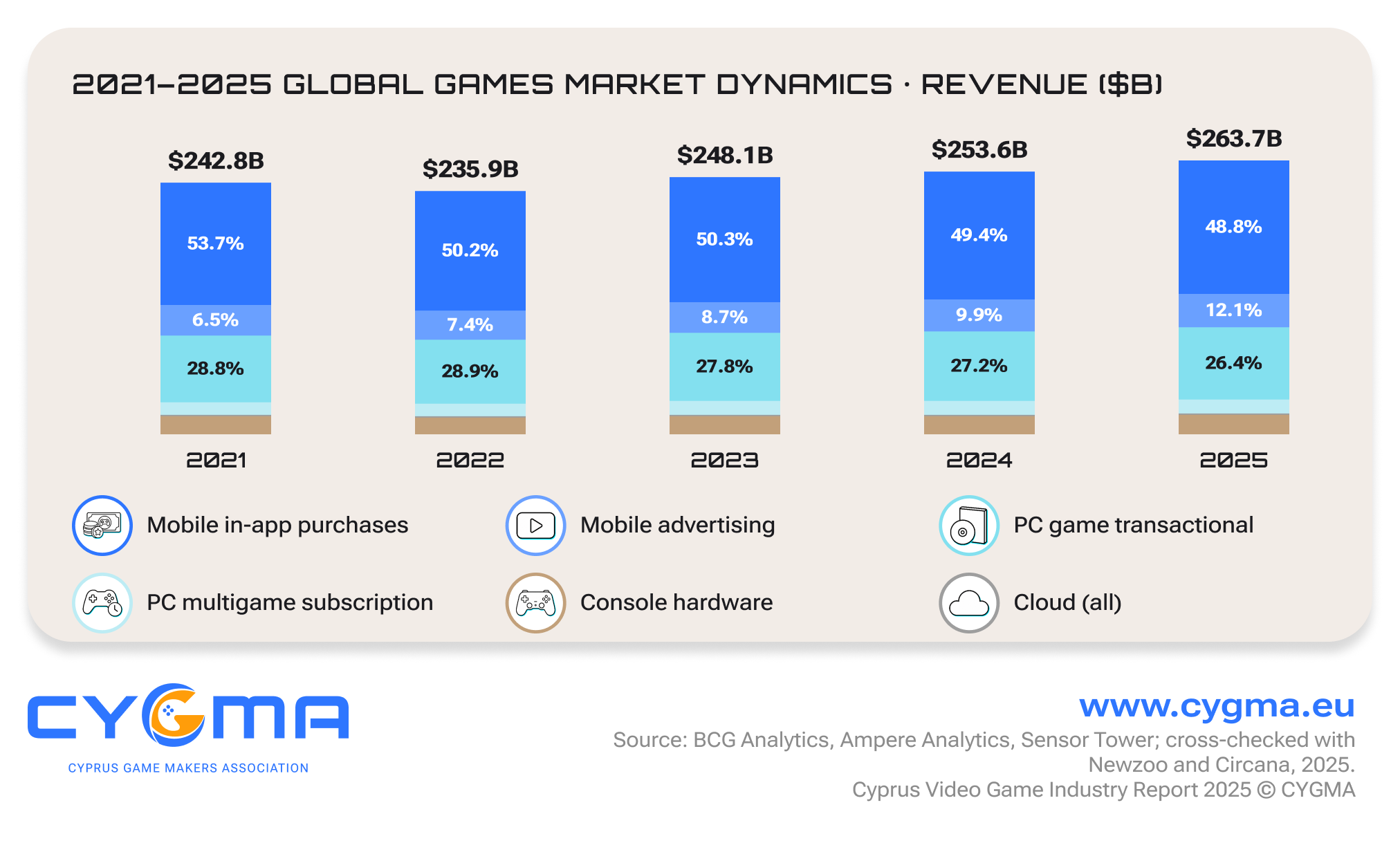
The report places Cyprus within a global games market worth $263.7 billion in 2025, up 4.0% year on year. The market stood at $242.8 billion in 2021, fell to $235.9 billion in 2022, and then rose to $248.1 billion in 2023 and $253.6 billion in 2024.
[2021–2025 global games market dynamics, revenue ($B)]
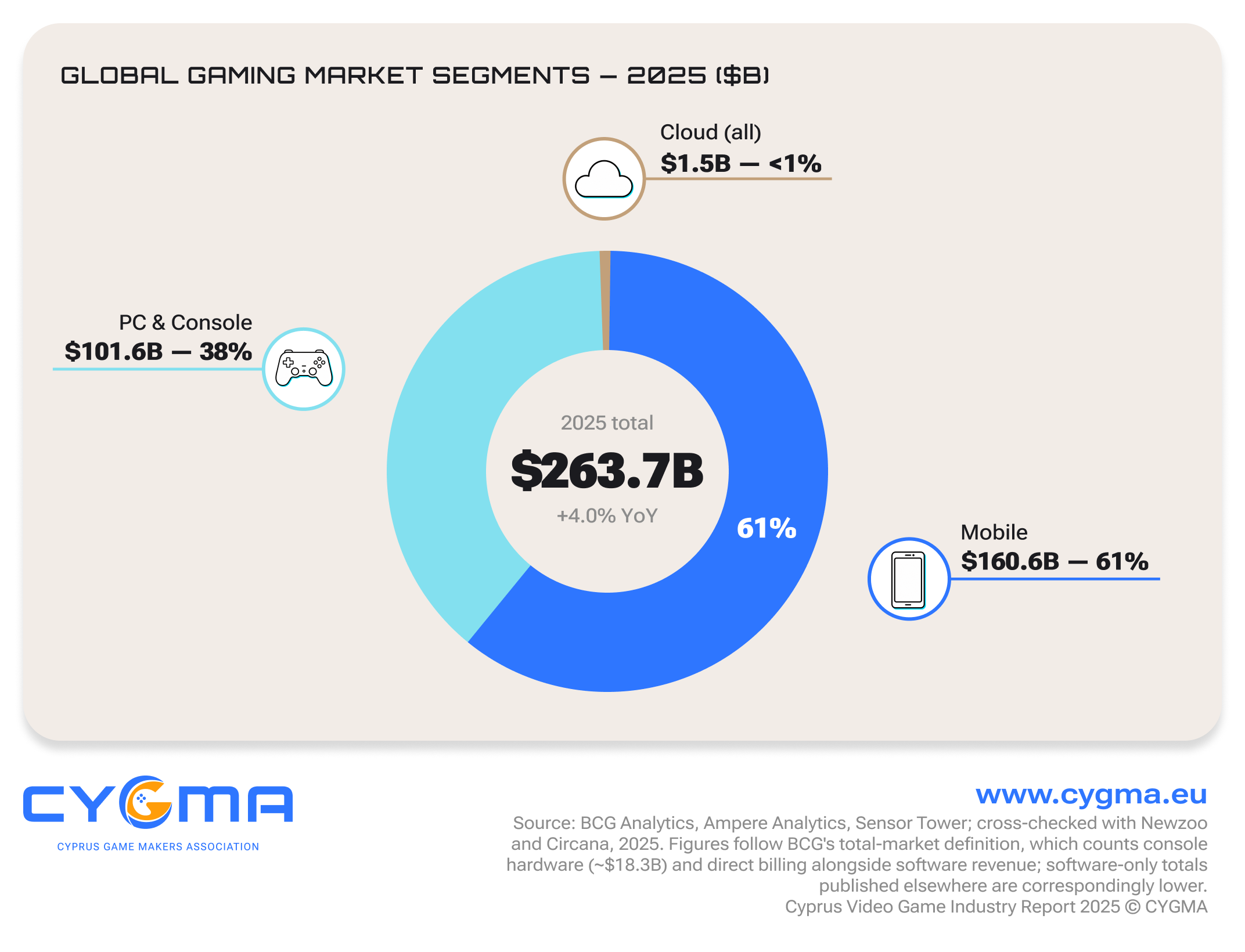
Mobile accounts for $160.6 billion, or 61% of the total. PC and console account for $101.6 billion, or 38%, and cloud gaming for $1.5 billion, less than 1%. These figures follow BCG's total-market definition, which counts console hardware (about $18.3 billion) and direct billing alongside software revenue. Software-only totals published elsewhere are correspondingly lower.
[Global gaming market segments 2025 ($B)]
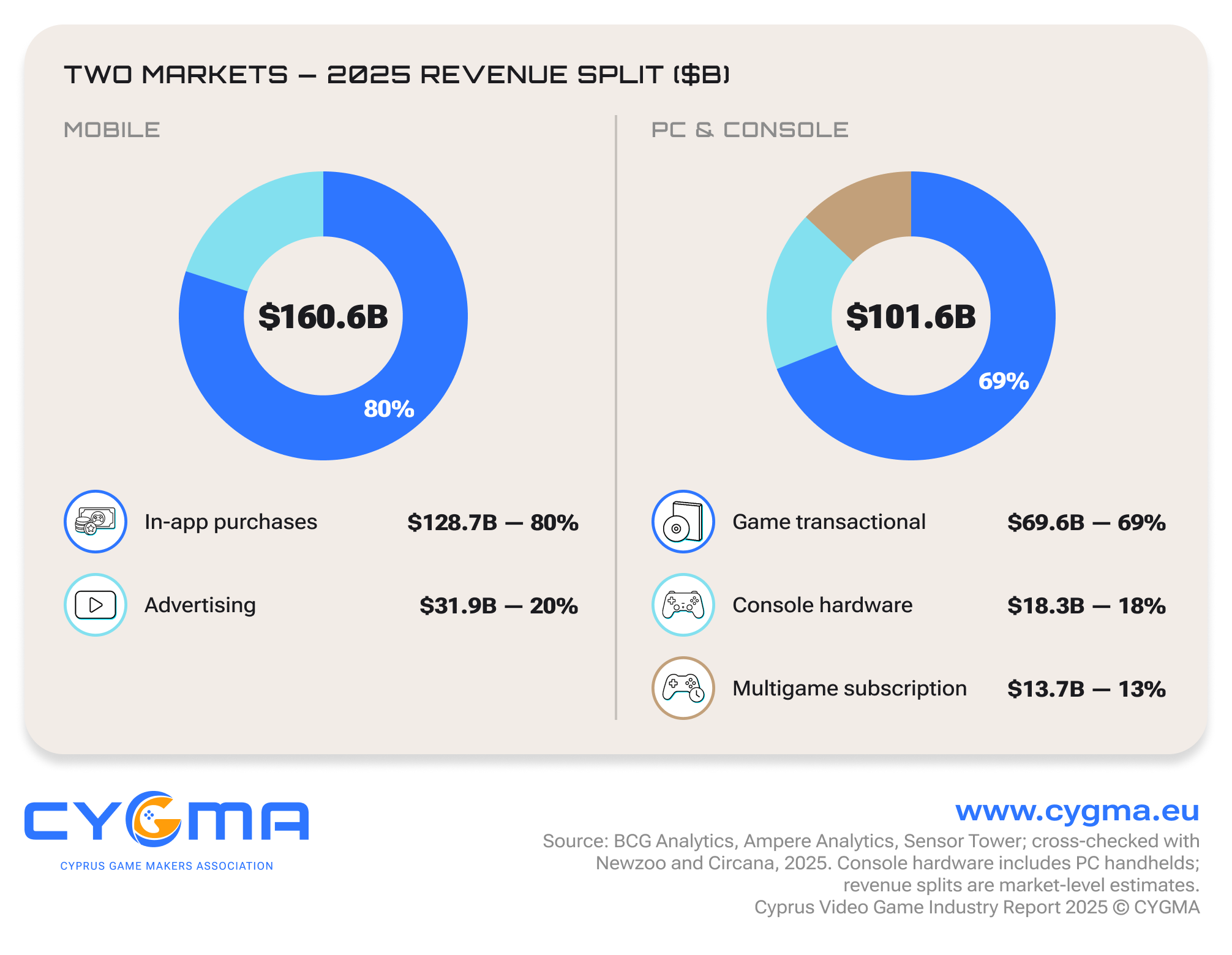
Within mobile, in-app purchases generated $128.7 billion (80%) and advertising $31.9 billion (20%). Between 2021 and 2025, the share of mobile in-app purchases in the total market fell from 53.7% to 48.8%, while mobile advertising rose from 6.5% to 12.1%.
Within PC and console, game transactional revenue was $69.6 billion (69%), console hardware $18.3 billion (18%)and multigame subscriptions $13.7 billion (13%).
[Two markets, 2025 revenue split ($B)]
Companies, jobs and turnover since 2019
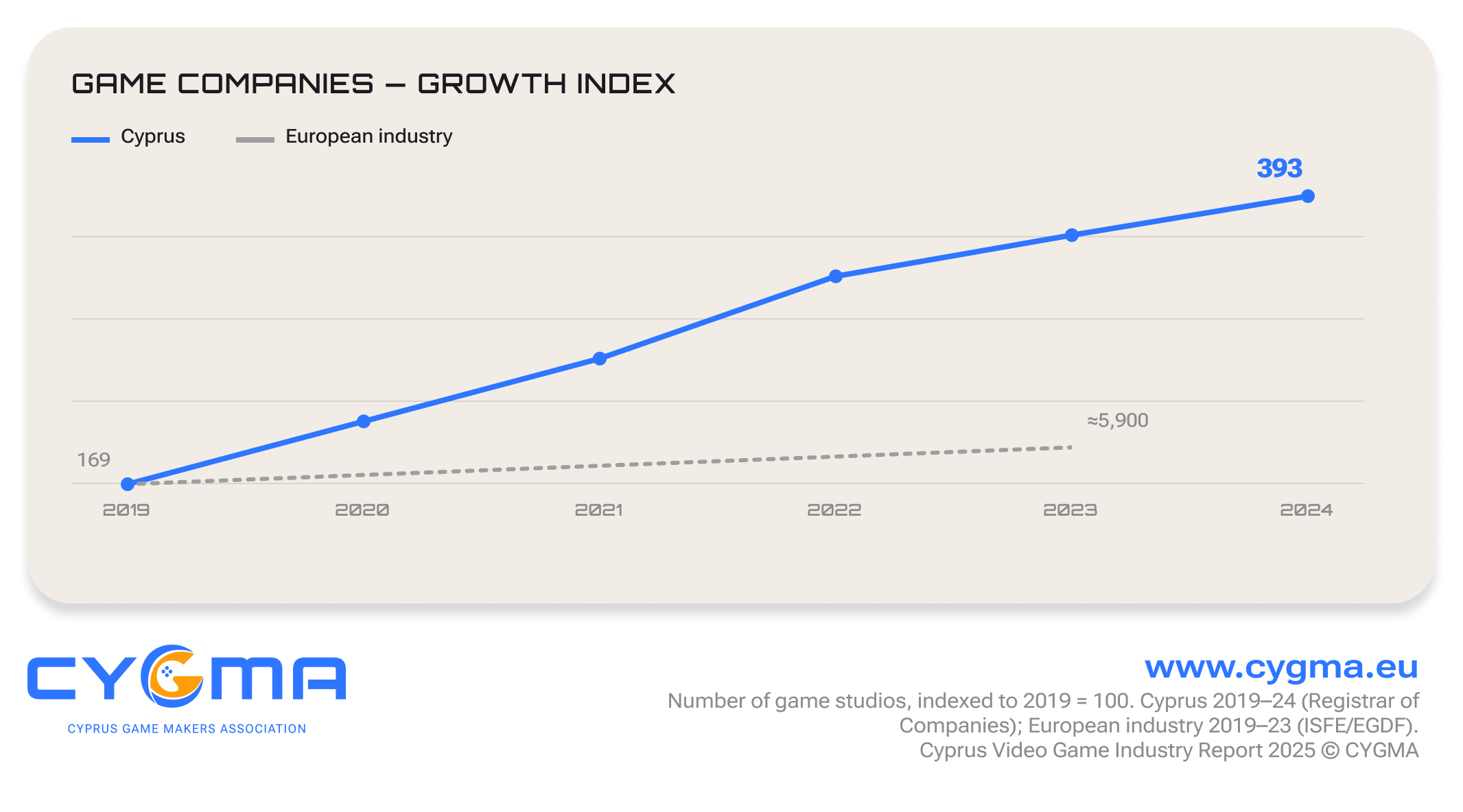
The number of game companies in Cyprus rose from 169 in 2019 to 393 in 2024, an increase of 133%. Year by year, the count went from 169 to 218, 267, 332, 363 and then 393.
Over the same period, employment in game publishing rose from 1,438 to 4,320, an increase of 200%. The report notes that this figure represents people employed and paying taxes in Cyprus.
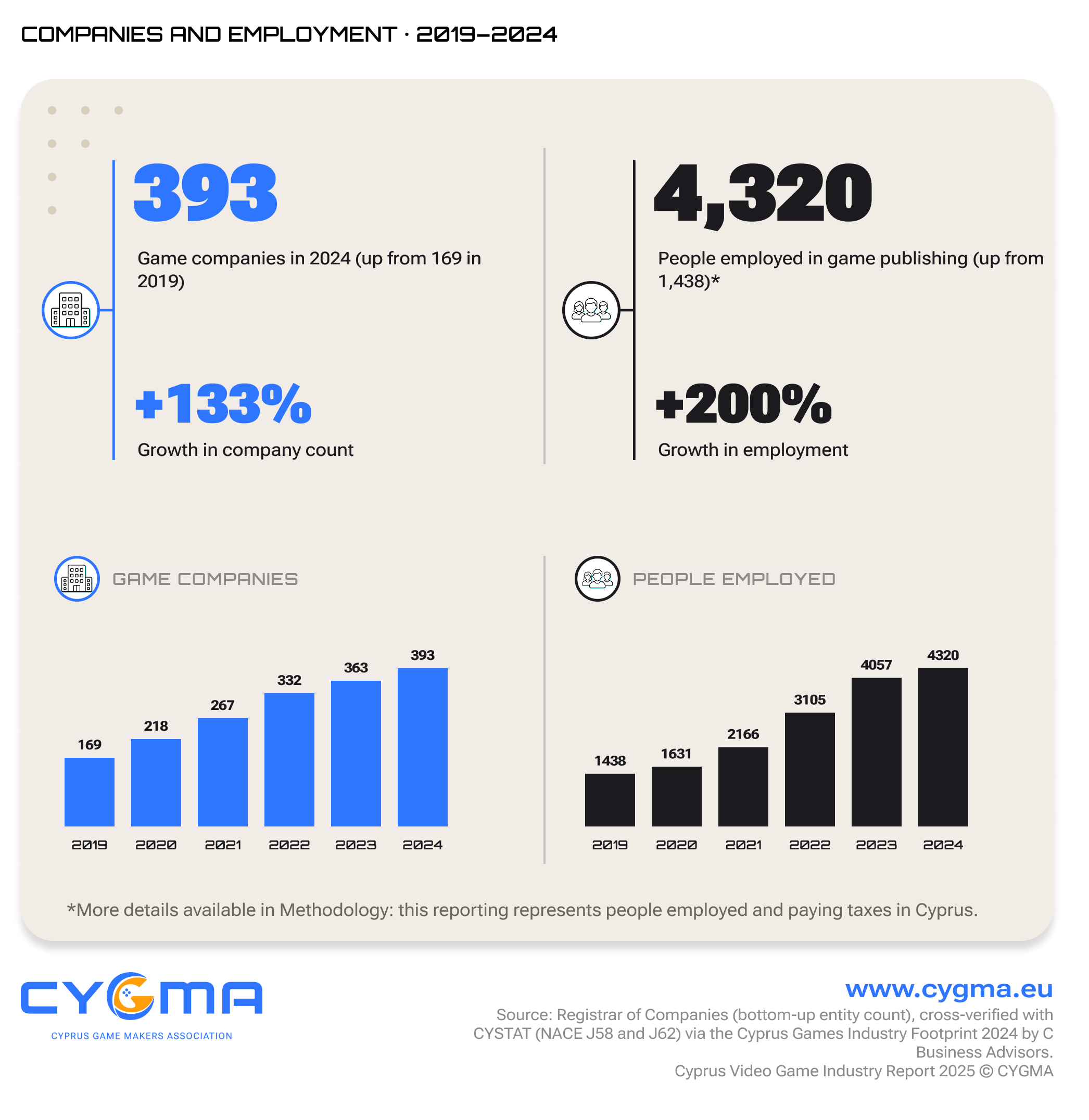
[Companies and employment 2019–2024]
Games and publishing turnover reached €4.35 billion in 2024, up from €1.26 billion in 2019, an increase of 245%. The sector's contribution to GDP reached €1.15 billion in 2024, up from around €300 million in 2019. Its share of the national economy rose steadily from 1.3% in 2019 to 1.7% in 2020, 2.5% in both 2021 and 2022, 3.0% in 2023 and 3.3%in 2024.
The employment, company and GDP figures come from CYSTAT (NACE codes J58 and J62) and Eurostat. They were compiled through the Cyprus Games Industry Footprint 2024 by C Business Advisors with Chrysostomides Advocates and Legal Consultants.
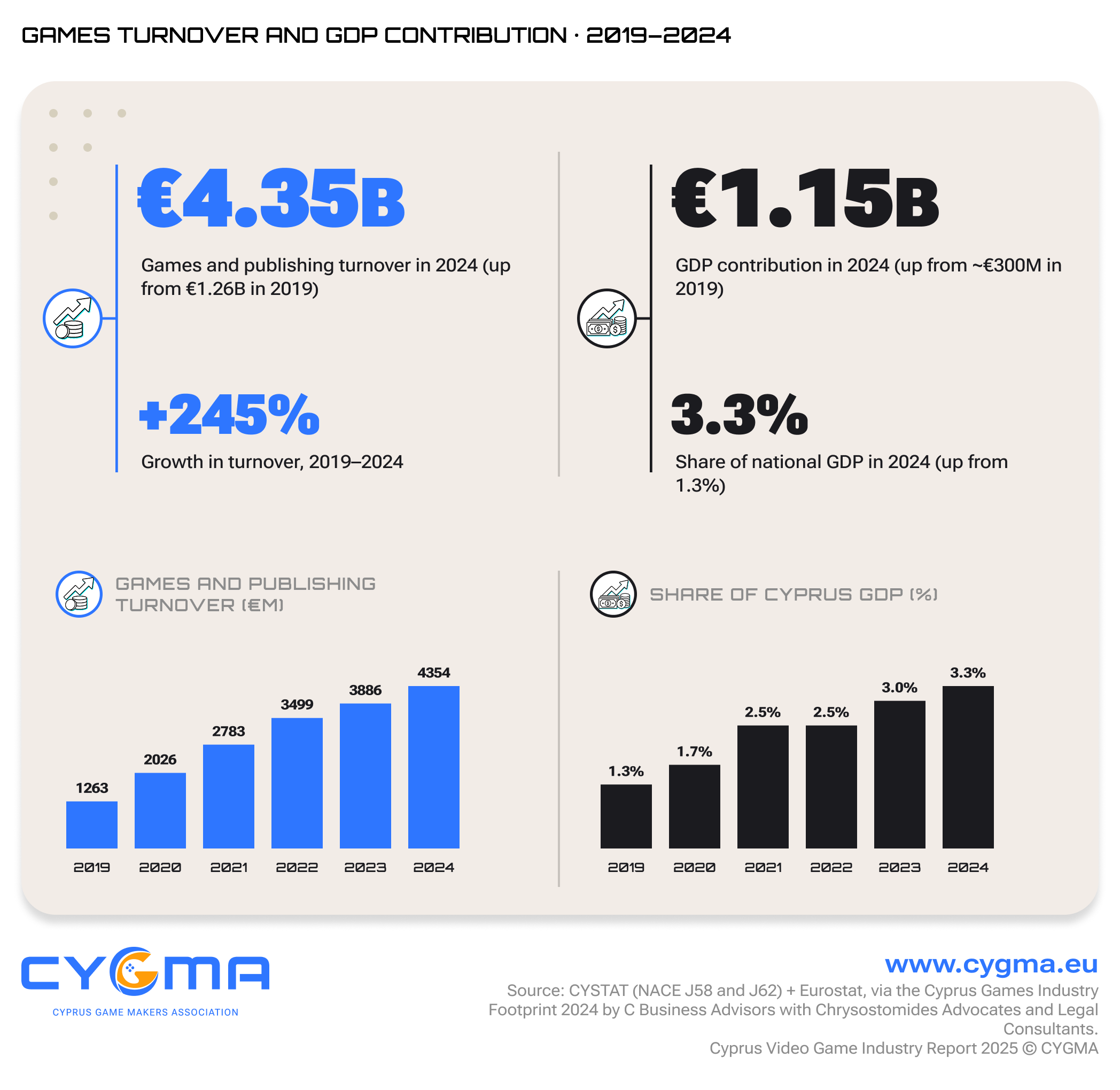
[Games turnover and GDP contribution 2019–2024]
First in the world per capita
According to the report, Cyprus ranks first in the world per capita on three separate measures: game companies, games revenue and mobile game downloads.
The island has 415 game companies and generated more than €3.2 billion in games industry revenue in 2025. Of that, €1.8 billion came from mobile and €1.4 billion from PC and console.
[Cyprus at a glance 2025]
The report compares Cyprus with three European peers. Cyprus has 415 game companies per million people, against 48 in Finland, 17 in Spain and 15 in Serbia. Games revenue per capita stands at €3,200 in Cyprus, against €509 in Finland, €51 in Spain and €32 in Serbia.
The report adds that the gap also holds against major global gaming markets, whose per capita figures are lower still. The comparison figures are drawn from Neogames (Finland), DEV (Spain) and SGA (Serbia), with Eurostat population data.
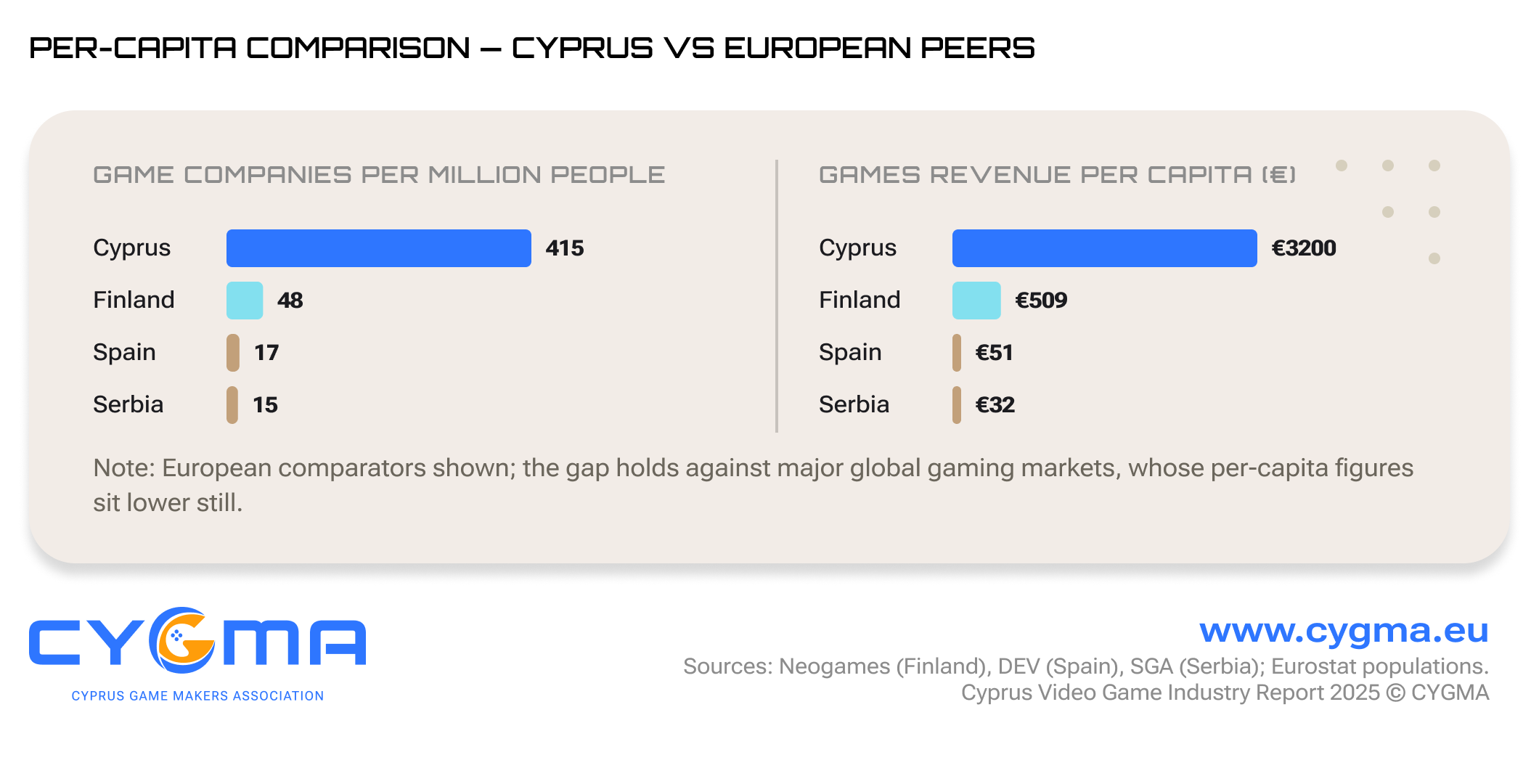
[Per capita comparison, Cyprus vs European peers]
Mobile: high volume, modest monetisation
Mobile is the backbone of the Cypriot industry. In 2025, studios on the island released 571 new mobile titles, which generated 615 million downloads. Total mobile industry revenue, including in-app purchases, in-app advertising and direct-to-consumer sales, reached about €1.8 billion.
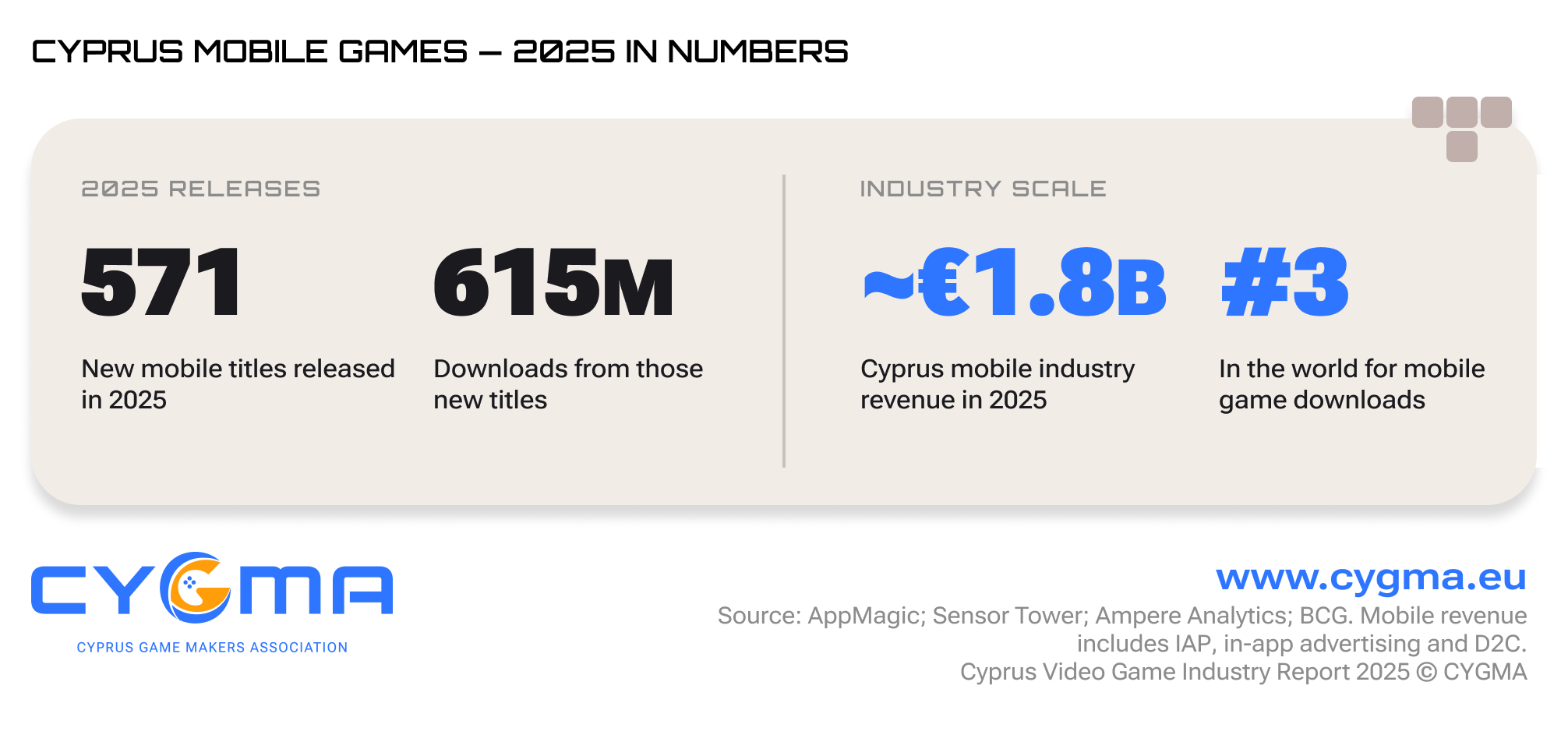
[Cyprus mobile games, 2025 in numbers]
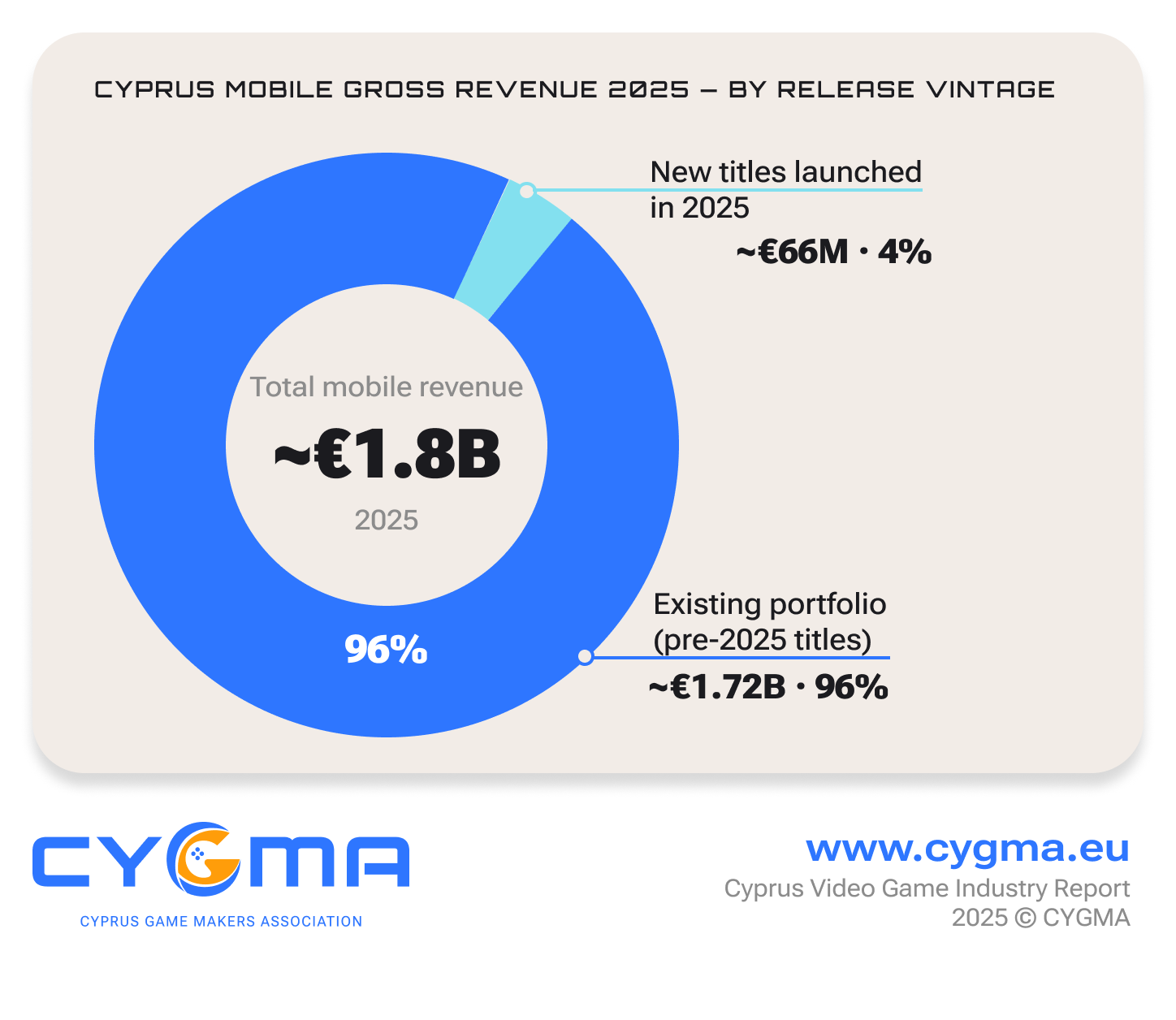
Most of that revenue comes from existing games. Titles launched before 2025 generated about €1.72 billion, or 96% of mobile revenue. New titles launched during 2025 contributed about €66 million, or 4%.
[Cyprus mobile gross revenue 2025 by release vintage]
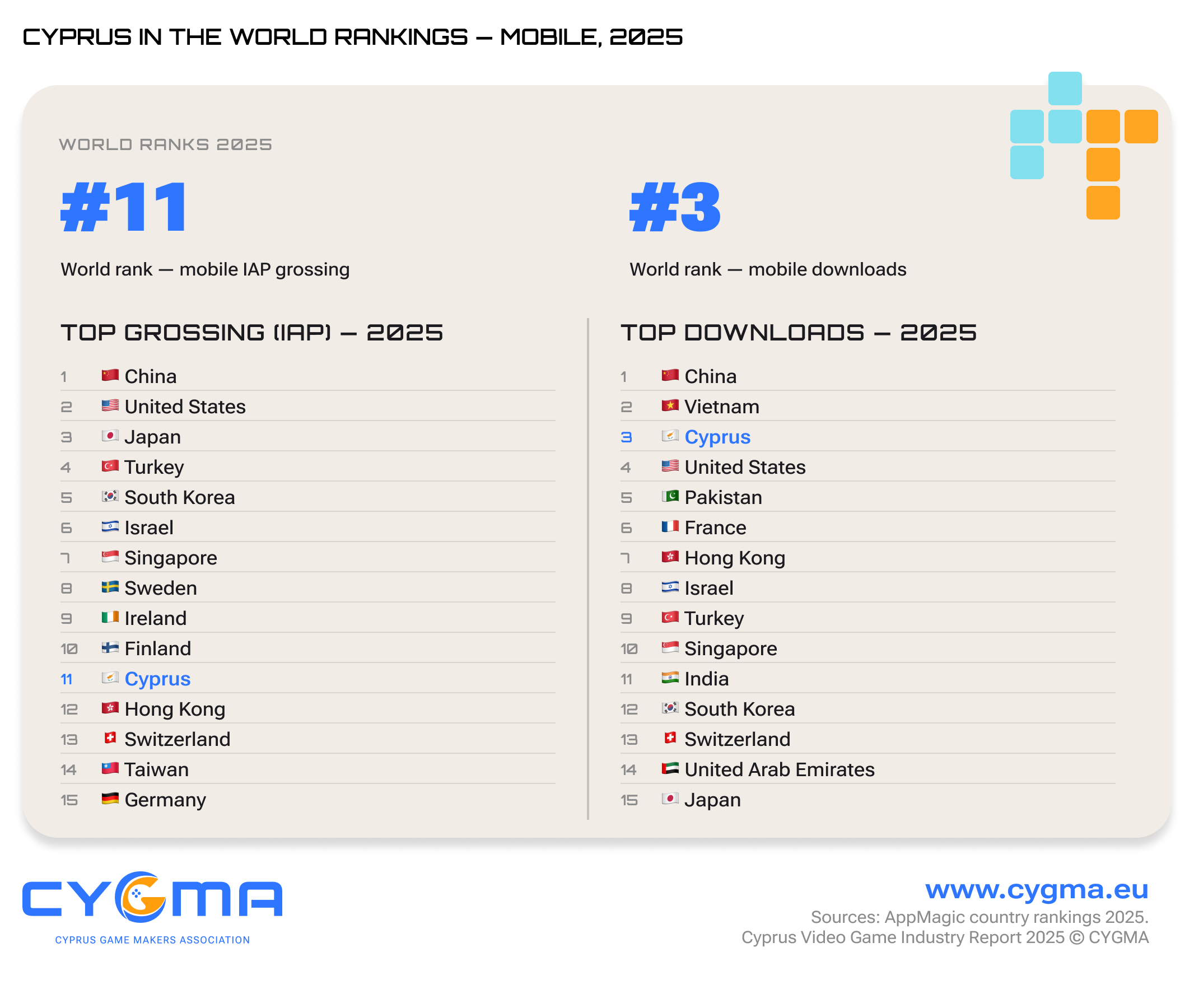
According to AppMagic country rankings, Cyprus ranked third in the world for mobile game downloads in 2025. It sits behind China and Vietnam and ahead of the United States, Pakistan, France and Hong Kong.
For mobile in-app purchase revenue, Cyprus ranked eleventh. That places it behind China, the United States, Japan, Turkey, South Korea, Israel, Singapore, Sweden, Ireland and Finland, and ahead of Hong Kong, Switzerland, Taiwan and Germany.
The report says this gap between the two rankings describes what Cyprus makes: casual and hyper-casual titles downloaded at enormous scale and monetised modestly.
[Cyprus in the world rankings, mobile 2025]
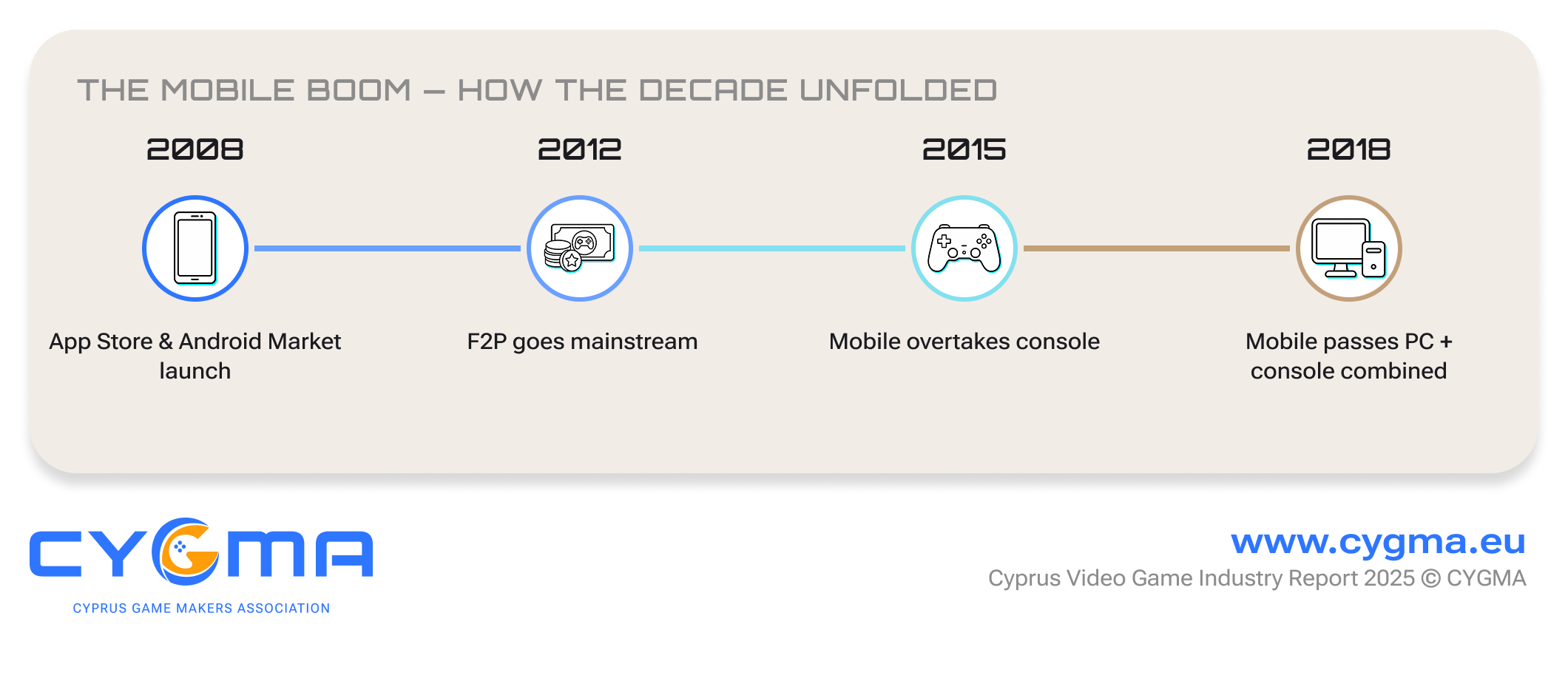
The report also traces how the mobile market developed over the decade in which the Cypriot company base was built:
2008: the App Store and Android Market launched.
2012: free-to-play went mainstream.
2015: mobile overtook console.
2018: mobile passed PC and console combined.
[The mobile boom, how the decade unfolded]
PC and console: most revenue is earned off Steam
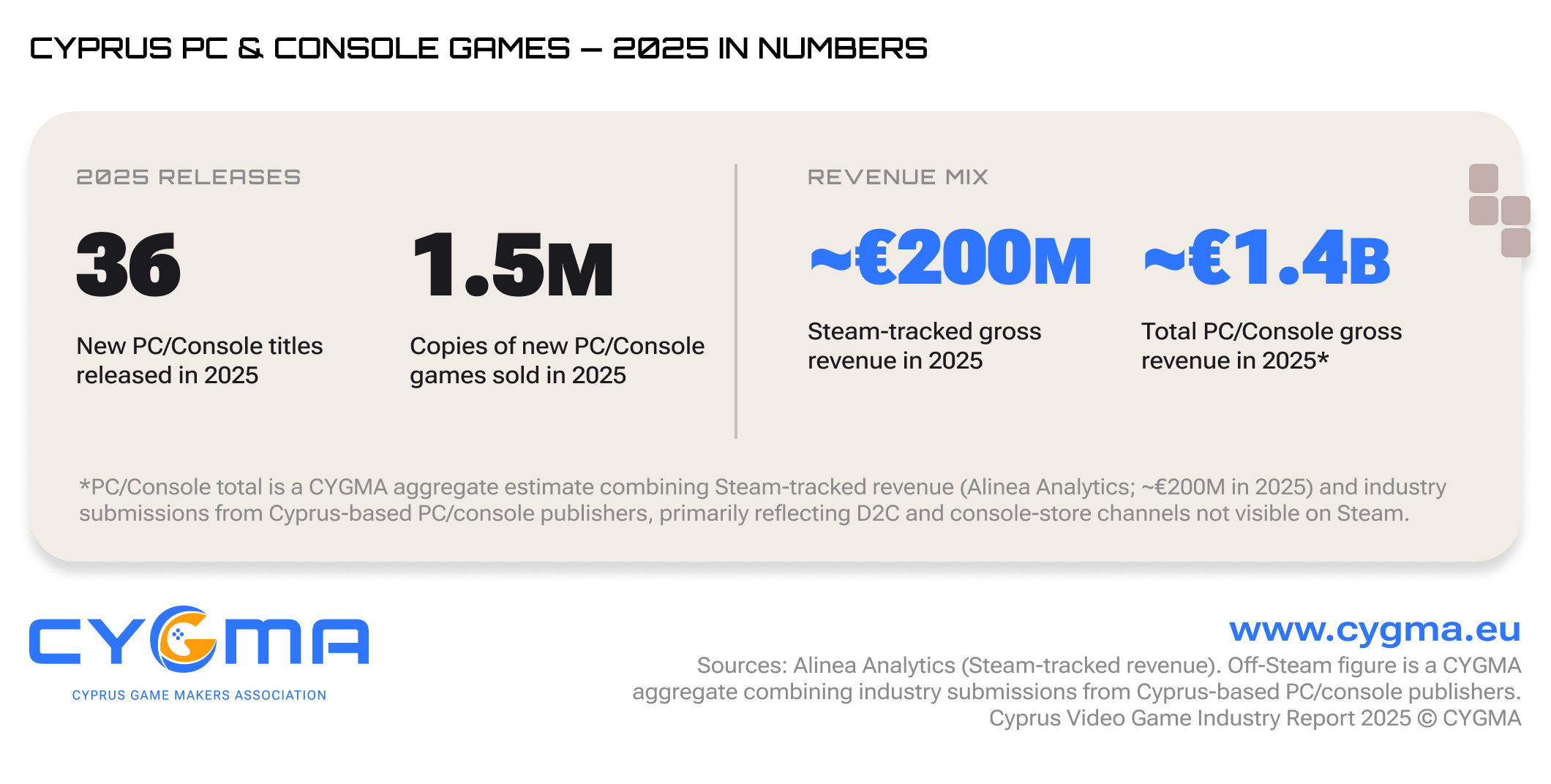
In PC and console, Cypriot studios released 36 new titles in 2025 and sold 1.5 million copies of new games. Revenue tracked on Steam was about €200 million, according to Alinea Analytics.
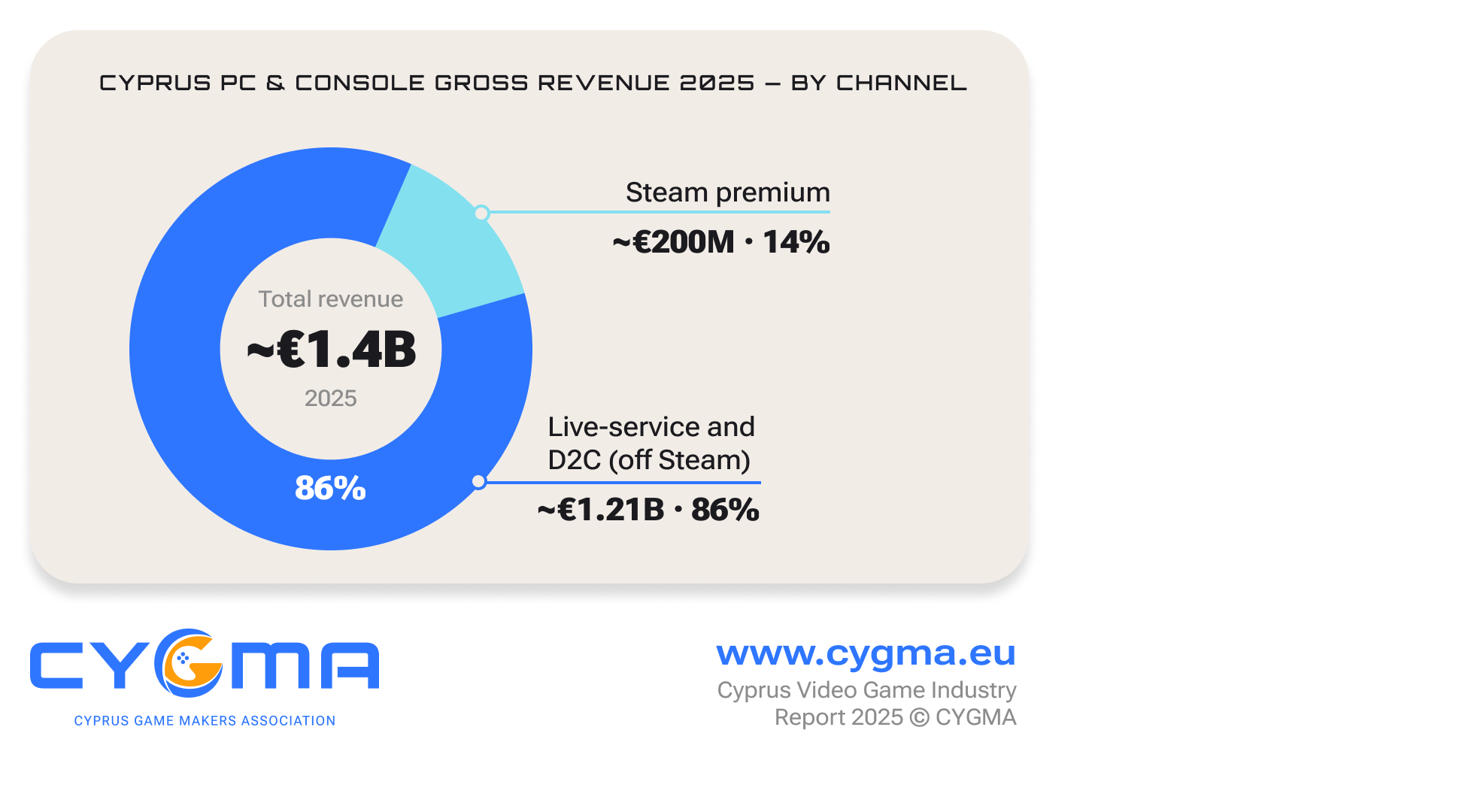
CYGMA puts total PC and console gross revenue at about €1.4 billion. This is an aggregate estimate that combines the Steam-tracked figure with industry submissions from Cyprus-based PC and console publishers. Those submissions mainly reflect direct-to-consumer and console-store channels that are not visible on Steam.
[Cyprus PC and console games, 2025 in numbers]
On that basis, 86% of the island's PC and console revenue, about €1.21 billion, comes from live-service and direct-to-consumer channels off Steam. Steam premium sales account for about €200 million, or 14%.
The report states that Cyprus publishers ran live-service direct-to-consumer businesses more than a decade before the model went mainstream.
[Cyprus PC and console gross revenue 2025 by channel]
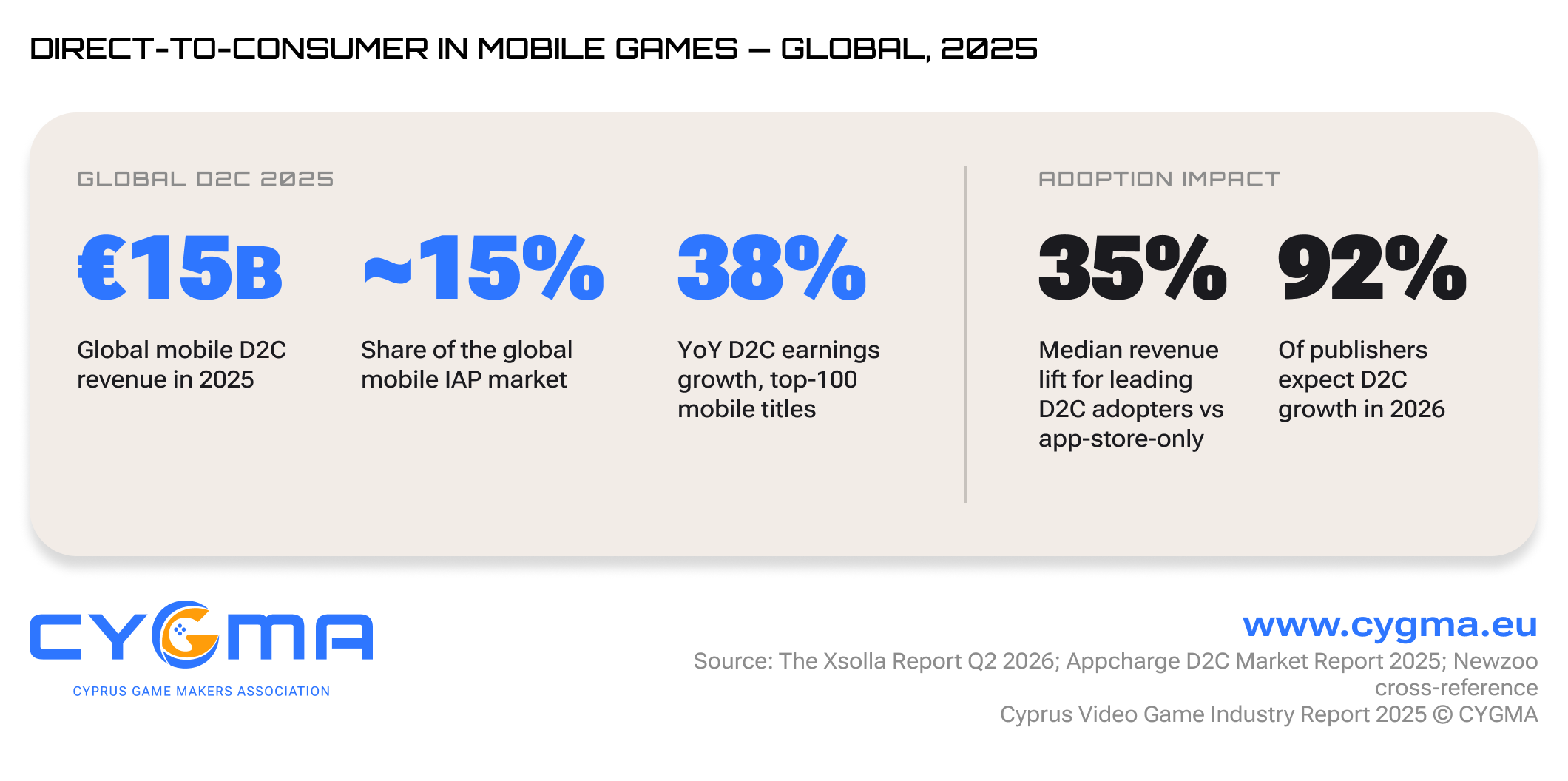
That model is now spreading across mobile gaming worldwide. The report puts global mobile direct-to-consumer revenue at €15 billion in 2025, about 15% of the global mobile in-app purchase market. It also cites these findings:
- Direct-to-consumer earnings for top-100 mobile titles grew 38% year on year.
- Leading adopters recorded a median revenue lift of 35% compared with app-store-only publishers.
- 92% of publishers expect direct-to-consumer growth in 2026.
These figures are drawn from The Xsolla Report Q2 2026 and the Appcharge D2C Market Report 2025, cross-referenced with Newzoo.
[Direct-to-consumer in mobile games, global 2025]
The company base: small teams, mobile focus
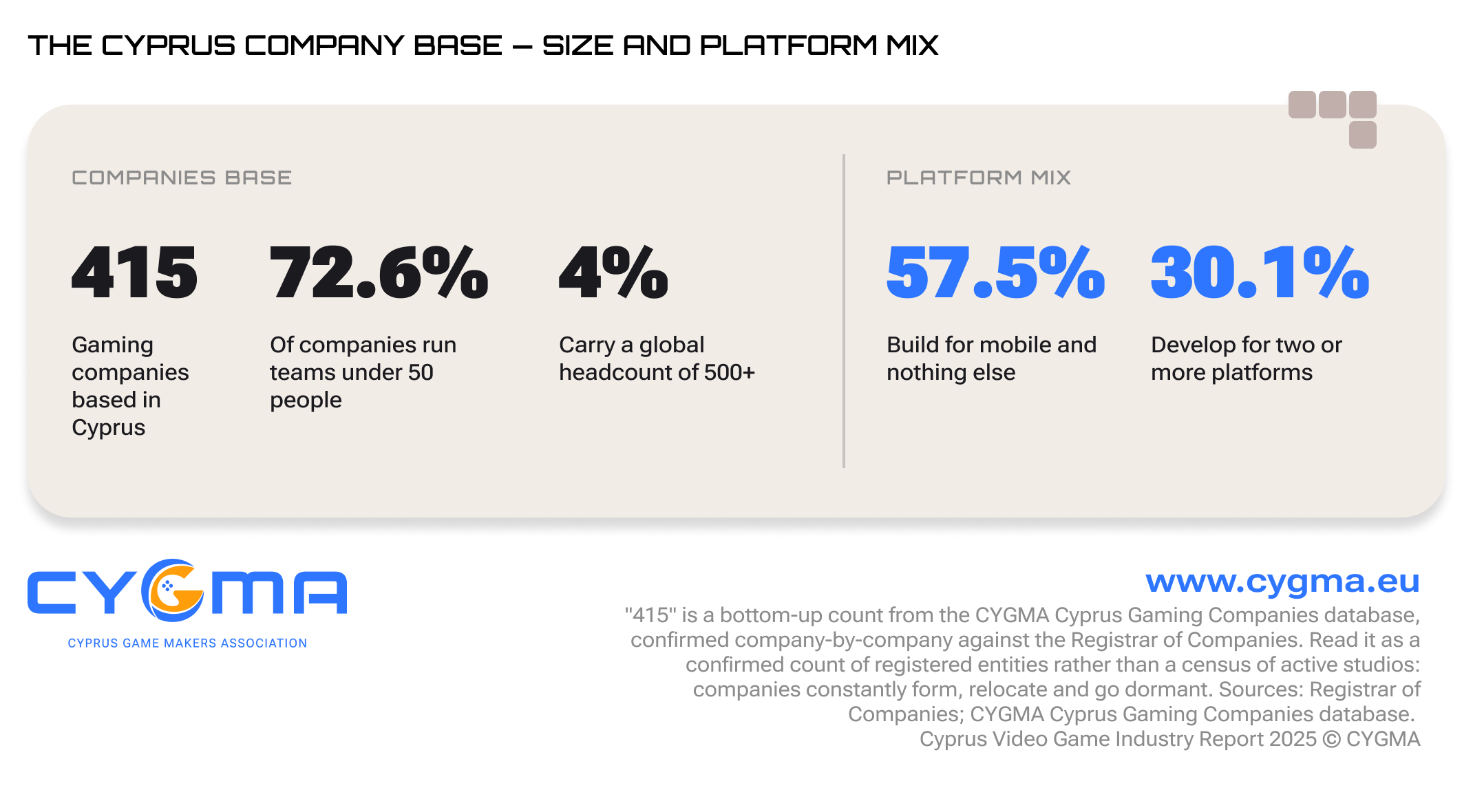
CYGMA identified 431 game companies operating from Cyprus. Of these, 415 were confirmed against the Registrar of Companies with entity codes, addresses and directors. The report asks readers to treat the figure as a confirmed count of registered entities rather than a census of active studios, since companies constantly form, relocate and go dormant.
Most companies are small. 72.6% run teams of fewer than 50 people, while 4% carry a global headcount of more than 500. On platforms, 57.5% build for mobile only, and 30.1% develop for two or more platforms.
[The Cyprus company base, size and platform mix]
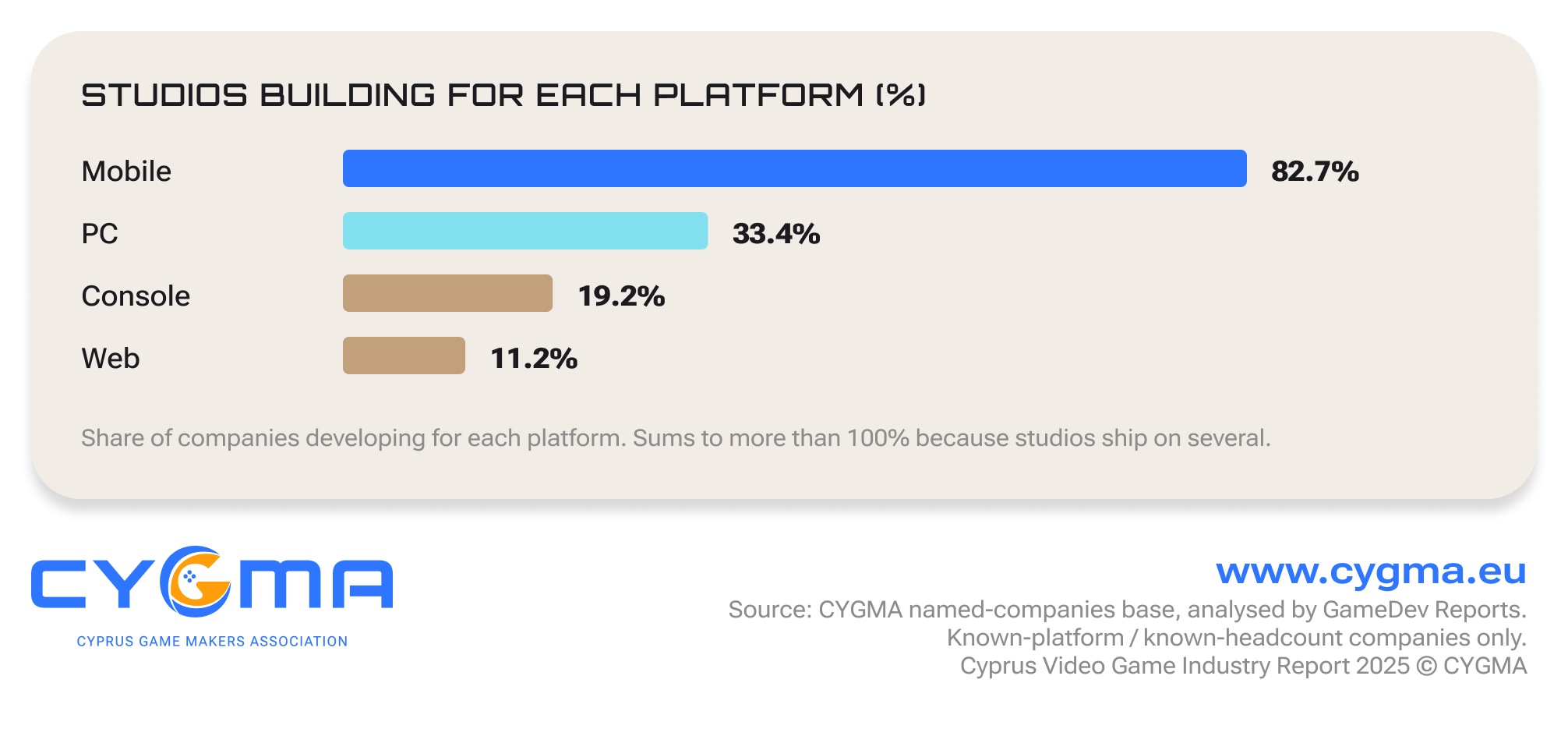
Among companies with a known platform, 82.7% develop for mobile, 33.4% for PC, 19.2% for console and 11.2% for web. The shares add up to more than 100% because many studios ship on several platforms.
[Studios building for each platform (%)]
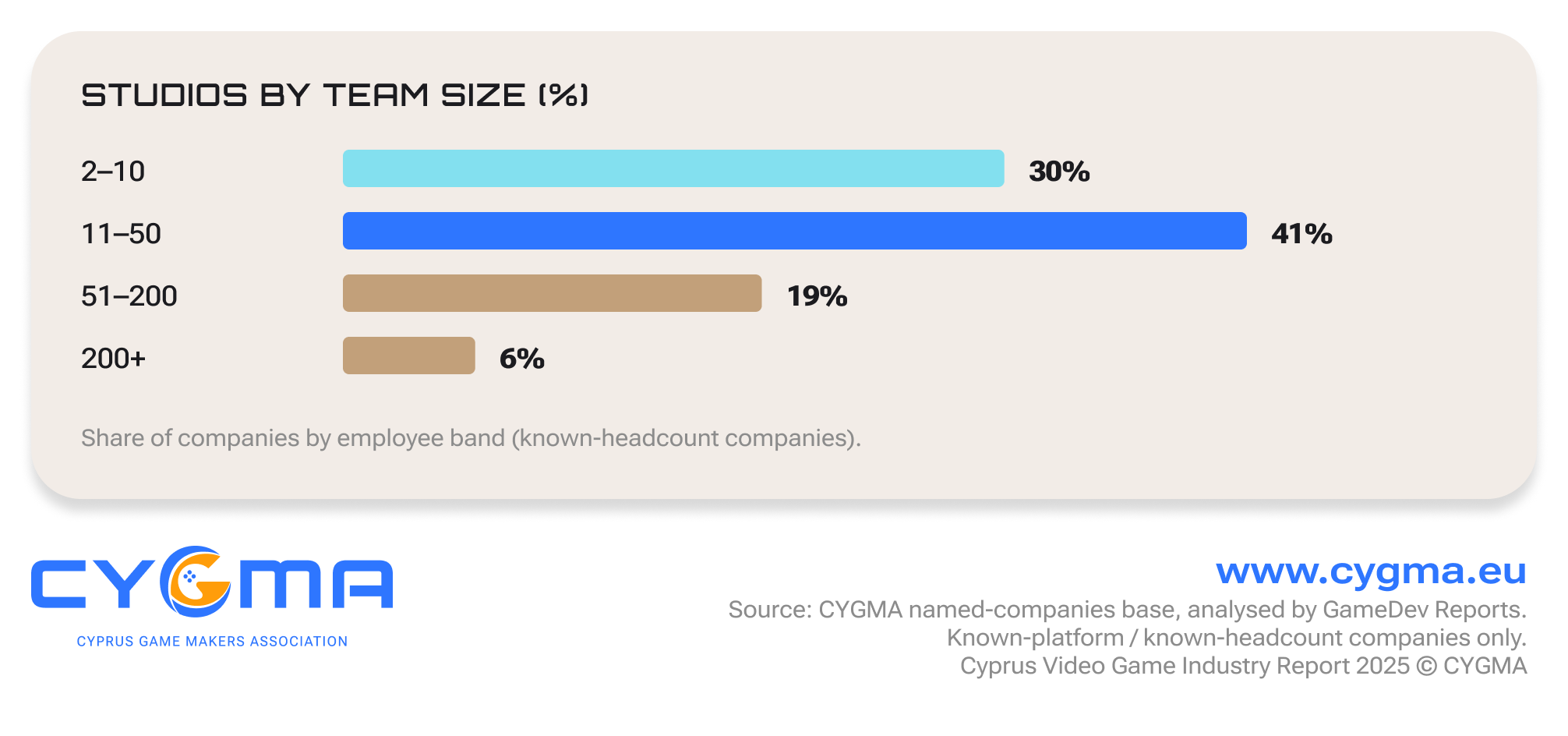
Among companies with a known headcount:
- 30% employ between 2 and 10 people.
- 41% employ between 11 and 50.
- 19% employ between 51 and 200.
- 6% employ more than 200.
These figures come from CYGMA's named-companies base, analysed by GameDev Reports.
[Studios by team size (%)]
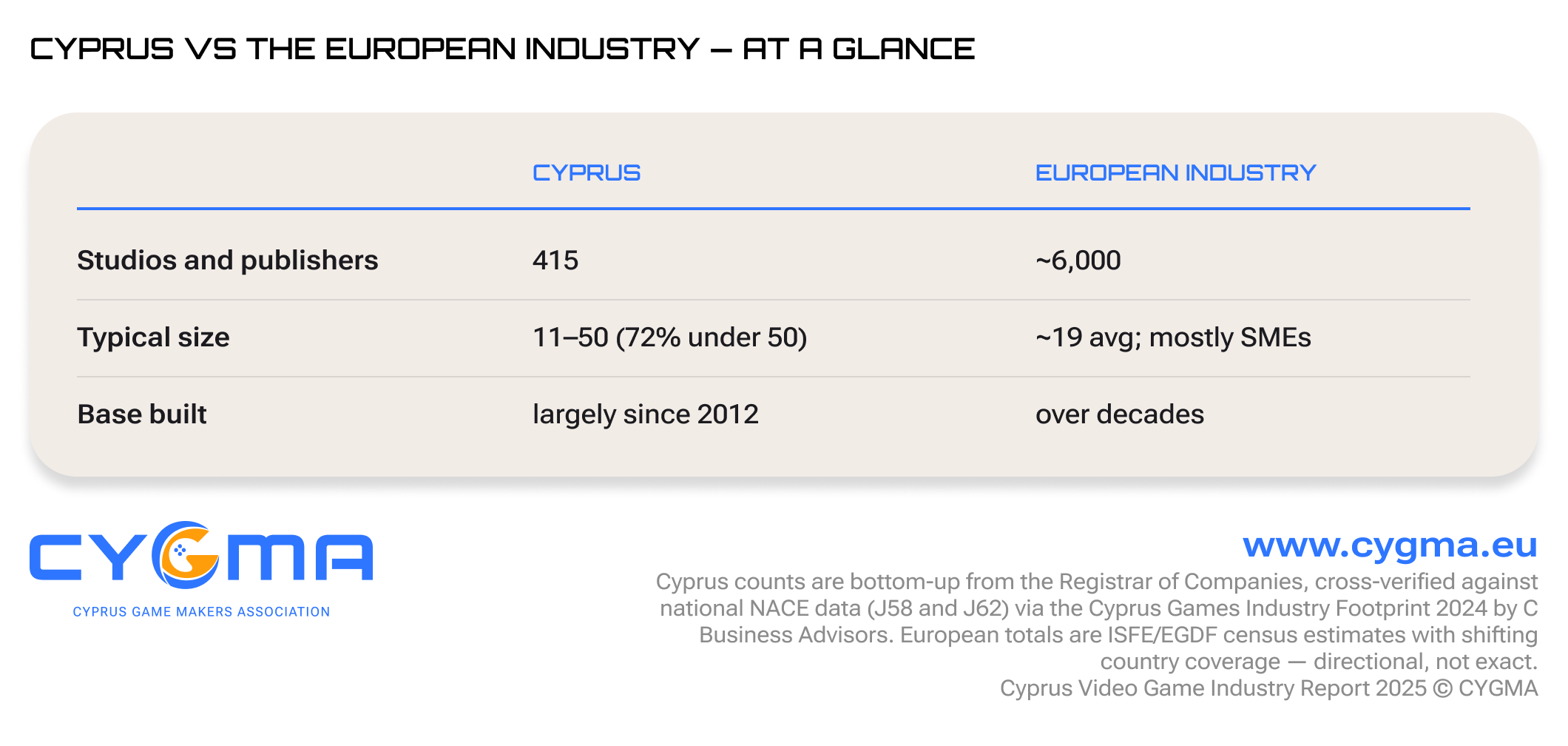
The report compares Cyprus with the wider European industry. Europe has about 6,000 studios and publishers, with an average of about 19 employees each, and its base was built over decades. The Cypriot base of 415 companies was built largely since 2012, and its typical company employs between 11 and 50 people.
Between 2019 and 2023, the European company count grew only gradually, to about 5,900. Over a similar period, the number of Cypriot companies more than doubled. The European totals are ISFE and EGDF census estimates, which the report describes as directional rather than exact.
[Cyprus vs the European industry at a glance]
[Game companies growth index]
Capital: €2.76 billion in exits
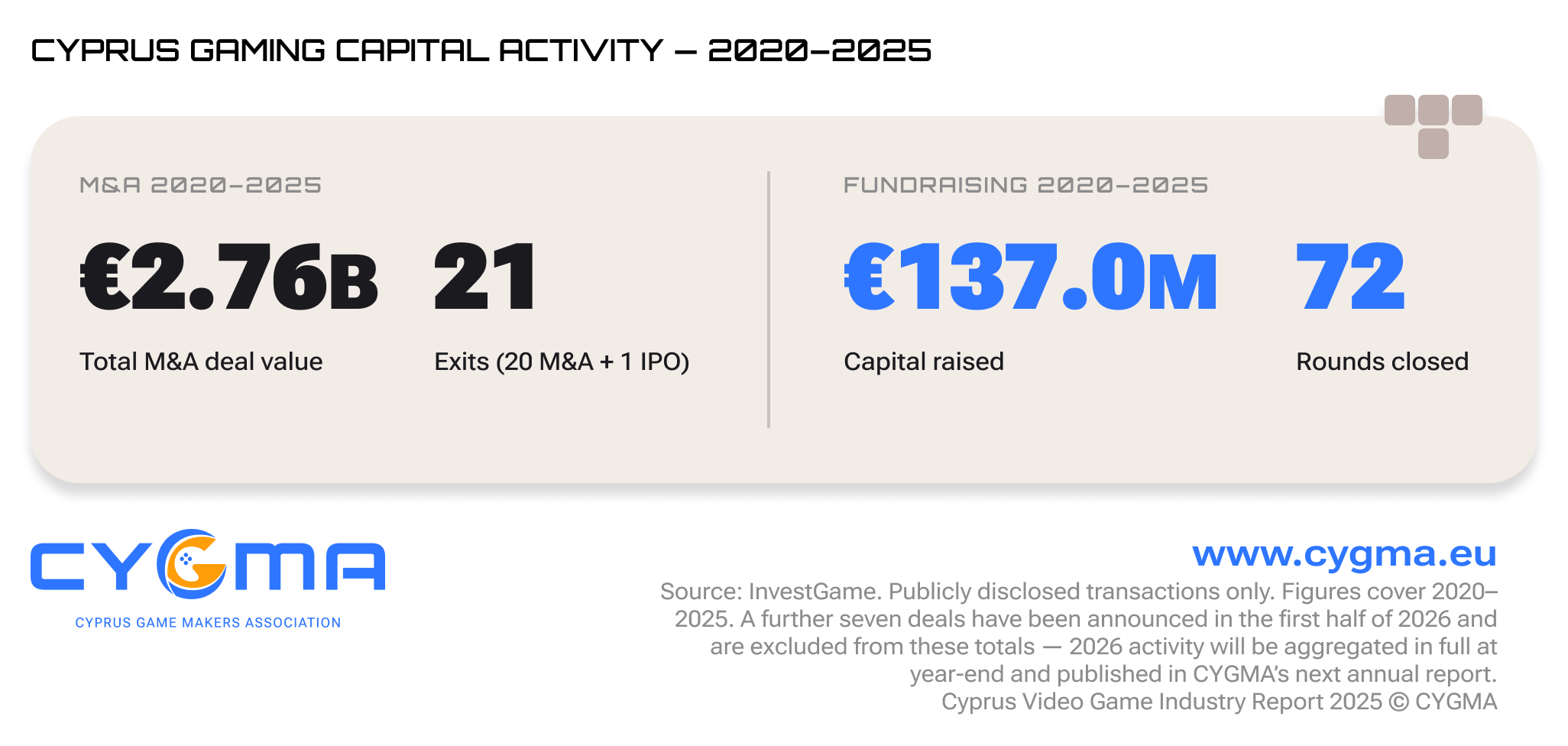
Between 2020 and 2025, Cyprus recorded €2.76 billion in disclosed mergers and acquisitions across 21 exits:20 acquisitions and one IPO. Over the same period, companies raised €137.0 million in equity across 72 funding rounds.
The figures include publicly disclosed transactions only. A further seven deals announced in the first half of 2026 are excluded and will be counted in CYGMA's next annual report.
[Cyprus gaming capital activity 2020–2025]
Cypriot M&A activity by year, counting control deals worth more than $10 million:
- 2020: €337 million across five deals.
- 2021: €677 million across three deals.
- 2022: €679 million across five deals.
- 2023: no deals.
- 2024: two deals, with values announced but not disclosed.
- 2025: €1.07 billion across five deals.
Globally, gaming M&A peaked at about €67.7 billion in 2023 and stood at about €58.4 billion in 2025. According to the report, Cyprus accounts for 4.4% of the world's disclosed games M&A deals worth more than $10 million.
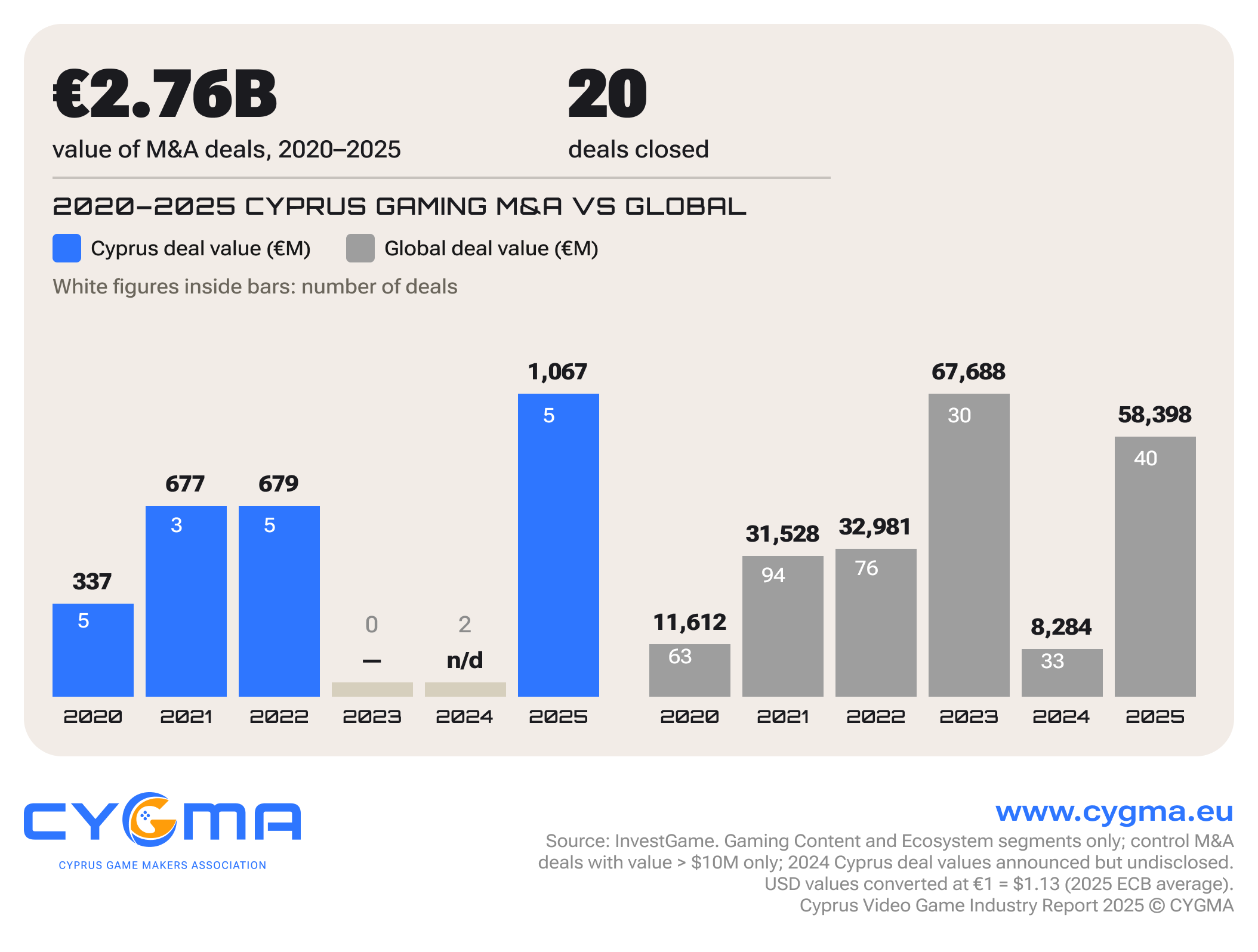
[2020–2025 Cyprus gaming M&A vs global]
The largest disclosed exit in the island's history was the sale of Easybrain to Miniclip for €1.06 billion in 2025. Easybrain had previously been acquired by Embracer Group in 2021 for €566 million.
The other major deals with a Cyprus nexus, as either target or acquirer:
- Outfit7 was acquired by the United Luck Consortium in 2017 for €885 million.
- MY.GAMES was acquired by Aleksander Chachava in 2022 for €568 million.
- Melsoft was acquired by Moon Active in 2020 for €265 million.
- Belka Games was acquired by AppLovin in 2019 for €136 million.
- Cubic Games was acquired by GDEV in 2022 for €53 million.
- Deus Craft (€43 million) and BeINGAME (€16 million) were both acquired by MY.GAMES in 2020.
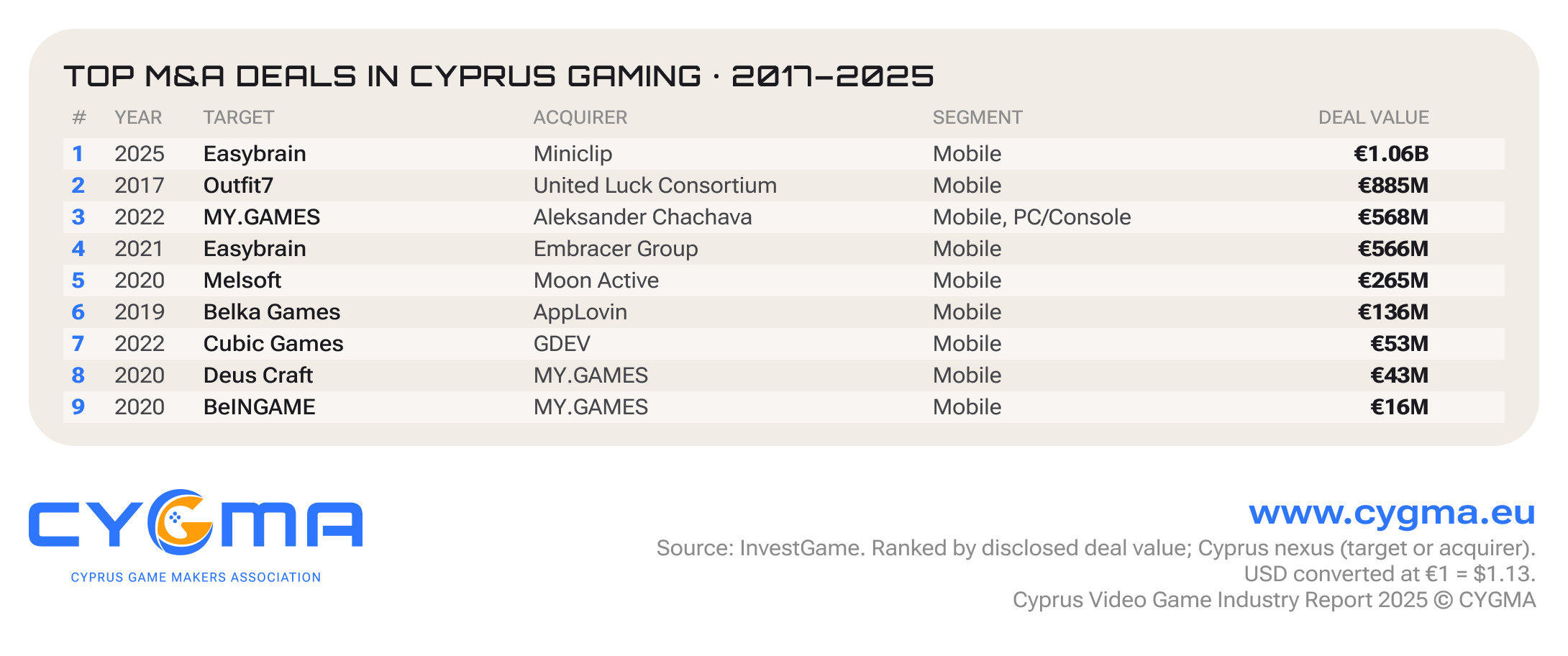
[Top M&A deals in Cyprus gaming 2017–2025]
The report notes that Cypriot companies are also acquirers. GDEV, MY.GAMES and Azur Games have all bought other Cyprus studios, and GDEV listed on Nasdaq via a SPAC in 2021.
Early-stage funding lags behind exits
Equity funding has been much smaller than exit values. Early-stage rounds raised €92.7 million across 69 roundsbetween 2020 and 2025, with a peak of €32.2 million across 19 rounds in 2024. In 2025, early-stage funding stood at €10.7 million across eight rounds.
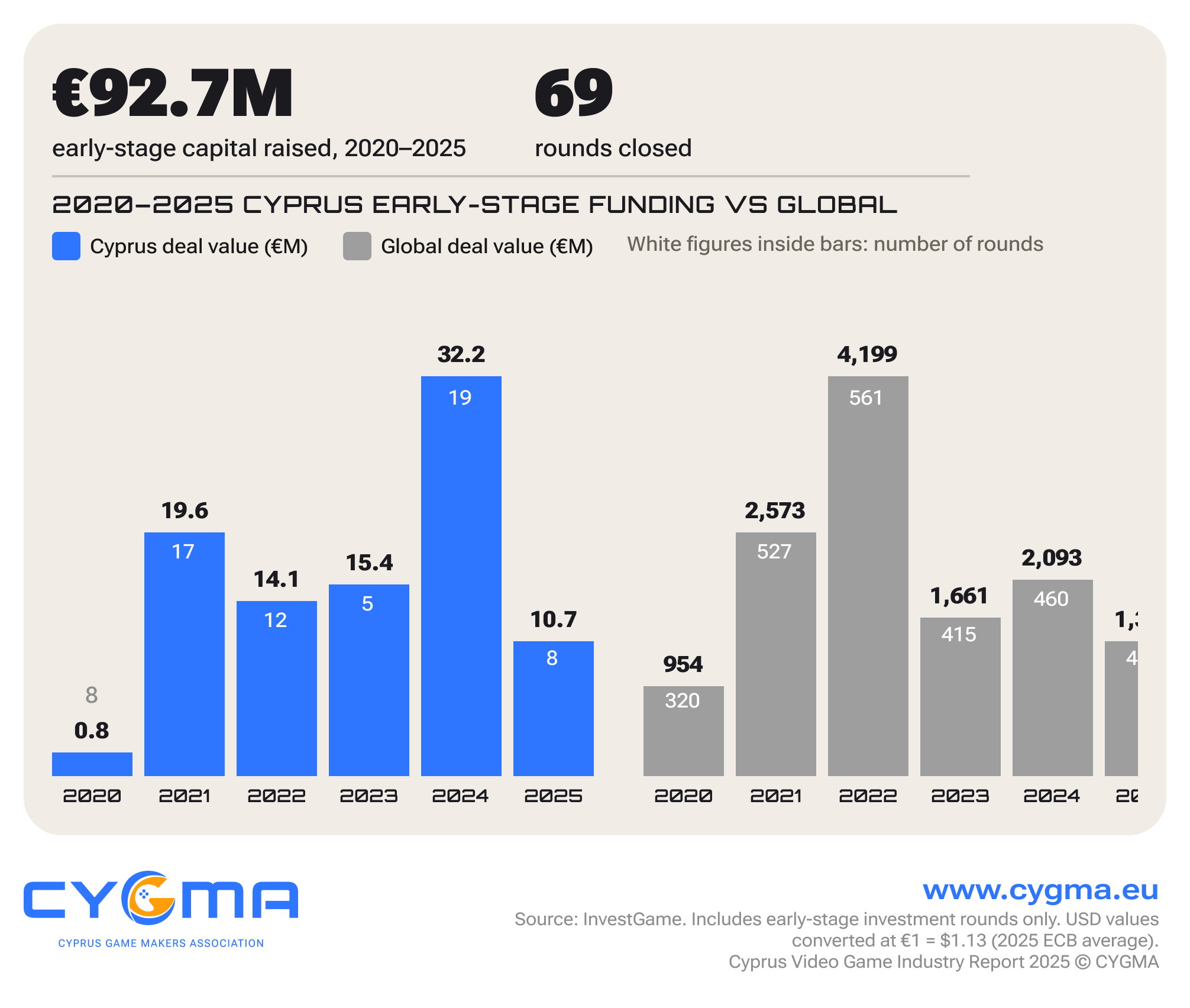
[2020–2025 Cyprus early-stage funding vs global]
Of the 72 rounds closed in total, 40 were pre-seed or seed. Only three Series B or later rounds closed in six years: one each in 2021, 2022 and 2023. Total capital raised peaked at €50.8 million in 2023, when only six rounds closed.
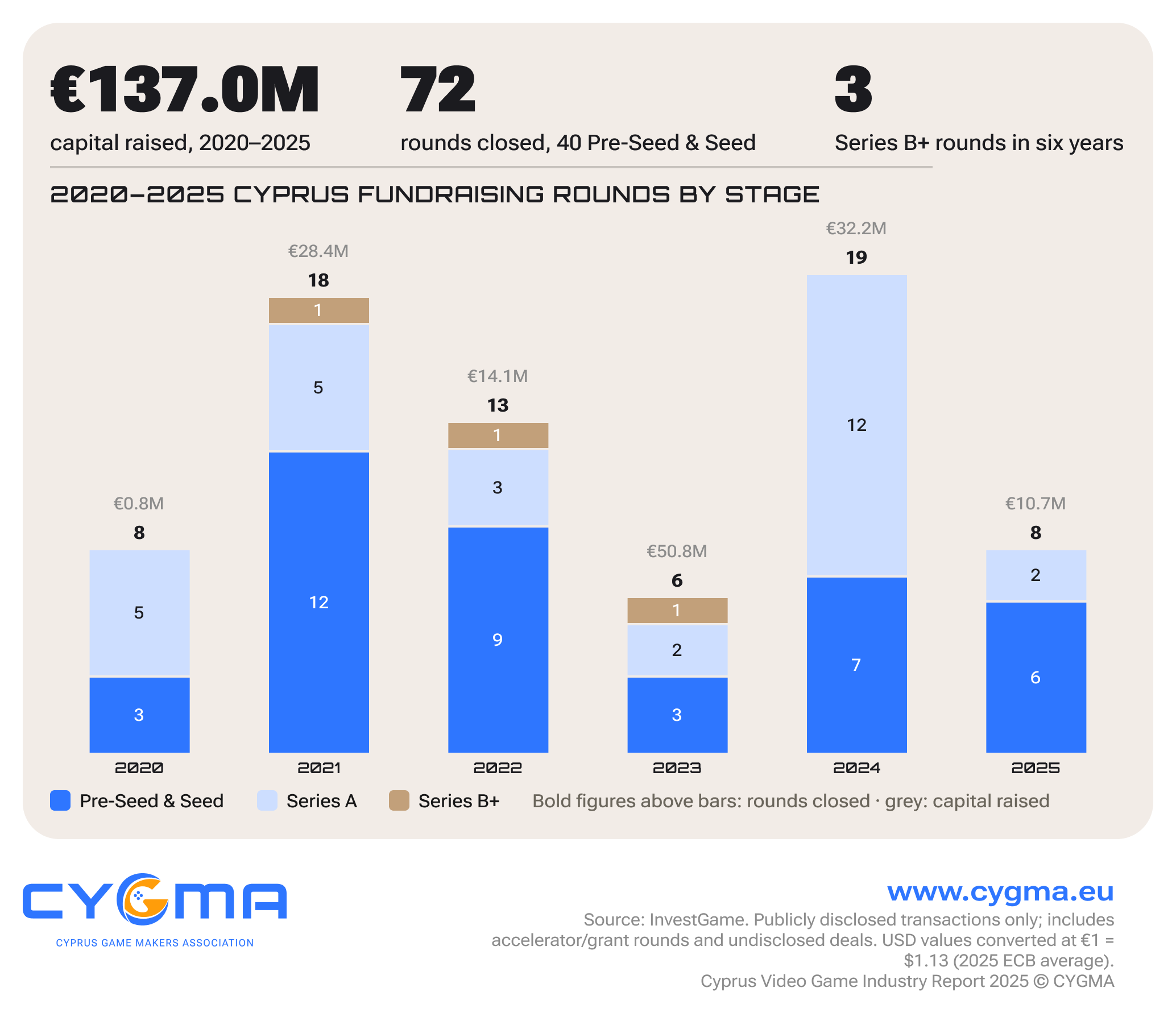
[2020–2025 Cyprus fundraising rounds by stage]
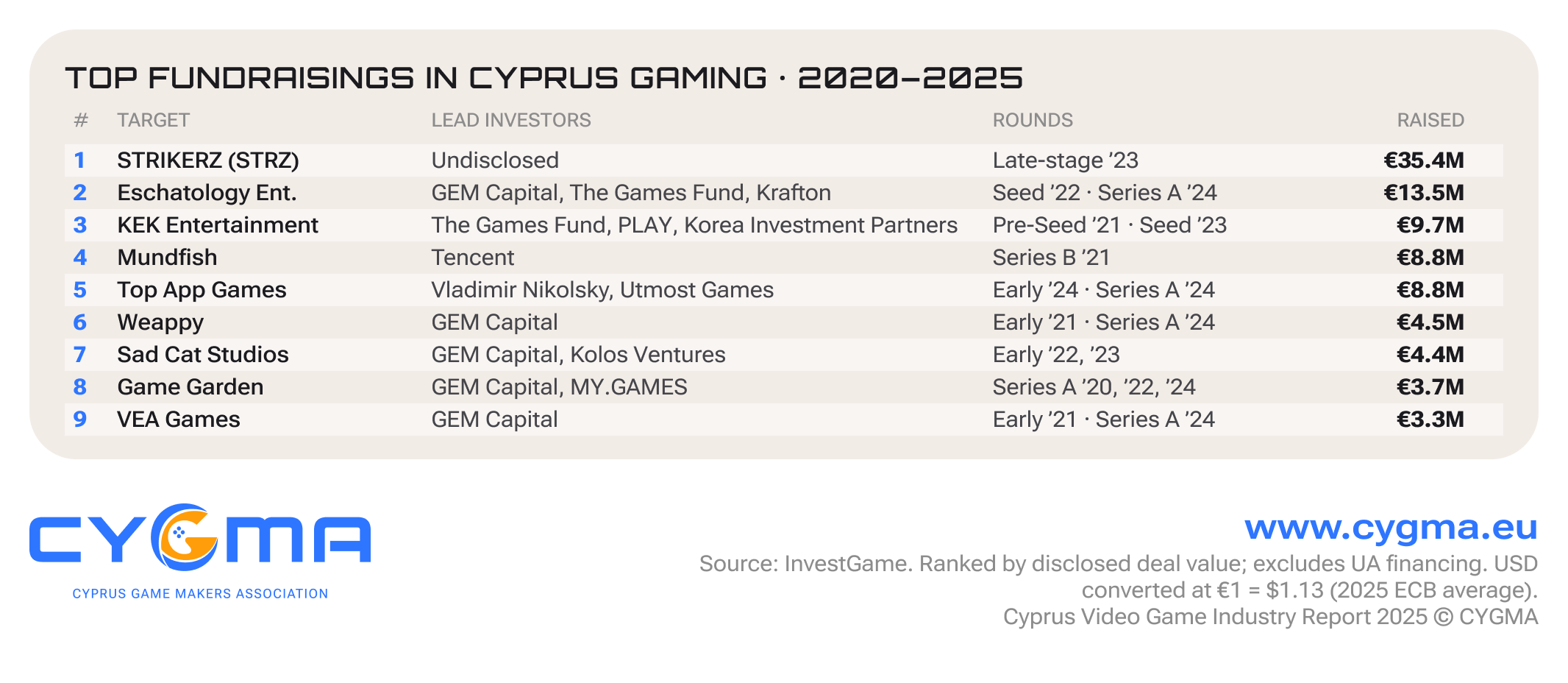
The largest single fundraising was a €35.4 million late-stage round by STRIKERZ (STRZ) in 2023, from undisclosed investors. The other leading fundraisings:
- Eschatology Entertainment raised €13.5 million in seed and Series A rounds led by GEM Capital, The Games Fund and Krafton.
- KEK Entertainment raised €9.7 million from The Games Fund, PLAY and Korea Investment Partners.
- Mundfish raised €8.8 million in a 2021 Series B led by Tencent.
- Top App Games raised €8.8 million, led by Vladimir Nikolsky and Utmost Games.
- Weappy (€4.5 million), Sad Cat Studios (€4.4 million), Game Garden (€3.7 million) and VEA Games(€3.3 million) all raised rounds involving GEM Capital.
[Top fundraisings in Cyprus gaming 2020–2025]
User-acquisition financing as a new source of capital
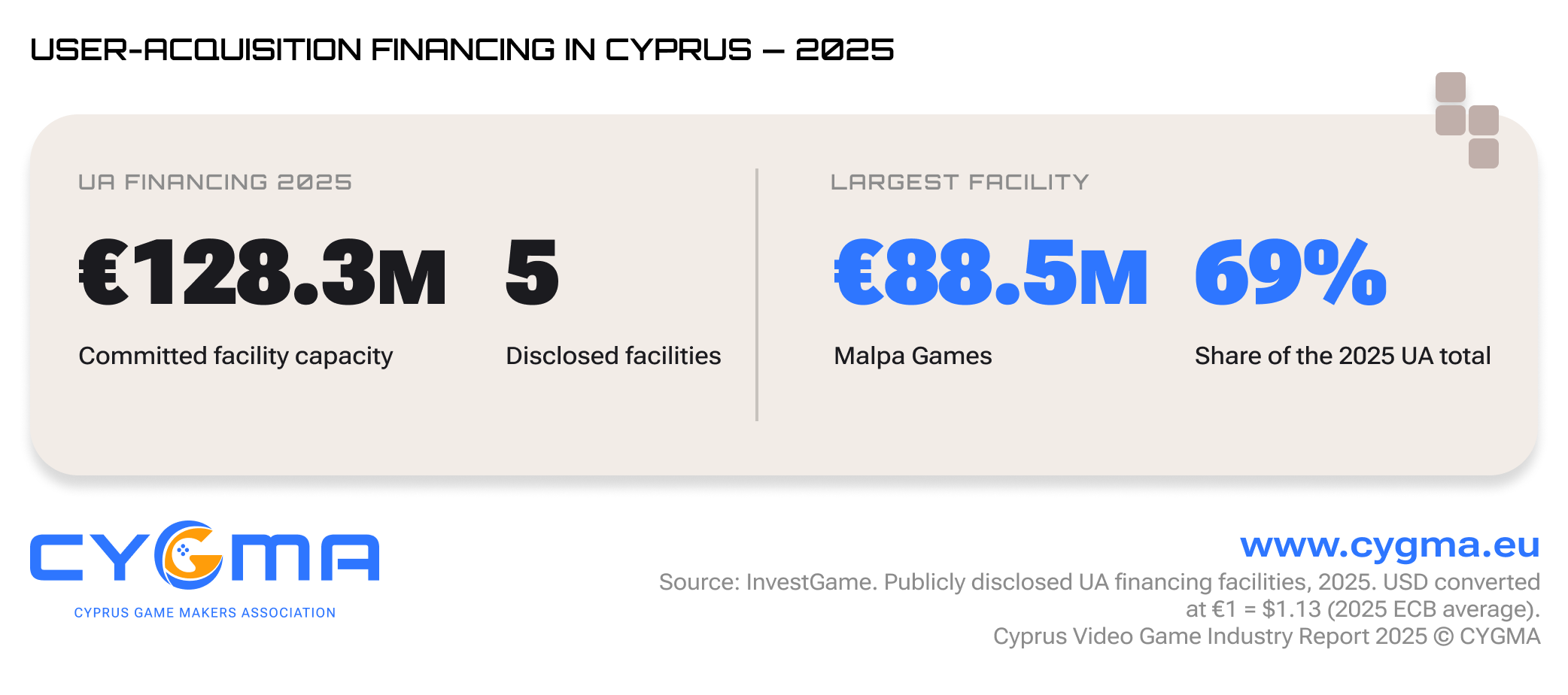
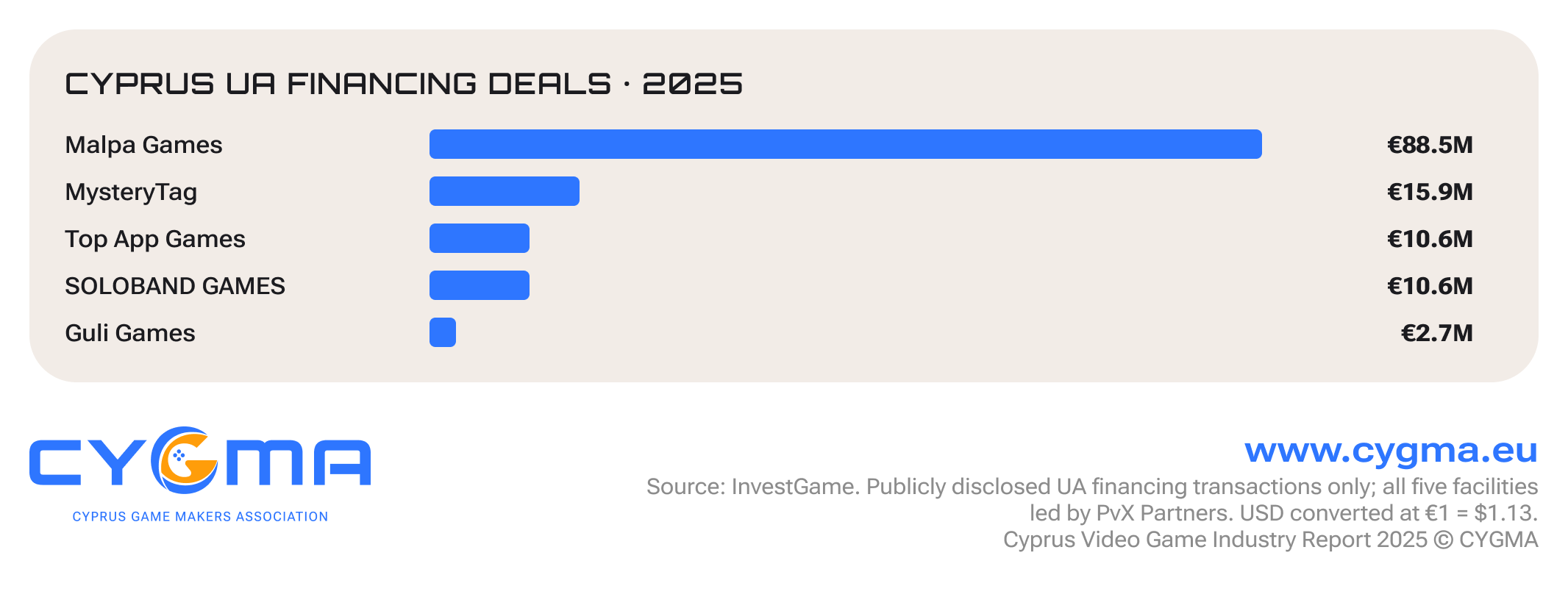
A different kind of financing emerged in 2025. Five user-acquisition financing facilities, all led by PvX Partners, committed €128.3 million to Cypriot studios. User-acquisition financing funds the marketing spend studios use to win new players.
The largest facility, €88.5 million to Malpa Games, accounted for 69% of the total. The others went to MysteryTag (€15.9 million), Top App Games (€10.6 million), SOLOBAND GAMES (€10.6 million) and Guli Games (€2.7 million).
[User-acquisition financing in Cyprus 2025]
[Cyprus UA financing deals 2025]
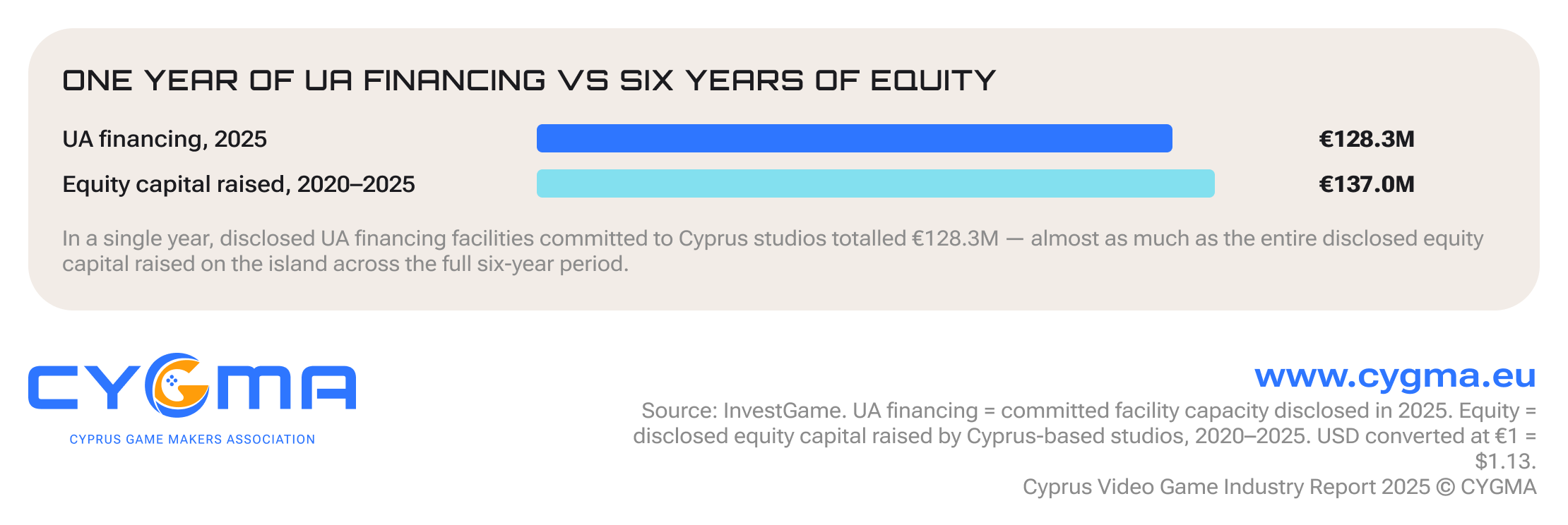
In a single year, user-acquisition financing came close to the €137.0 million in disclosed equity raised on the island over the entire six-year period.
[One year of UA financing vs six years of equity]
Tax and funding regimes compared
The report compares the Cypriot framework with those of the United Kingdom, Germany, Turkey and Abu Dhabi.
Cyprus applies a standard corporate income tax rate of 15% from 2026. Its IP Box regime allows an 80% deduction on qualifying intellectual property profits, which brings the effective rate to about 3%.
Direct funding in Cyprus comes through the Research and Innovation Foundation (RIF):
- SEED offers grants of up to €500,000.
- INNOVATE offers grants of up to €1 million.
- DISRUPT and BOOST are blended-finance schemes, matched to venture capital or angel commitments in companies that have a minimum viable product.
A Plug&Play accelerator launching in 2026 will be the first dedicated gaming instrument.
The other four jurisdictions:
The United Kingdom applies a 25% main rate and offers a Video Games Expenditure Credit of 34%on qualifying development spending.
- Germany has a combined rate of about 30%. It has no dedicated games tax credit yet, although one is planned, and SMEs can claim a 35% R&D allowance (Forschungszulage). A €125 million-a-year Federal Games Fund starts in 2026.
- Turkey offers 0% corporate tax in Technology Development Zones, plus subsidies for user acquisition, platform commissions, salaries and office rent.
- Abu Dhabi applies 0% corporate tax for qualified free-zone companies. The twofour54 regime allows full foreign ownership and waives licensing fees for the first two years.
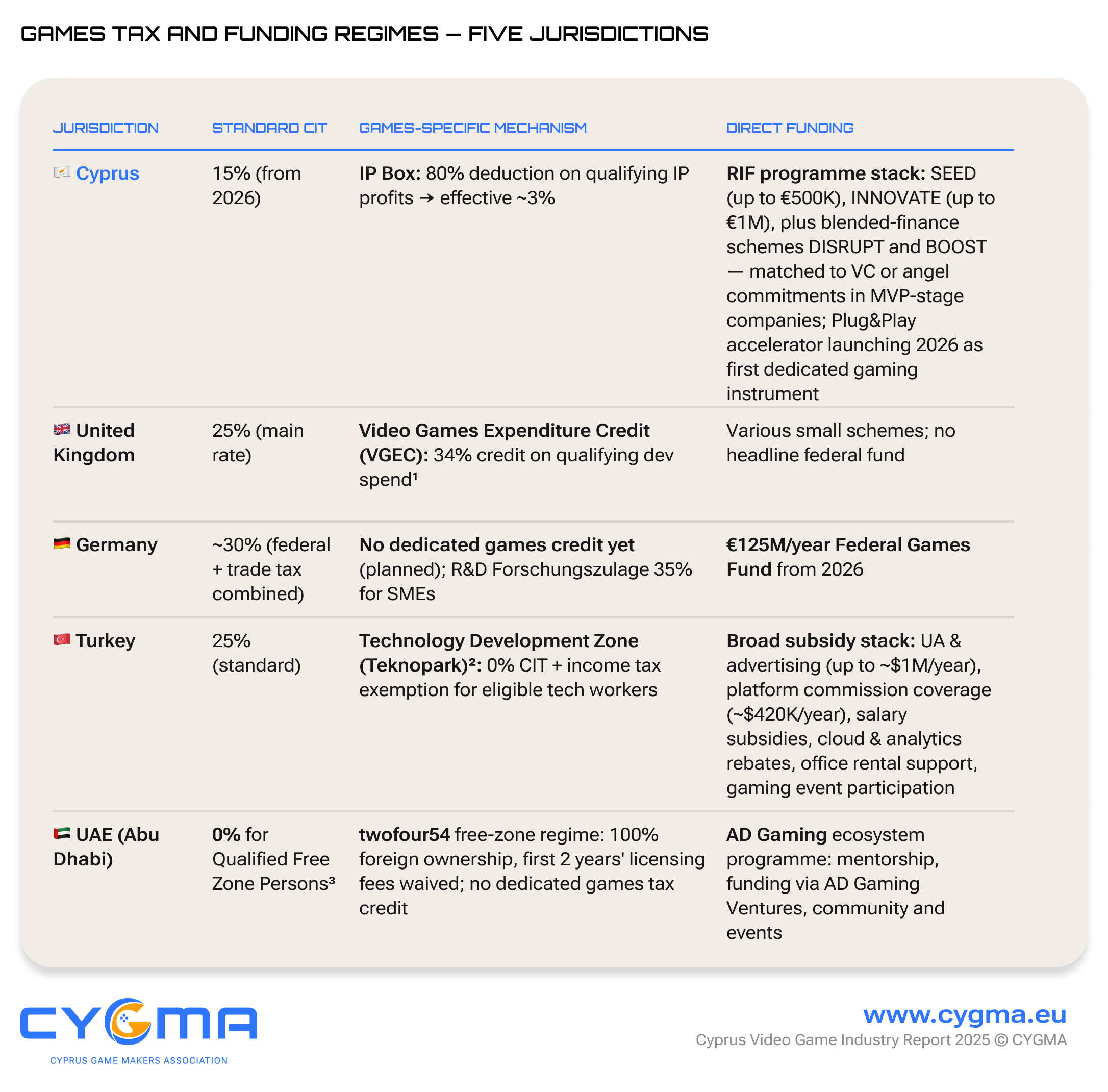
[Games tax and funding regimes, five jurisdictions]
On early-stage grants dedicated to games, the report records that Cyprus has none yet, with Plug&Play due from 2026. Gaming companies are eligible for RIF's general innovation grants. The BOOST scheme offers a 50% match of up to €300,000, and DISRUPT matches venture capital investment of €1 million or more.
By comparison:
The UK Games Fund has run since 2015, offering prototype grants of £30,000 to £50,000 and content grants of £100,000 to £250,000.
- Germany's Press Start grant pays €2,750 a month for 18 months.
- Turkey offers partial support, including salary subsidies and coverage of up to 80% of event costs.
- Abu Dhabi provides direct funding through its AD Gaming programmes.
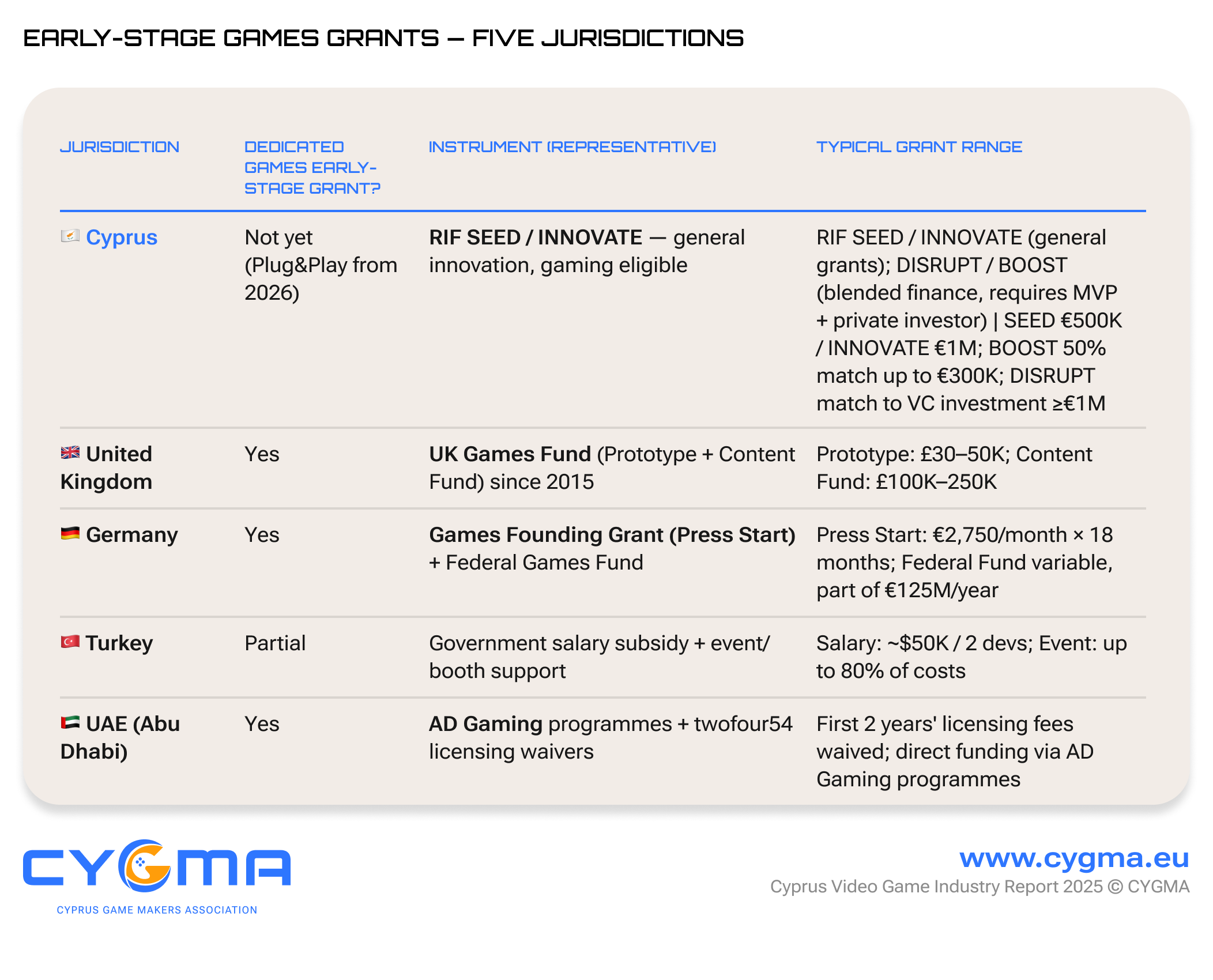
[Early-stage games grants, five jurisdictions]
The talent pipeline
The report identifies talent as the sector's main constraint. It traces a funnel that narrows sharply from the higher education system to the graduates local studios can realistically hire:
- Cyprus has 13 universities (three public and ten private), plus about 45 other tertiary institutions.
- They enrolled 57,889 students in 2023/24.
- They produce an estimated 12,000 to 14,000 graduates a year.
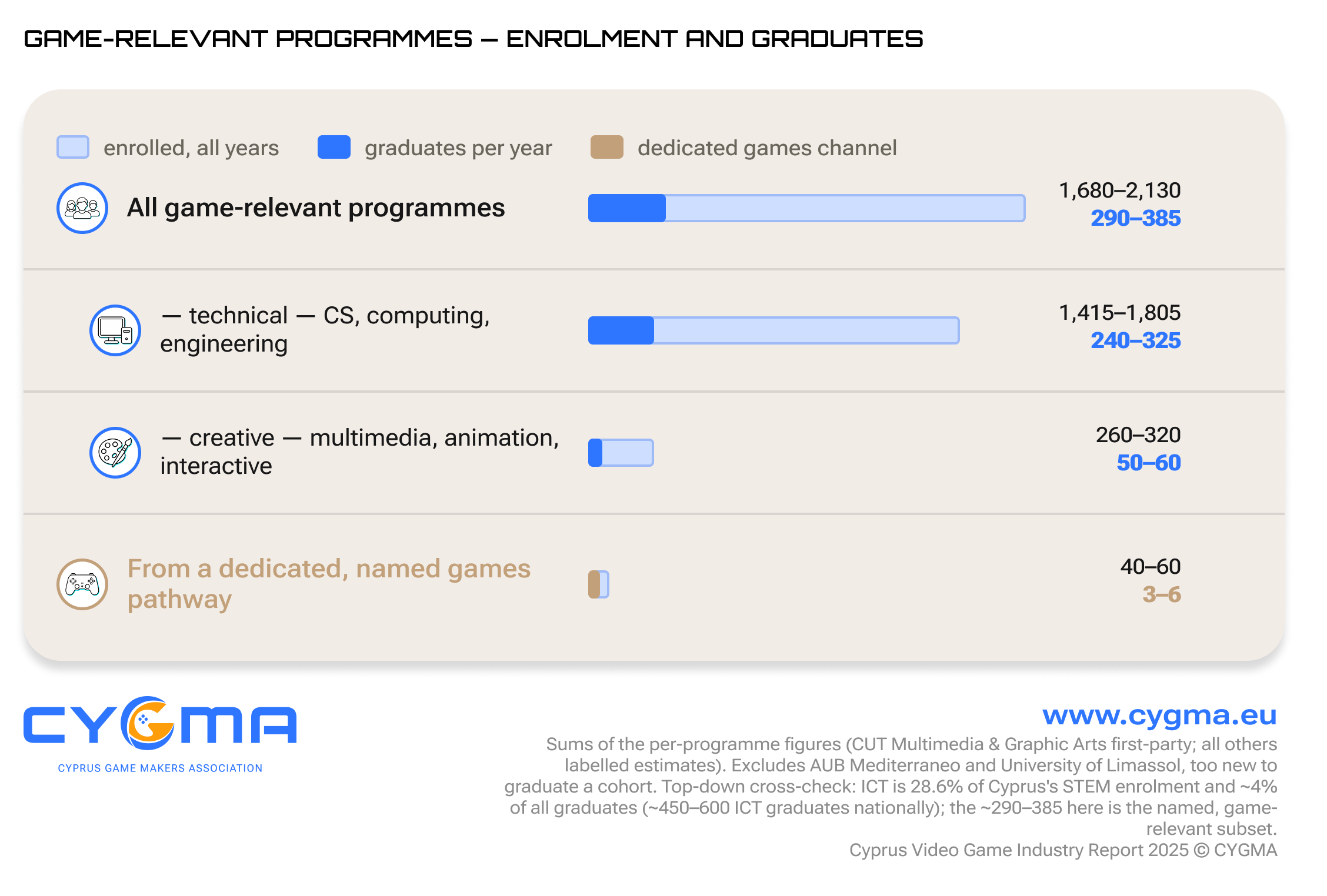
- Between 1,680 and 2,130 students are enrolled in game-relevant degrees across all years.
- Between 290 and 385 game-relevant graduates are expected in 2026.
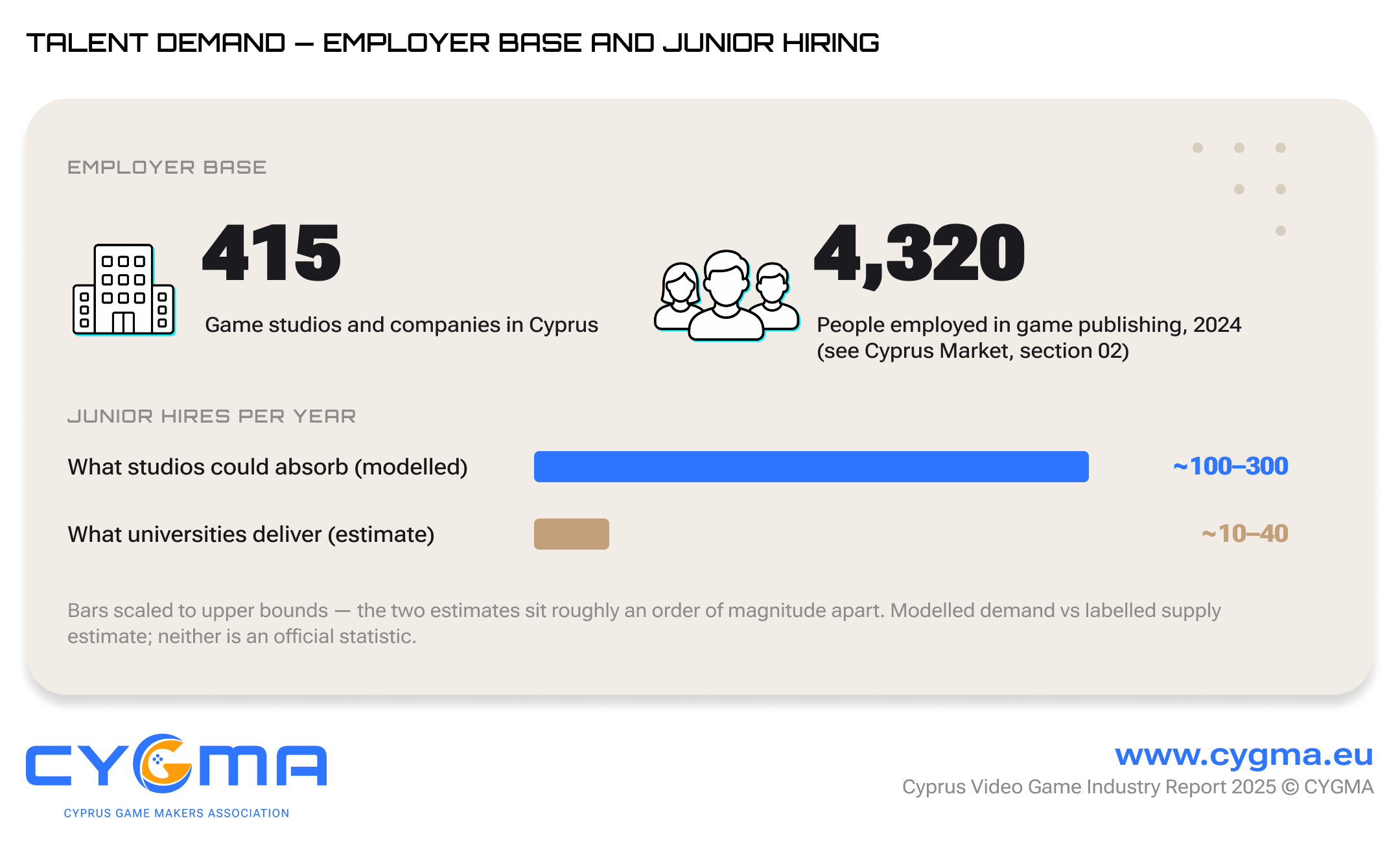
- Only 10 to 40 a year are hireable into local studios.
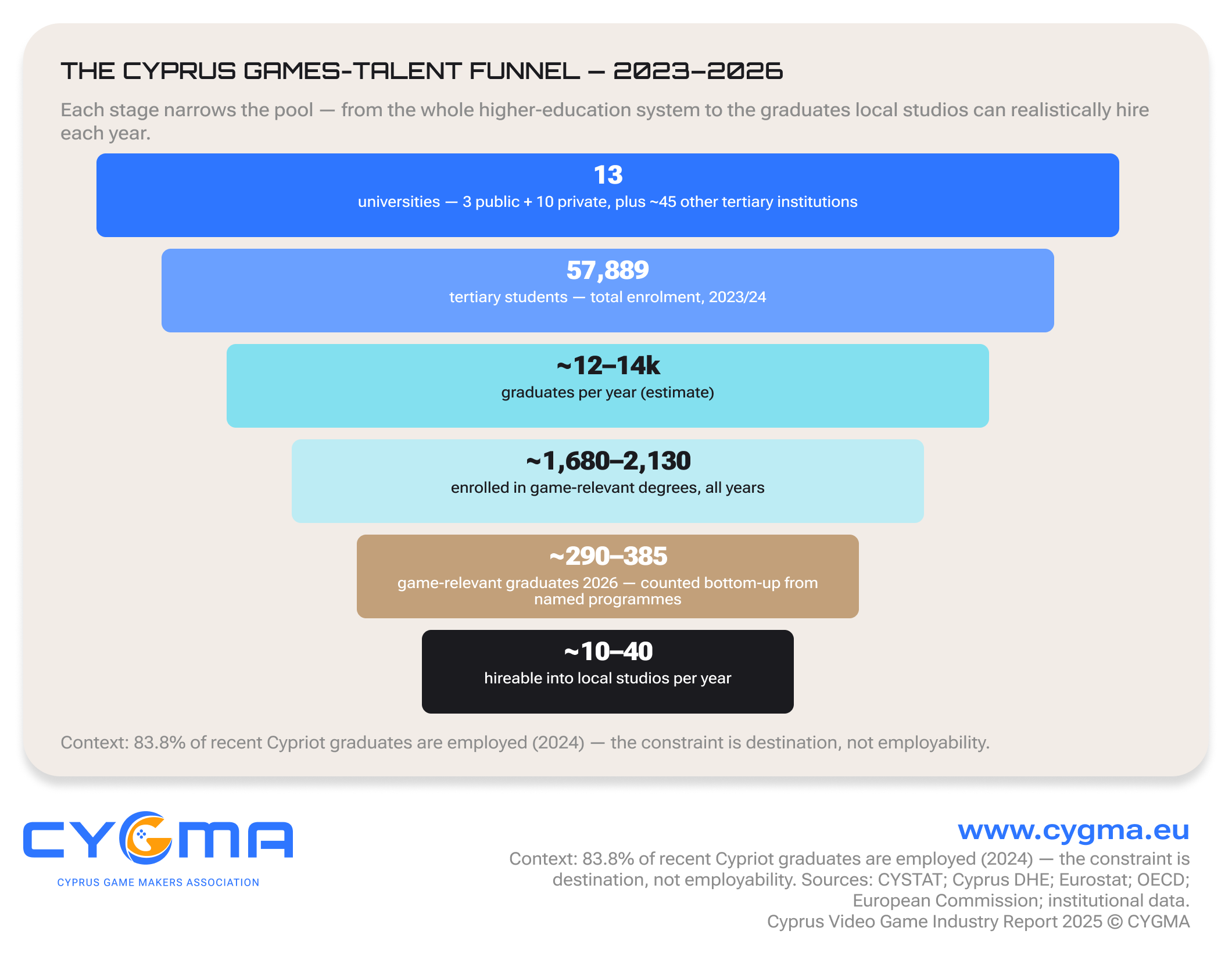
[The Cyprus games-talent funnel 2023–2026]
The report stresses that employability is not the issue. 83.8% of recent Cypriot graduates were employed in 2024; the constraint is where they go.
The higher education system is strong on several measures. International students make up 22.3% of the student body, the third-highest share in the EU. 60.1% of 25 to 34-year-olds hold a degree, against an EU average of 44.2%.
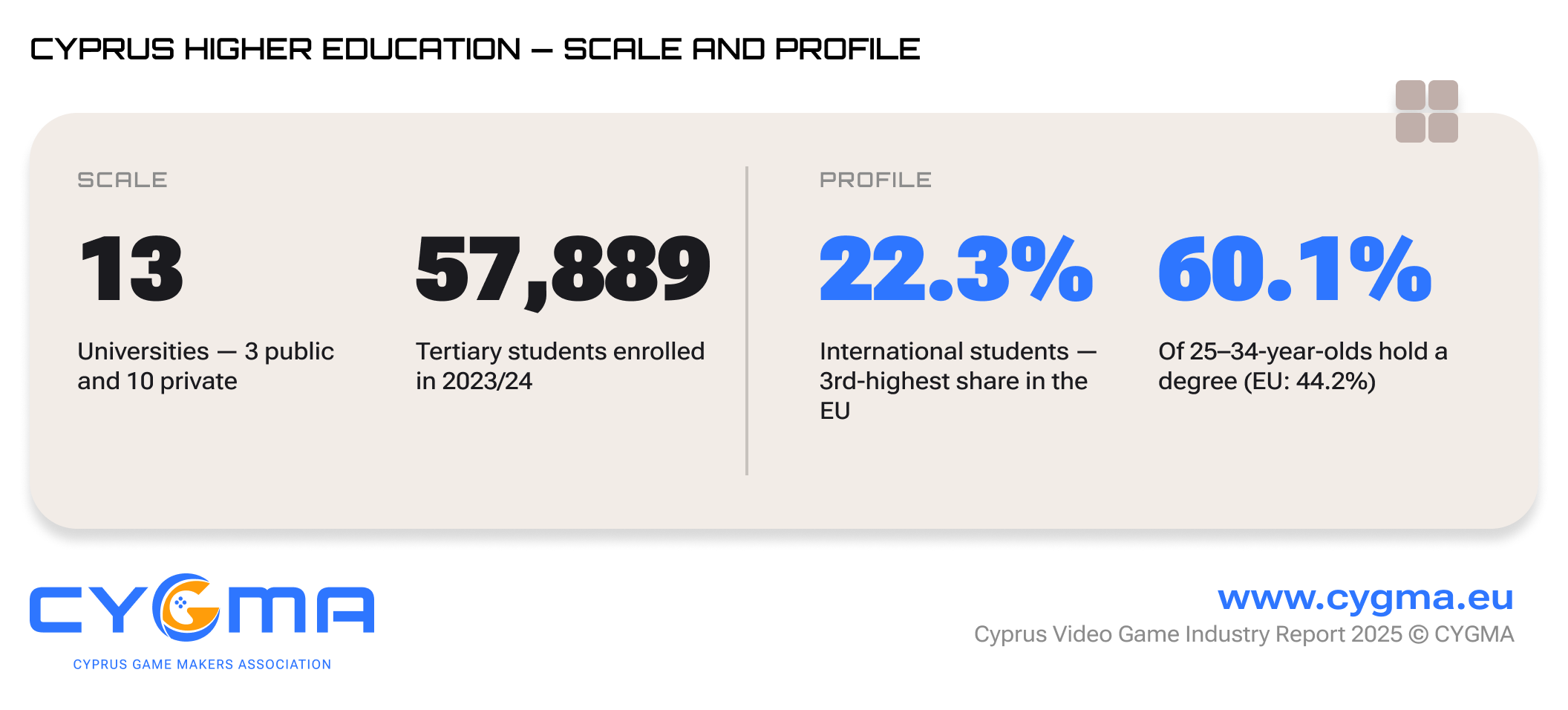
[Cyprus higher education, scale and profile]
The shortfall lies in specialisation. Technical programmes (computer science, computing and engineering) enrol between 1,415 and 1,805 students and produce 240 to 325 graduates a year. Creative programmes(multimedia, animation and interactive design) enrol 260 to 320 and produce 50 to 60. A dedicated, named games pathway enrols 40 to 60 studentsand produces just three to six graduates a year.
The figures exclude AUB Mediterraneo and the University of Limassol, which are too new to have graduated a cohort. As a cross-check, the report notes that ICT makes up 28.6% of STEM enrolment in Cyprus and about 4% of all graduates, or roughly 450 to 600 ICT graduates nationally.
[Game-relevant programmes, enrolment and graduates]
On the demand side, the report models that studios could absorb 100 to 300 junior hires a year, against the 10 to 40 that universities currently deliver. The two figures sit roughly an order of magnitude apart. The report notes that neither is an official statistic.
[Talent demand, employer base and junior hiring]
The pressure will increase from 2 January 2027. From that date, foreign-interest companies will be assessed against a commitment that 30% of their workforce is Cypriot or EU.
In response, CYGMA is working with Cypriot universities on dedicated game development specialisations. The report models that these could add 45 to 85 industry-ready graduates a year.
Events and community
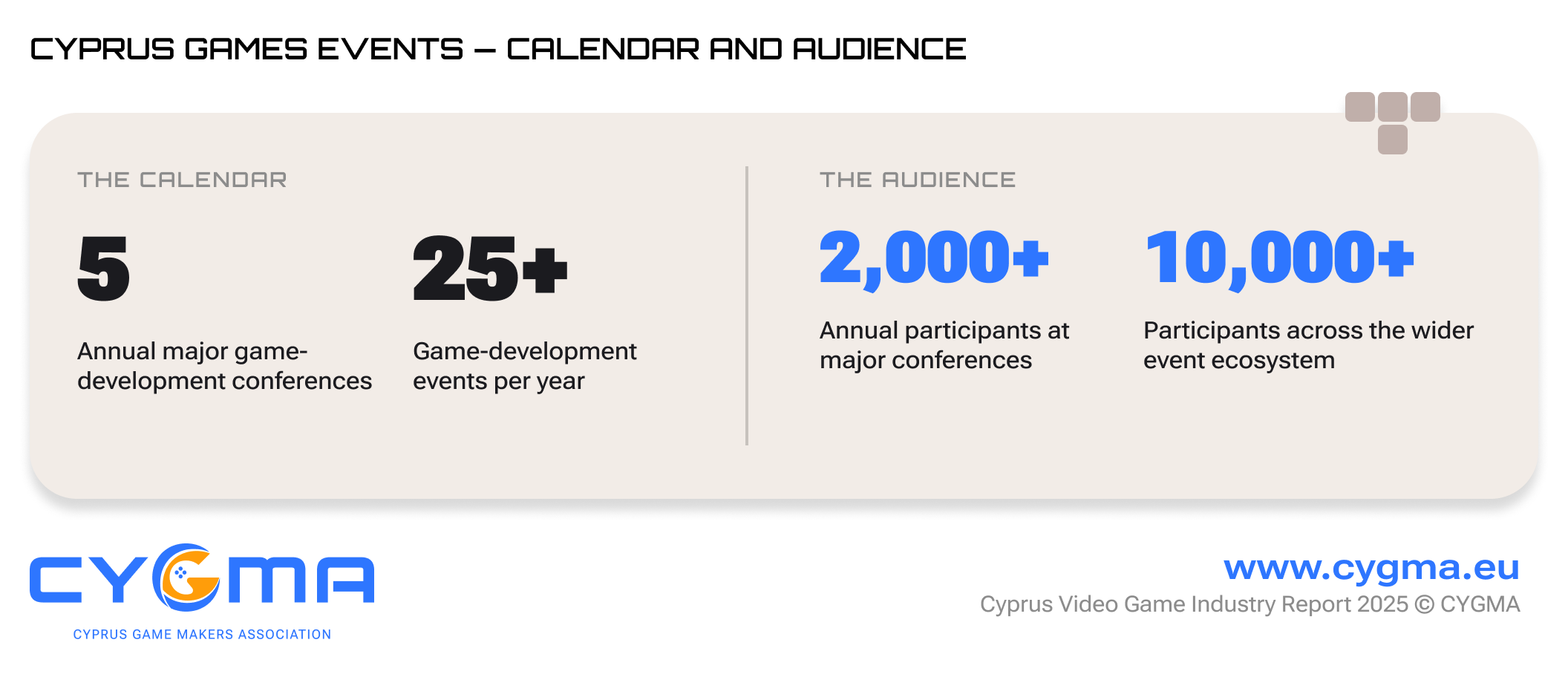
Cyprus hosts five major game development conferences a year and more than 25 game development events in total. The major conferences draw more than 2,000 participants annually, and the wider event ecosystem draws more than 10,000.
[Cyprus games events, calendar and audience]
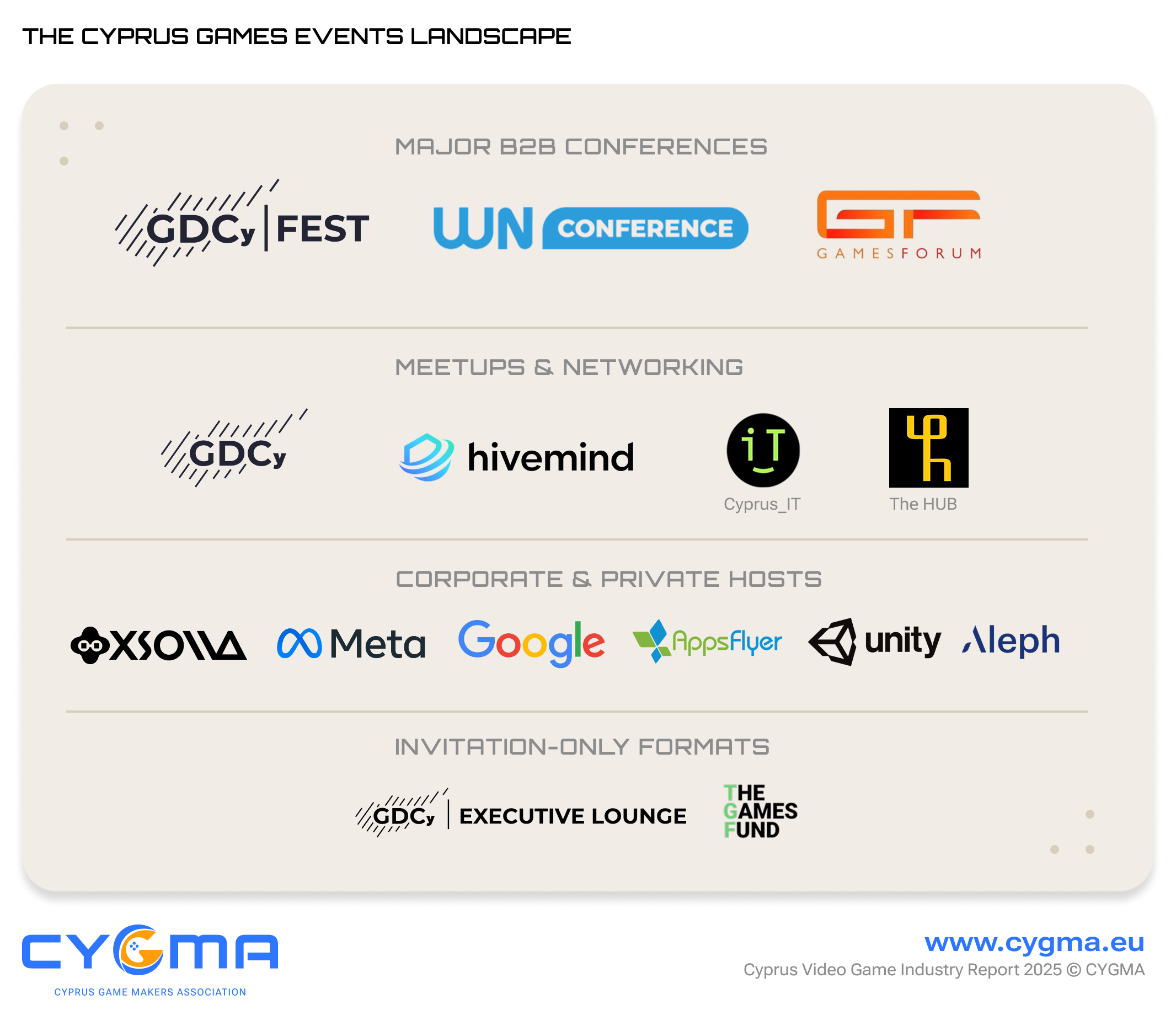
The landscape has four tiers:
- Major B2B conferences: GDCy Fest, WN Conference and Gamesforum.
- Meetups and networking: GDCy, hivemind, Cyprus_IT and The HUB.
- Corporate and private hosts: Xsolla, Meta, Google, AppsFlyer, Unity and Aleph.
- Invitation-only formats: the GDCy Executive Lounge and The Games Fund.
[The Cyprus games events landscape]
According to official analytics from WN Conference, GDCy and Gamesforum:
- 59% of conference attendees come from Cyprus, 15% from the rest of Europe, 10% from the CIS, 9% from the Middle East and North Africa, and 6% from other regions.
- 59% are C-level executives or founders.
- 53% represent companies of 1 to 70 people, 27% companies of 70 to 300, and 20% companies of more than 300.
- Developers are the largest group, at 57%, followed by advertising (32%), platform (31%), publisher (24%) and investor (18%) companies. Respondents could choose more than one type.
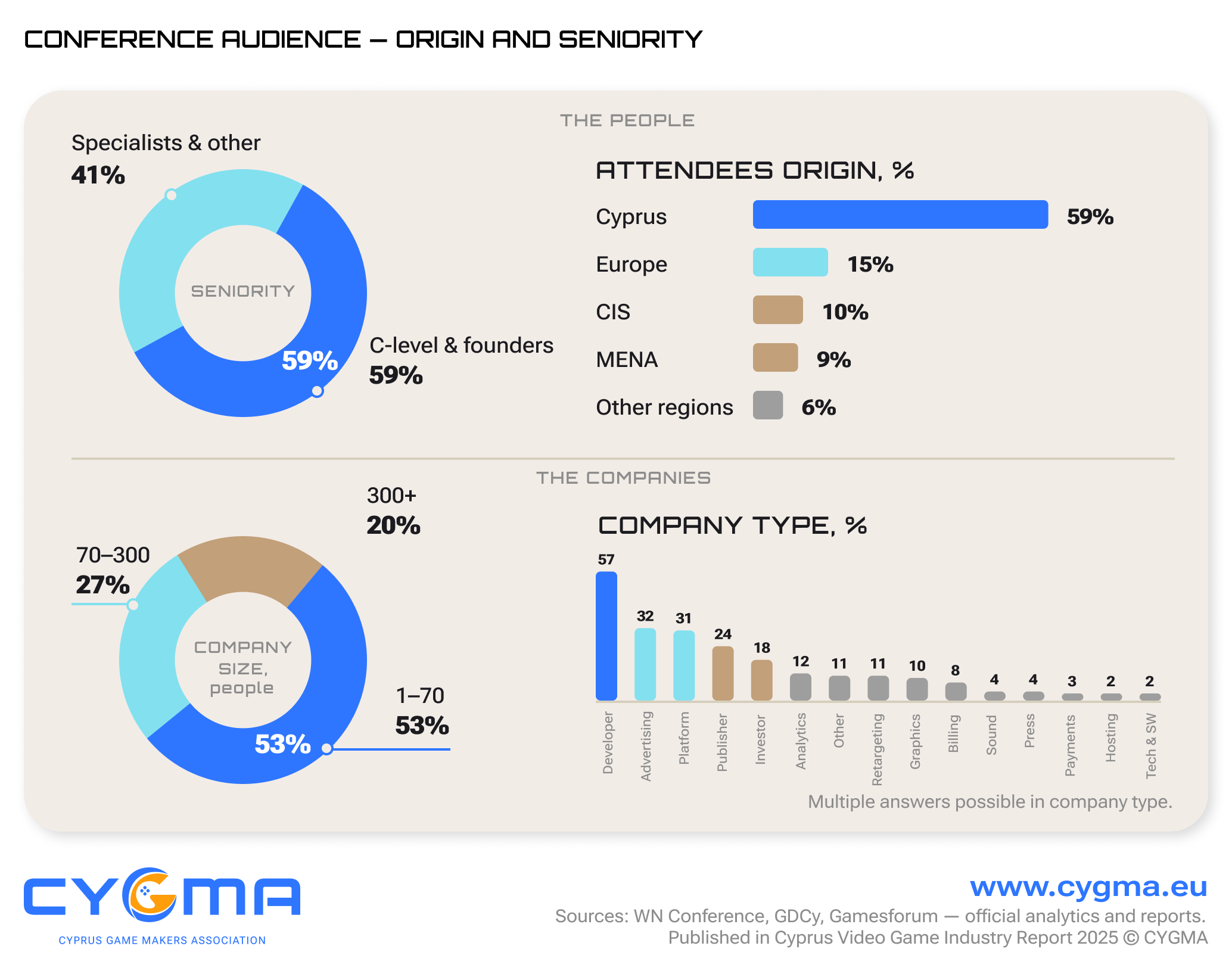
[Conference audience, origin and seniority]
CYGMA's leadership
Andrey Ivashentsev joined CYGMA as General Manager in January 2026 to build the association's operations. He co-founded GDCy, the island's game development community, and its annual conference, GDCy Fest. He is also a partner at The Games Fund.

Before moving to Cyprus, he spent six years leading technology evangelism at Microsoft across Central and Eastern Europe. He later served as Chief Innovation Officer at mobile publisher Game Insight, where he led GI Academy, a programme of game jams and university training for students entering game development.