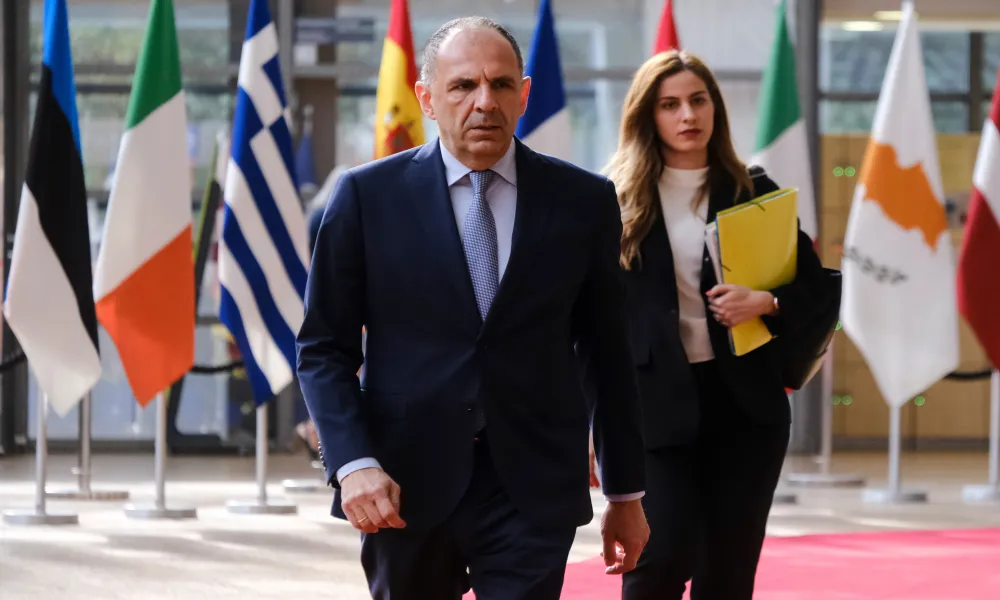

Turkish media have accused Greek Foreign Minister Giorgos Gerapetritis of making “provocative threats against Turkey” over the Great Sea Interconnector (GSI), the electricity cable meant to link Greece and Cyprus. Meanwhile, Turkish Energy and Natural Resources Minister Alparslan Bayraktar has put forward plans to connect Cyprus to Turkey by undersea electricity cable and a natural gas pipeline.
What the Greek foreign minister said
According to reports in the Greek press, Mr Gerapetritis briefed MPs on the progress of the project during a closed-door session of the Greek Parliament’s Committee on Foreign Affairs and National Defence.
He reportedly made clear that if work on the project is obstructed, Athens will take the necessary operational action to make sure it goes ahead.
Turkish media reaction
CNN Türk gave particular prominence to the minister’s remarks on the GSI. It presented them as a threat to Ankara and asked whether Athens was warning Turkey of a military response.
The Turkish network described the remarks as a “scandalous threat” and said that “Athens is playing with fire”.
In the same broadcast, the Greek minister is reported to have said that he does not consider it likely that Turkey will try to block the project. This is because it does not concern Greece alone but is a European project in which France is also involved.
At the same time, the nationalist Turkish newspaper Aydınlık referred to a possible Turkish intervention if surveys for laying the cable begin.
Ankara’s proposal for an electricity link
Striking a different tone, Mr Bayraktar said he would be willing to cooperate with Greece on energy.
In an interview, he spoke of a Turkish plan to connect Cyprus to Turkey’s grid by undersea cable, arguing that this would allow electricity to be supplied to the island.
He said Ankara had proposed to the Greek foreign minister that interconnection capacity be made available to companies wishing to supply electricity to the Republic of Cyprus. He claimed, however, that the proposal was rejected for political reasons.
Plans for a natural gas pipeline
The Turkish minister also referred to plans to build a natural gas pipeline from Turkey to Cyprus. He argued it could help produce electricity from cleaner sources and, under certain conditions, allow that electricity to be sold to the southern part of the island as well.
He added that such a pipeline could in future also work in reverse, carrying natural gas from the Eastern Mediterranean to Turkey and from there to European markets.