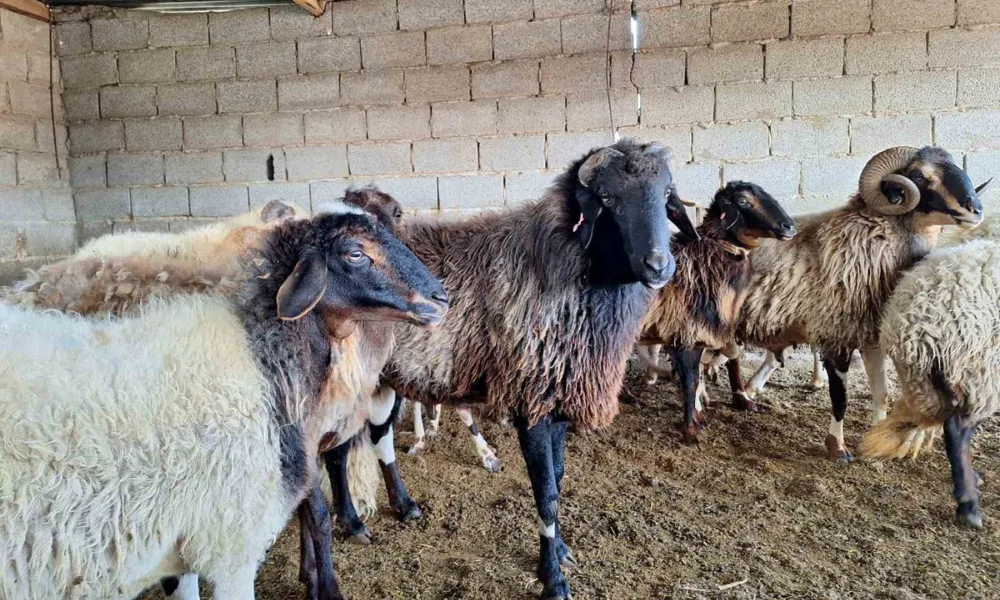
A decision on rare animal breeds affected by foot-and-mouth disease is expected within the day, the Director-General of the Ministry of Agriculture, Rural Development and Environment, Andreas Gregoriou, told the Cyprus News Agency. At the same time, he said planning remains in place to meet the 2029 milestone for increasing the proportion of sheep and goat milk in halloumi PDO.
Meanwhile, Michalis Koulouros, Executive Secretary of the Cyprus Cheesemakers Association, said there had been no particular problem with halloumi exports recently, while EKA General Secretary Panikos Hambas strongly opposed the government’s decision to reduce the share of sheep and goat milk in halloumi PDO from 25% to 15%.
Decisions on rare breeds expected
Referring to rare breeds, including fat-tailed sheep and red cattle, Gregoriou said European regulations allow for the possibility of an exemption from the usual procedures in such cases. He noted, however, that the competent authority for taking the decision is the Veterinary Services Department.
“I understand that the advisory committee has met, discussed the matter, and a decision by the Director of the Veterinary Services Department is expected within the day,” he said.
On Monday’s meeting between the Agriculture Minister and stakeholders, Gregoriou described it as particularly useful and productive, saying it allowed the ministry to explain in detail issues relating to the implementation of the European regulation, the emergency vaccination plan, epidemiological checks, animal culling and compensation.
He said stakeholders, through their statements after the meeting, appeared to have recognised the ministry’s efforts to tackle foot-and-mouth disease, provide fair compensation as soon as possible, and prepare a programme to rebuild livestock numbers with additional incentives when conditions allow.
Gregoriou also said several requests had been submitted, including the movement of animals from breeding farms to holdings owned by the same person within zones of the same health status and the same district, as well as the movement of breeding pigs from holdings not located in restricted zones. Other requests included allowing animals from two or three different farms to be transported in the same vehicle to slaughterhouses, permitting grazing, and allowing livestock trading businesses to operate in areas outside restricted zones.
“These requests were forwarded to the competent department for assessment, so it could tell us whether some of them can be decided on immediately,” Gregoriou said. “So far, we have not received a response.”
Sampling is also under way in districts not affected by foot-and-mouth disease, namely Limassol, Paphos and the free Famagusta area. It is expected to be completed on Friday.
“If these areas are found to be free of the disease, some decisions will be taken to satisfy these requests,” he said.
2029 target under pressure
Referring to the 2029 milestone, when the share of sheep and goat milk in halloumi should exceed that of cow’s milk, Gregoriou said the recent decision to reduce the required share was linked to the fact that foot-and-mouth disease had affected around 11% of the sheep and goat population, causing a corresponding fall in milk production. The matter was raised at the advisory committee, where farming organisations and sheep and goat breeders expressed their disagreement, he said. However, it was judged that the change had to be made.
“In any case, we are working to defend halloumi as a protected designation of origin product. It is a European monopoly. Only in Cyprus can cheese with these characteristics be produced and called halloumi,” Gregoriou said.
He said the PDO status gives Cyprus a comparative advantage that benefits cow farmers, sheep and goat farmers, and the wider economy.
“We are working to protect halloumi PDO and we have a few years ahead of us in that direction,” he said, adding that support measures already exist through the Rural Development Programme for the creation of new sheep and goat farming units.
He also referred to efforts to improve the genetics of sheep in order to increase productivity.
“All these measures are aimed at increasing both the quantity of sheep and goat milk and the productivity of the animals, so that we can meet the regulation’s requirement,” he said.
Asked whether the 2029 target remains achievable, Gregoriou said he was not in a position to say.
“There is planning aimed at meeting this obligation. This will become clearer next year, but unfortunately foot-and-mouth disease has set us back because the loss of livestock reduces this possibility and prospect,” he said.
Halloumi research programme extended
According to the Agriculture Ministry, the project board responsible for the implementation of the Halloumi PDO research programme has decided to extend the programme by another six months, until the end of 2026.
The programme began in June 2024 following an agreement between the Agriculture Ministry, the State General Laboratory, the Cyprus University of Technology and the Department of Agriculture. Its main aim is to prove the authenticity of halloumi, particularly by developing a method to detect any illegal use of milk powder through isotope analysis.
The ministry said the results so far were considered very satisfactory and that a database had been created containing analysis results from halloumi samples with different milk ratios, made with and without the addition of milk powder. The extension was considered necessary in order to analyse a larger number of samples and draw more complete conclusions.
Cheesemakers say exports continue normally
Koulouros said the decision to issue a decree setting the sheep and goat milk quota at 15% was deemed necessary based on measurable data from the Agriculture Ministry’s milk recording software, especially after the recent animal culls caused by foot-and-mouth disease. He said the previous decree had been issued on 31 December 2025, before the outbreak of the disease in Cyprus, and therefore did not take into account the milk lost as a result of culling.
The new decree, he said, allows cheesemakers to continue producing halloumi and serving both the Cypriot market and export markets, which bring around €350 million into the economy. Asked about the 2029 milestone for alignment with the European regulation on halloumi PDO, Koulouros said that since halloumi was registered as a PDO product, there had already been 13 other important changes to its specifications.
He said that, following a legal opinion received by the association and communication with the European Commission, a modification could be made regarding the quota that must be fixed in 2029. Koulouros said the Cheesemakers Association is essentially asking for the quota to be set according to the real data produced by the Agriculture Ministry’s software, which he said provides indisputable figures on milk production in Cyprus.
He added that the count should be carried out soon so the quota can be determined and the necessary time given to make the required amendment to the halloumi file.
“What matters to us is to be given the tools to continue producing halloumi, to bring in the €350 million from exports, to continue employing around 15,000 people in cheesemaking, and to continue taking in all the milk produced in the country,” Koulouros said.
He said no particular problem had arisen with halloumi exports recently, adding that cheesemakers had taken specific steps to avoid any reduction in production, especially for export orders, which account for the largest volumes. Following the decree setting the sheep and goat milk share at 15%, he said the association does not expect any further problem, provided the percentage reflects the real data recorded through the ministry’s milk monitoring system.
Asked whether foreign companies working with Cypriot cheesemakers had shown hesitation or changed their stance, Koulouros said no.
“We continue normally,” he said.
He said the only issue arose initially, when the first cases of foot-and-mouth disease were detected, with some countries asking for clarifications on the safety of halloumi and the possibility of the virus being transmitted through the product. The association, in cooperation with the Agriculture Ministry, provided the necessary information to the competent authorities in those countries, he said.
“Exports are now continuing normally, without any problem,” Koulouros added.
He said the association’s first priority is to maintain exports, safeguard jobs in cheesemaking, and continue taking in all milk produced in Cyprus. Around 80% of milk production, whether cow’s milk or sheep and goat milk, is used to make halloumi, he said.
Farmers warn PDO status is at risk
Hambas said EKA was strongly opposed to the government’s decision to reduce the share of sheep and goat milk in halloumi to 15%, arguing that the European regulation clearly provides that the largest share of milk used in halloumi must come from sheep or goats.
“We asked for an adjustment until 2029. Only three years remain. How will we reach more than 50% in 2029 when, in 2026, they have reduced it to 15%?” he said.
He said the issue was not whether there is enough milk.
“Halloumi PDO is a quality standard. The rules of the European Commission must be met,” Hambas said.
Asked about the cheesemakers’ intention to pursue a change to the halloumi PDO specification, Hambas said that was their matter, but argued that the original application for the product’s recognition had been made by sheep and goat farmers with small dairies.
“That initiative must be respected. No one can try to exploit halloumi PDO,” he said.
“We believe that, with such moves, halloumi PDO is at risk of being lost. Dairy industries, sheep and goat farmers, and cow farmers will all suffer. We must therefore comply with the European standard for halloumi PDO,” he concluded.