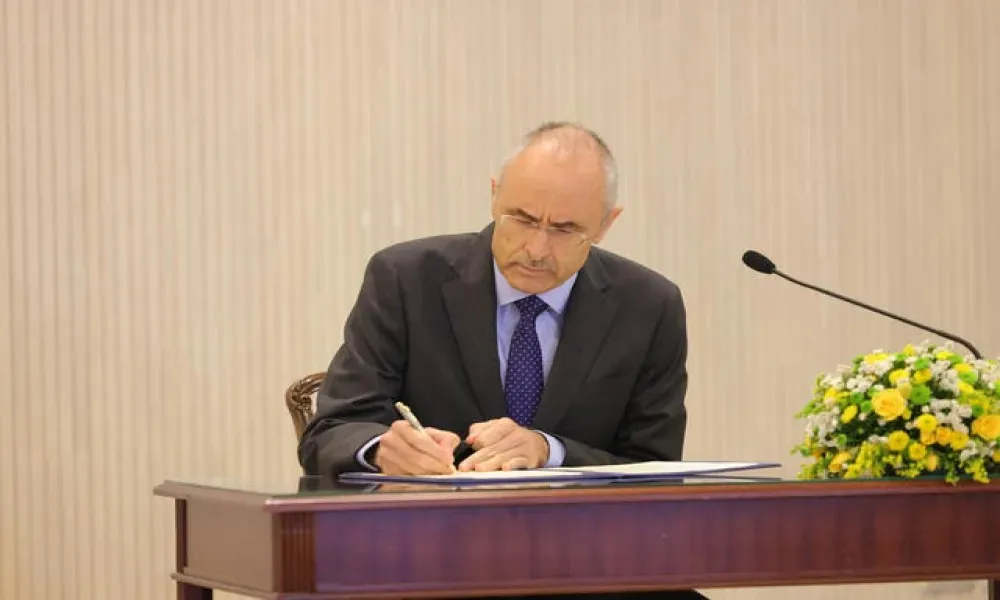

The president of the Supreme Constitutional Court, Antonis Liatsos, comments on the self-regulation of judges’ asset declarations. He also discusses digitalisation and the integration of artificial intelligence technologies into the administration of justice.
The much-discussed issue of asset declarations for judges, the digitalisation of judicial procedures, the use of artificial intelligence and how useful mediation could be in Cyprus are addressed in the second part of his interview with Politis. On the issue of asset declarations in particular, which has attracted strong criticism regarding judges, Mr Liatsos expresses the view that, since everyone is subject to scrutiny, it is a fair and effective system.
President, how do you comment on the self-regulation of asset declarations for judges? Do you consider it fair, not only for judges themselves but for the wider public, that judges regulate this sensitive issue on their own? Should additional safeguards be introduced for oversight and to convey the message that judges are also subject to scrutiny?
When the House of Representatives attempted to regulate the issue of judges’ asset declarations through legislation, the conclusion of the then Supreme Court, following a reference by the President of the Republic, was that judicial independence was being violated. It was considered an interference by the legislative power in judicial affairs.
Subsequently, we decided as judges that this issue should be regulated so that judges are subject to oversight. Let me clarify that asset declarations do not concern assets a judge had before appointment to the judiciary. What matters is whether, due to their position and service, in ways that may not align with their income, they increased their assets.
At the first joint session of the Supreme Court and the Supreme Constitutional Court, the new system for monitoring asset declarations was decided, in a manner similar to that applied to other officials. Judges submit their declarations every three years. The president and judges of the Supreme Constitutional Court submit their declarations to the president of the Supreme Court and, conversely, the president and judges of the Supreme Court, as well as all other judges in the country, submit their declarations to the president of the Supreme Constitutional Court. If someone fails to submit a declaration, disciplinary liability arises, or if a false declaration is identified, criminal liability may also arise. Additionally, if, during examination of the submitted information, anything is found that does not align with previous declarations, such as unjustified acquisition of assets, an investigation is initiated.
Therefore, the way the system is applied, and given that it is strictly adhered to and that everyone submits declarations, meaning that everyone is subject to scrutiny, I consider it to be a fair and effective system. I also consider it important that there are two Supreme Courts, each overseeing the other, which makes the process credible.
With the implementation of this system, has anything questionable been identified?
At this stage, no. The second submission of judges’ asset declarations will take place this coming September or October. The new declarations will be compared with those submitted three years earlier to identify any discrepancies. If any unjustified discrepancy is found, action will be taken.
Criticism has also been expressed regarding the digitalisation of judicial procedures. Where does this important issue stand today?
An attempt was made to introduce e-justice, which, as I understand, did not proceed for technical reasons, leading to a return to the previous system, i-justice. I believe digitalisation has progressed, but not yet to the extent that one could speak of a fully modernised system. At present, a model is in place whereby case filings can now be made electronically, yet significant weaknesses remain. Beyond technological issues, one of the main problems is that judges themselves are required to devote valuable time to procedural and administrative tasks that are not strictly judicial, which reduces the time available for their substantive work. At the same time, solutions such as digital recording for keeping transcripts are being examined. However, implementing such tools requires suitable courtrooms, technical infrastructure and sufficient staffing. Therefore, digitalisation is not only a technological issue but also one of properly supporting the system with the necessary personnel and infrastructure.
Can artificial intelligence help in the administration of justice?
Artificial intelligence can help, but only as a supporting tool and certainly not as a substitute for the judge. Its use can contribute to faster and more comprehensive case-law research, facilitate legal research and improve access to relevant sources, which in practice supports the work of judges. However, it must be stressed that these tools are not always fully reliable. For this reason, AI should be seen as assisting the judicial function, not replacing judicial reasoning and responsibility.
Why has mediation not developed as much as it could in Cyprus? Could it help reduce the burden on the courts?
The main difficulty appears to be a lack of public trust in alternative dispute resolution methods. In Cyprus, there is still a strong perception that a dispute is resolved “properly” only through court proceedings, rather than through mediation or other out-of-court mechanisms. Additionally, due to the small size of society, there is often suspicion about whether a mediator is truly independent or impartial. Therefore, although mediation is recognised as a useful and internationally proven institution that could ease court congestion, in practice it has not yet succeeded in gaining the trust of Cypriot society. To change this, institutional credibility is needed, along with better public information and the gradual cultivation of a new culture in dispute resolution.