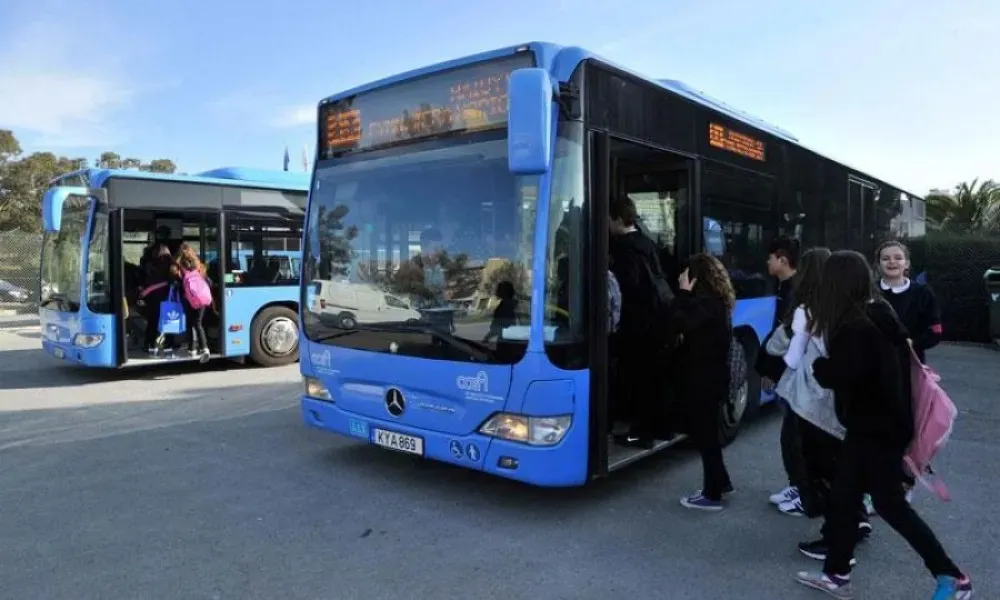

Just over two months remain until the first school bell of the new academic year rings, and one question remains unanswered: Will there be enough inspected and, above all, safe buses to transport thousands of students to school?
Organised parents sent a clear message yesterday that no bus should be allowed to transport students in September unless it holds a valid roadworthiness certificate.
Bus companies, on the other hand, warned that the available timeframe is extremely tight and that, given the current capacity of state inspection centres, it cannot be taken for granted that all fleets will be ready on time.
During yesterday's meeting of the House Transport Committee, parents, educational organisations, bus operators and MPs called on Transport Minister Alexis Vafeades to take immediate action, bombarding him with questions about how the government intends to ensure that children will not once again face a system marked by gaps, delays and uncertainty when schools reopen.
Student Safety
The president of the Confederation of Secondary School Parents' Associations, Loizos Constantinou, placed the issue at its core, noting that "these are our children travelling on buses, and for us the issue of safety is non-negotiable."
He also pointed out that more than 50% of students use buses for transportation, making the matter a broad public concern rather than a peripheral or technical issue.
Parents' concerns are not limited to buses that failed inspections. They also extend to vehicles that never appeared for additional inspections despite having been summoned.
Mr Constantinou said that nobody should be able to refuse such an inspection and insisted that no bus should be allowed on the road in September without the necessary certificate.
Education organisations OELMEK, POED and OLTEK adopted a similar position, expressing serious concern about the findings of the Audit Office and calling for increased inspections.
For teachers, the issue goes beyond daily transport to and from school and also concerns school excursions, special schools and every organised student transportation service.
Tight Timelines
Facing pressure from parents and educators, bus companies attempted to steer the discussion towards practical realities.
They did not dispute the need for strict inspections. On the contrary, they stated that safety is above all else.
The question they raised was whether the state is organising inspections in a way that makes it realistically possible to complete them.
The president of the Famagusta District Transport Organisation, Demetris Panteli, said that Famagusta had become a "punching bag," arguing that transport companies are not irresponsible and that their owners are parents themselves.
However, he described a process that, in his view, could not be implemented smoothly.
According to Mr Panteli, the company operates approximately 150 buses, while the Famagusta MOT centre was capable of inspecting only two buses per day.
He referred to understaffing and technical problems at the state testing centre, claiming that equipment at the Deryneia facility was not functioning as it should.
He further stated that companies were notified within extremely restrictive timeframes, with schools reopening while operators were still trying to arrange inspections.
Under these circumstances, he warned that it is not certain that fleets will be ready by September.
A similar view was expressed by EMEL chief executive Giorgos Kyriakou, who spoke of an unfair overall picture being painted of bus operators.
He said companies do not oppose additional measures that strengthen the sense of safety but that decisions must take into account market realities, adaptation periods and implementation capabilities.
The president of the Tourist Bus Owners Association, Pambos Kapnos, also focused on the manner in which directives are issued.
He stated that over the last two years instructions had been issued with deadlines that were difficult to meet and stressed that when hundreds of buses are affected, methodical planning and sufficient preparation time are required.
The Audit Office Report
The backdrop to the discussion was the Audit Office report, which, while not introducing new information, explains why pressure on the Transport Ministry has intensified.
According to the figures presented, 692 school buses were operating across Cyprus.
The Ministry of Transport had requested additional inspections at state testing centres, prioritising older vehicles.
However, 53% failed to appear for the mandatory inspection by the designated deadline.
Of the buses that ultimately presented themselves for inspection, 14% did not have a recent inspection certificate.
Even more concerning was the fact that 35% were deemed unroadworthy by state inspection centres.
In practical terms, one in three buses inspected displayed problems that prevented it from being considered safe for transporting students.
In the Famagusta district, the failure rate reached 76%.
In Larnaca and Paphos it stood at 47%, while in Limassol it was recorded at 39%.
These figures reinforced the perception that the problem does not concern isolated vehicles but rather the overall functioning of the inspection and oversight system.
Particular attention was also given to the reliability of private testing centres.
The Audit Office found that 19% of the buses rejected by state centres had previously passed inspections at private MOT facilities, raising questions about the quality and strictness of those inspections.
Even more troubling was the finding that, during sample inspections in Famagusta, five buses that had been deemed unroadworthy continued to operate routes.
The Audit Office concluded that these were not isolated incidents but systemic weaknesses and recommended stricter, more deterrent penalties as well as intensified inspections.
Vafeades' Response
Transport Minister Alexis Vafeades did not dispute the Audit Office's findings, noting that they provide valuable assistance in reviewing all procedures.
Mr Vafeades stated that the finding that 35% of buses were unroadworthy emerged from inspections initiated by the Ministry of Transport itself, arguing that the results confirmed the correctness of the decision to conduct additional checks.
As he explained, there had already been suspicions that "the job was not being done as it should be," particularly with regard to the adequacy of inspections carried out by private centres.
The minister acknowledged that five buses had been found operating without roadworthiness certificates, describing the situation as regrettable.
He also stated that he had requested explanations regarding how buses had begun operating without possessing a valid three-month certificate.
Mr Vafeades admitted that there "may" be a problem within the industry and that the system may not have functioned as it should have.
However, he assured that inspections will continue and will be increased, both for buses and for the mechanisms governing inspection procedures.
He added that sample inspections will be conducted at state testing centres and that the operating mechanisms of private MOT centres will also be reviewed.
According to the transport minister, all school buses must undergo a quarterly inspection before the start of the new school year.
As he stressed, inspections will not be limited to daily school services but will also extend to buses transporting students on excursions, serving special schools, educational units and private schools.