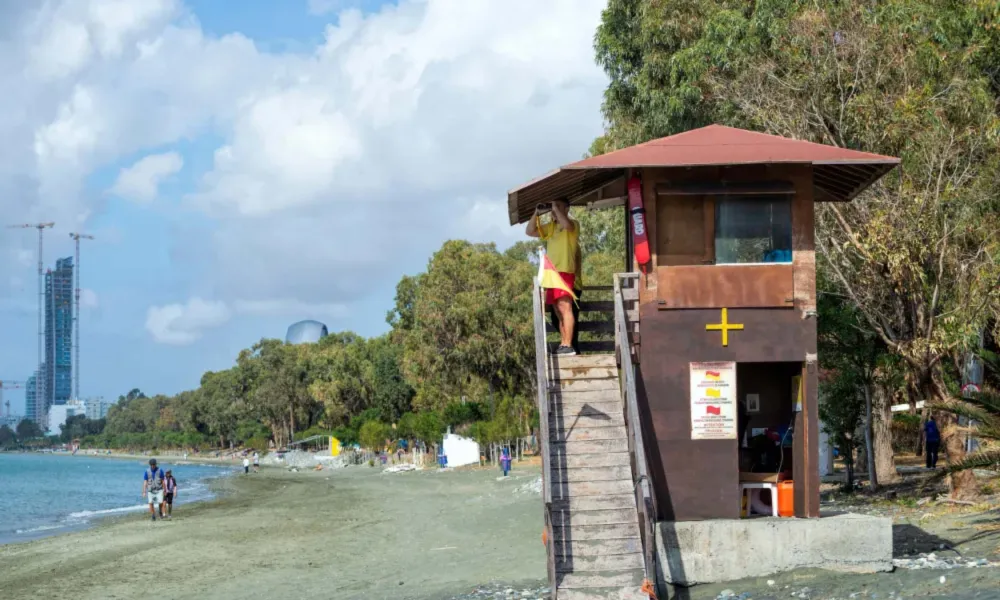

Serious concerns over lifeguard coverage at beaches, hotels and swimming pools have resurfaced at the height of the summer season, with the Cyprus Lifesaving Federation warning of staff shortages, limited coverage hours and potential weaknesses in a new certification regime.
Speaking to Politis radio, federation president Polys Pallikaros said lifeguard coverage on beaches should not only be strengthened but also extended.
According to Pallikaros, both the federation and health authorities advise people to avoid prolonged sun exposure between midday and around 4pm. As a result, many beachgoers choose to swim early in the morning or later in the evening, periods when lifeguards are often not on duty. "Ideally, there would be coverage from sunrise to sunset," he said, acknowledging that this may not be realistic for every beach.
He argued, however, that more beaches should offer extended hours and that the public should be clearly informed about where it is safe to swim at 6am or 8pm.
A decade of warnings
Pallikaros said the federation has been sounding the alarm over understaffing for at least ten years.
While lifeguard positions are advertised through district administrations under the Ministry of Interior, many remain vacant.
Ten-month contracts are generally easier to fill, he said, while some eight-month positions remain unfilled. The biggest challenge concerns seasonal positions lasting four or five months. "Why would someone leave their job to work for four or five months and then have no income afterwards?" he asked.
According to Pallikaros, Cyprus has trained lifeguards available, but employment conditions are not attractive enough.
He said one solution would be to increase the number of eight-month positions.
The current shortfall is estimated at around 80 lifeguards out of approximately 400 positions.
Letter to minister unanswered
The federation recently wrote to the Interior Minister seeking cooperation with the Ministry of Labour.
Pallikaros said the proposal was to identify unemployed people in each district, provide training and certification and place them in vacant positions.
However, he said the federation has yet to receive a response.
“They're picking people off the street”
Pallikaros was particularly critical of a recent parliamentary decision to temporarily remove the requirement that qualifications held by lifeguards working in hotels and public-use swimming pools be recognised or certified by the Cyprus Lifesaving Federation.
He argued that the change leaves the sector without a meaningful oversight mechanism until the Human Resource Development Authority (HRDA) introduces a new training and certification framework.
While acknowledging that many private training schools provide high-quality instruction, he warned that others offer inadequate preparation. "There are also pirates," he said. According to Pallikaros, some companies responsible for supplying dozens of lifeguards to hotels are focused primarily on filling vacancies quickly rather than ensuring candidates possess the necessary qualifications. "When a company needs 50 or 60 lifeguards, do you think its main concern is whether they are properly qualified? They'll take whoever they can find," he said.
He further claimed that reports have been submitted alleging that some prospective lifeguards are merely instructed to watch a couple of YouTube videos, read a few notes and then put on a uniform.
According to Pallikaros, those complaints have already been submitted in writing to parliament.
He stressed that the rarity of serious incidents should not be used as justification for lowering training standards. "It only takes one time. And that one time requires proper training to save a life."
What parliament approved
The House of Representatives unanimously approved amendments to swimming pool regulations, with 51 votes in favour.
Under the temporary arrangement, the requirement for lifeguard qualifications to be recognised or certified by the Cyprus Lifesaving Federation has been suspended for those working as safety supervisors at leisure pools, sports facilities, hotels and other tourist accommodation.
The measure will remain in place until a permanent framework governing licensing, training and qualification recognition is established.
During the parliamentary debate, MPs acknowledged that the change was intended as a temporary response to severe staffing shortages, while stressing that it should not result in weaker training standards, certification procedures or oversight.