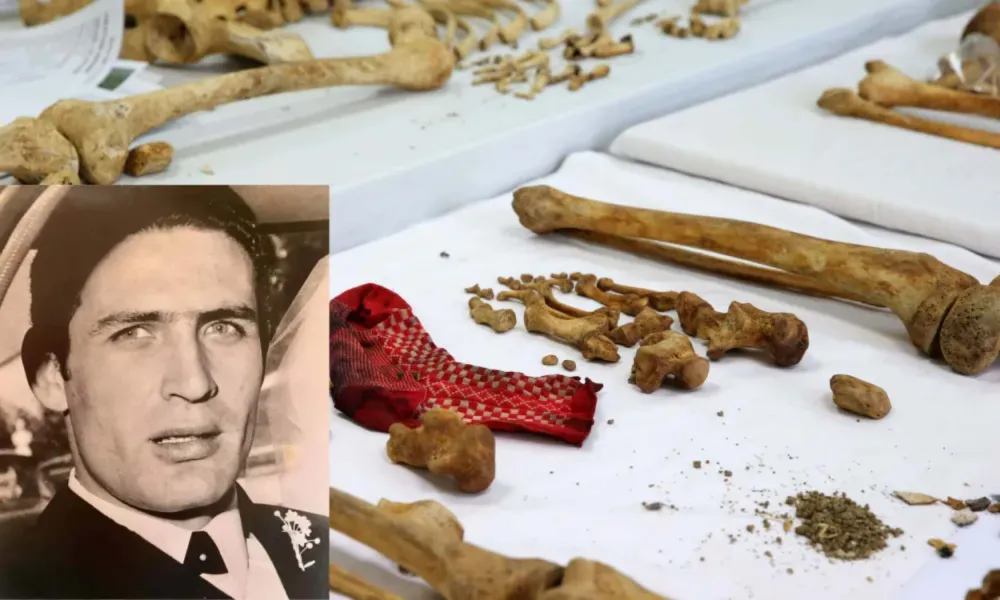

The case of Alkistis Varnava, daughter of Varnavas Varnava, who has been missing since 1974, is raising serious questions about how legislation and state services deal with the families of Cyprus' missing persons.
Speaking on Politis Radio, Varnava described the difficult decision she was forced to make in seeking a legal declaration that her father was "absent" in order to resolve inheritance issues, as well as the bureaucratic obstacles she says she continues to face.
Missing for 52 years
Varnava said information available to the family suggests that her father is likely buried in an area near the Praxandros stadium in Kyrenia that now lies within a military zone.
According to her, this has made it extremely difficult to secure permission for excavations and investigations, leaving the case unresolved for decades.
"I had no other choice"
Varnava explained that she was forced to seek a declaration of absence following the death of her mother around a year and a half ago.
While dealing with her mother's property in Paphos, she discovered that under current legislation her father continued to be regarded as a legal heir.
"When I learned this, I was genuinely shocked," she said, adding that as an only child she had no alternative if she wanted the process to move forward.
She explained that legislation enacted in 2003 treats those missing since 1974 in the same way as any other person who has disappeared, forcing families to seek a declaration of absence in order to settle property and inheritance matters.
"Offensive and upsetting terminology"
Varnava said she strongly disagrees with the provision.
"It is not easy to declare absent a man who fought and sacrificed himself for his country," she said.
She argued that when a person disappeared during the Turkish invasion and their remains have not yet been recovered, the use of the term "absent" is particularly painful.
"I believe it is deeply offensive for someone who has been missing since 1974 because of the Turkish invasion to be declared absent," she said.
Varnava stressed that the issue affects not only her family but hundreds of families of missing persons who continue to face similar procedures.
New obstacle involving the Land Registry
Despite obtaining a court order recognising her as her mother's sole heir, the matter remains unresolved.
According to Varnava, the Land Registry Department requested additional legal opinions before proceeding.
Her file was transferred from the Paphos Land Registry to the department's headquarters in Nicosia and subsequently to the Legal Service in Limassol.
"In essence, the file is being moved from one service to another until someone decides whether I am actually my mother's sole heir," she said.
Two months without meaningful updates
Varnava said her case has remained pending for around two months, after she had already gone through the lengthy legal process required to have her father declared absent.
What frustrates her most, she said, is the lack of communication from the authorities.
"The worst thing is that there has been no official update provided to me," she said, explaining that both she and her legal representatives had to make repeated phone calls simply to determine where the file was located.
"These are not acceptable practices. The state cannot operate like this when dealing with families of missing persons," she added.
Calls for separate legislation
Varnava argued that those missing as a result of the events of 1974 should not be treated under the law in the same way as any other missing person.
She said she is not seeking special treatment, but rather a specific legal framework that takes into account the unique circumstances of the missing persons of 1974 and their families, who more than half a century later are still searching for answers while continuing to face bureaucratic obstacles.