


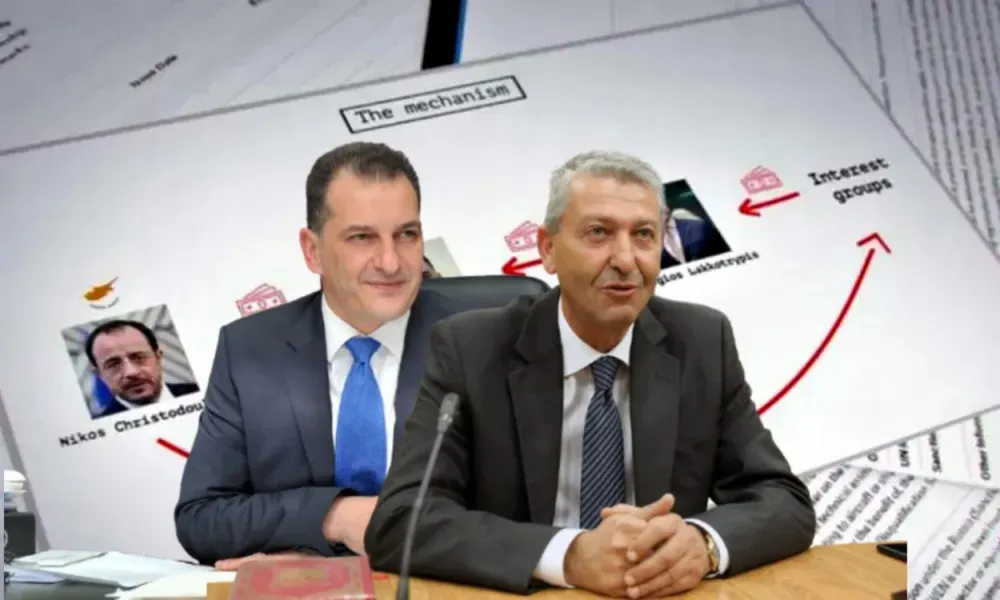

In the statement issued days ago by independent criminal investigator Andreas Paschalides, the possibility was left open for the investigation of potential criminal offences involving two individuals who were not named.
According to information obtained by Politis, the two individuals are former ministers Giorgos Lakkotrypis and Giorgos Lillikas, who allegedly appear in the approximately 26 hours of audiovisual material promising services and mediation to Black Cube operatives who presented themselves as major investors.
The two former ministers are expected to be assessed by the team of officials established within the Legal Service to examine the Paschalides findings, in order to determine whether the offence of trading in influence may have been committed.
Trading in influence is considered a serious corruption offence involving situations where a person exploits real or presumed influence to affect decision-making by a public official in exchange for financial or other benefits.
In the case of Giorgos Lakkotrypis, it has been confirmed that he received €5,000 per month from the supposed investors he met at hotels in Britain and the Netherlands. The payments were made over a three-month period.
Politis contacted Giorgos Lillikas on Wednesday to verify information suggesting he had offered services to the alleged investors in exchange for financial remuneration. However, he declined to comment on the VideoGate case.
When is an offence committed?
The criminalisation of trading in influence is based on international anti-corruption instruments, including the Council of Europe's Criminal Law Convention on Corruption and the United Nations Convention Against Corruption.
The purpose of the legislation is to protect the integrity of public institutions and prevent the creation of informal influence networks that undermine meritocracy, transparency and equality before the law.
Trading in influence is punishable in both its active and passive forms.
Passive trading in influence:
Committed by a person who requests, receives or accepts a promise of any benefit, financial or otherwise, in order to exert improper influence on a decision-maker.
Active trading in influence:
Committed by a person who offers or promises a benefit to an intermediary in order to secure favourable treatment or achieve a specific outcome.
The offence is considered complete from the moment a benefit is requested, received or promised. It is not necessary for the influence to have actually been exercised, nor for the desired outcome to have been achieved.
Paschalides' references
Particular significance is attached to two references contained in the statement issued by Andreas Paschalides, as they leave open the possibility that the Legal Service may investigate corruption-related offences and, specifically, trading in influence.
The first concerns Paschalides' statement that: "Various agreements (confidentiality and service agreements) were signed between three of the Cypriot protagonists and the purported investors, under which two of those Cypriot protagonists derived financial benefits."
The second reference is regarded as even more significant.
Although Paschalides stated that the evidence gathered so far does not reveal a violation of the criminal code by any of the Cypriot protagonists, he noted that both he and the police investigation team examined the possibility of breaches of the Council of Europe Convention on the Criminalisation of Corruption.
As he stated, this possibility was examined: "Because of the actions, representations, promises, statements and, generally, the conduct" of those involved.
However, both Paschalides and the police investigators expressed a series of reservations regarding the matter.
To parliament for explanations
Particular political and institutional interest now centres on the anticipated appearance of Andreas Paschalides before the House Institutions Committee, where he is expected to be asked to explain alleged contradictions in his findings.
Paschalides was appointed to investigate possible acts of corruption involving close associates of President Nikos Christodoulides, as well as matters relating to the Social Support Agency Fund, whose management committee was chaired by the First Lady during the relevant period.
A few days before submitting his findings, the Council of Ministers renewed, for a third consecutive term, his five-year appointment as chairman of the Independent Authority for the Investigation of Allegations and Complaints Against the Police (AADIPA).
The decision sparked political reactions and questions relating to institutional ethics and the possible impact on the independence of the criminal investigator.
What questions will be asked?
Among the issues on which Paschalides is expected to be asked to provide explanations before the Institutions Committee are the following:
1. The conclusion of hybrid warfare
How did Paschalides conclude that the VideoGate affair involved a hybrid warfare operation against the Republic of Cyprus by a hostile state, with references that appear to point towards Russia, when the identity of the person or persons who funded Black Cube's operation has not yet been established?
It is noted that Paschalides himself requested and received an extension until the end of the year to identify those behind the financing of Black Cube.
2. The authenticity of the video
How is the conclusion justified that the approximately eight-minute video published on 8 January 2026 through a fake account on X does not constitute an authentic representation of events when the full 26 hours of unedited footage had previously been examined and verified as authentic?
The confirmation of the authenticity of the complete footage was, in fact, a key prerequisite both for the Legal Service's evaluation of the case and for the taking of witness statements from Black Cube officials, a process that ultimately took place.
3. Immunity granted to Black Cube
Why did Paschalides agree, together with the Attorney General and Deputy Attorney General, to grant protected status to Black Cube and its operatives involved in gathering the audiovisual material before obtaining further information regarding the person who financed the operation?
Extraordinary meeting on 31 July
These issues, together with other questions arising from the findings, are expected to be discussed when Paschalides is summoned before the House Institutions Committee on 31 July.
Members of the committee intend to request the full Paschalides report, arguing that access to it is essential for meaningful and effective parliamentary oversight.
However, the publication or submission of the report to parliament faces obstacles because the material is still under evaluation by the Legal Service regarding the possible filing of criminal charges.
Findings unlikely to be released
Legal sources told Politis that findings from criminal investigations have not traditionally been made public while assessments regarding possible prosecutions remain ongoing.
Furthermore, should criminal proceedings ultimately be initiated, the evidence collected during the investigation would become part of a judicial process.
Will the Attorney General block the appearance?
An open question remains as to whether Attorney General Giorgos Savvides will permit the independent criminal investigator to attend the extraordinary meeting of the Institutions Committee, given that the findings remain under evaluation and no final decisions have yet been taken regarding possible criminal prosecutions.


