
The circumstances surrounding the National Guard's destruction of munitions at the Kalo Chorio firing range, which preceded Monday's wildfire near Agia Anna and Psevdas, remain under investigation, with officials confirming that warnings about heightened fire danger had been issued beforehand.
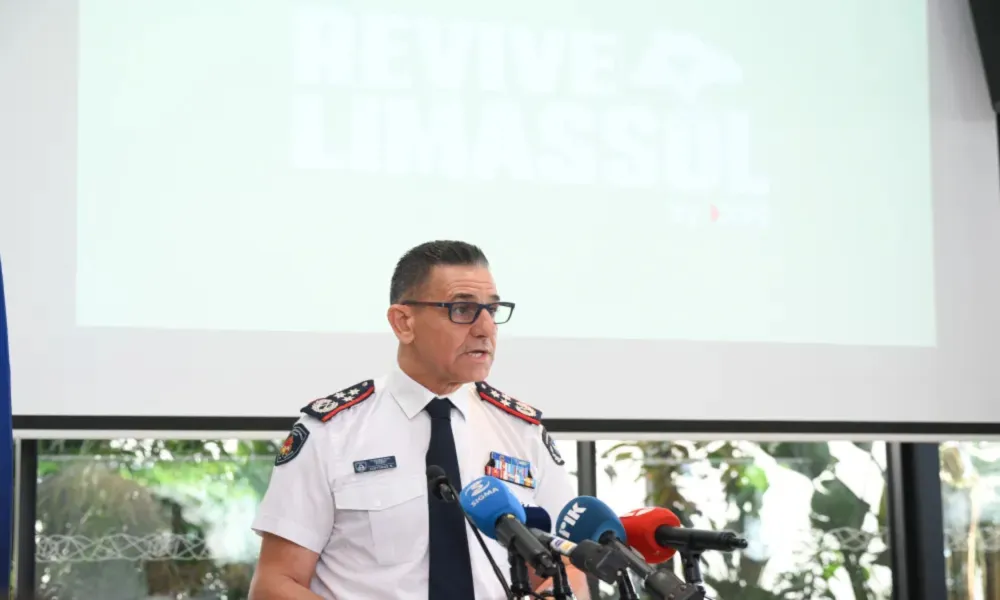
Speaking on Politis Radio's Proini Epitheorisi programme, Nikos Longinos, Chief Fire Officer and coordinator for major wildfires, said a notification letter regarding the planned operation had been circulated to the relevant authorities.
At the same time, he noted that the Department of Forests and other agencies had repeatedly warned of extreme wildfire risk during the current period.
“A single flame can bring disaster,” Longinos said, adding that activities capable of causing ignition should not be carried out during the summer months.
‘My responsibility begins when the fire starts’
Responding to questions about whether he had prior knowledge of the munitions disposal operation, Longinos stressed that his role is not that of National Civil Protection Coordinator but of coordinator for major wildfires.
He said his responsibilities begin once a fire breaks out and shows signs of developing into a major incident.
“If a fire starts, I am responsible for informing all relevant services, convening coordination centres and coordinating their actions,” he said.
According to Longinos, the first notification to the Fire Service was received at 12.27pm. Four firefighting vehicles, two from the Fire Service and two from the Department of Forests, were dispatched immediately.
Civil Defence was also mobilised to inform residents and prepare for potential evacuations.
Technical failure in SafeCY Alert
Longinos confirmed that the SafeCY Alert system failed during the initial attempt to send warning messages to residents because of a technical problem that will be investigated by Civil Defence.
Despite the malfunction, Civil Defence teams had already been deployed to the area and began warning residents and carrying out evacuations before the fire reached residential areas.
“Fortunately, the teams had already been sent because the system did not function initially. They were on the ground and began evacuations while efforts were under way to send the alert,” he said.
He suggested the warning system should undergo regular testing, potentially every 10 to 15 days, to ensure it remains operational.
Call for compliance with instructions
Longinos said authorities moved quickly to restrict access to affected communities and prevent people from entering dangerous areas.
He acknowledged, however, that some residents ignored instructions and attempted to approach the fire front on their own.
“We need to create a culture of compliance. When clear instructions are issued, they must be followed. People cannot simply take their tractor or vehicle and head towards a wildfire on their own,” he said.
Praise for organised volunteers
Longinos distinguished between uncoordinated civilian actions and the work of organised volunteer groups.
He said around 400 volunteers had received training this year and were working in coordination with emergency services.
“The volunteer groups are excellent. They work alongside us, carry out patrols and receive guidance on where they should be. The problem comes from those acting independently and without coordination.”
He added that between 60% and 70% of the vegetation clearance work required across Cyprus had been completed, although significant areas still require attention.
For the Kalo Chorio area specifically, he said he had received assurances that firebreaks had been cleared and that firefighting vehicles encountered no major access difficulties.
Wind-driven embers created new fire fronts
Longinos also highlighted the challenges created by strong winds, which carried embers over long distances and repeatedly ignited new fire fronts.
According to him, embers can travel 800 metres to one kilometre ahead of the main fire, creating fresh outbreaks even when firefighters appear to have contained the blaze.
“That is the biggest problem. While you are holding the fire on one line, an ember can land hundreds of metres ahead and start a new outbreak. The fire front becomes enormous and can even trap those trying to fight it.”