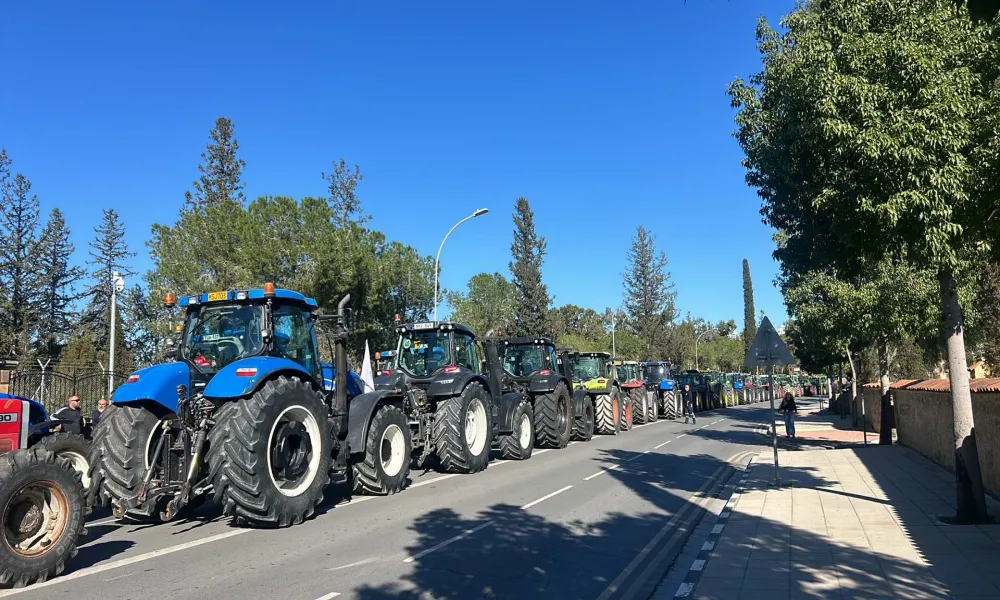

A new financing tool for farmers is expected to come into effect within the year, once the participation of Bank of Cyprus and Eurobank is finalised, Agriculture, Rural Development and Environment Minister Maria Panayiotou said on Thursday, noting that only the formal signing of the agreement remains.
Panayiotou spoke at the Ministry of Agriculture following a meeting with the director-general of the Association of Cyprus Banks, Marios Skandalis, Eurobank Cyprus's director-general of corporate banking, Foivos Stassopoulos, and Bank of Cyprus's director of retail banking, Theodosis Theodosiou.
Bridging the gap before grants are paid
Panayiotou said the tool would address the funding gap facing producers who secure approval for support under the Common Agricultural Policy but lack the initial capital to carry out their investment before the grant is paid. "For the first time, Cypriot producers are gaining access to a comprehensive financing tool," she said, describing it as a solution to the longstanding problem of liquidity shortages for necessary investment.
She added that until now, this funding gap had delayed or, in several cases, cancelled investments altogether, whereas the new tool would allow farmers to proceed immediately with the investments they need, through favourable lending terms and by drawing on Common Agricultural Policy resources. She said the meeting formally completed the participation of Bank of Cyprus and Eurobank, through the Association of Cyprus Banks, in the scheme.
Panayiotou described the development as the result of months of work under the ministry's three-year strategy, which includes 70 targeted actions, as well as cooperation between the public and private sectors. She said the government had built the framework, with the two banks providing financing to beneficiaries, and called the tool one of the most significant measures in the strategy for the primary sector and a further concrete step in implementing President Nikos Christodoulides's governance programme. She thanked the finance ministry, the treasury, the law office, the banking institutions and the Cyprus Agricultural Payments Organisation for their cooperation in shaping the framework, adding that supporting the farming community requires suitable financing tools, faster procedures and economic security for people living in rural areas.
Banks call the scheme a step for the primary sector
Skandalis said the completion of cooperation with the agriculture ministry marked a substantial step in the banking sector's support for the primary sector, adding that the new targeted financing tools would give farmers greater flexibility and more direct access to the resources they need to make better use of state schemes. He said the initiative reflected the importance of public-private cooperation and fits within the banking sector's strategy of supporting the economy, society and the development prospects of rural Cyprus.
In a statement, the Association of Cyprus Banks said interested farmers would be able to approach the participating banks directly, and that, as with any loan application, a creditworthiness check would take place beforehand, with financing linked to the corresponding state scheme once approved. According to the statement, funds would be disbursed in stages, covering both the initial phase of a project's launch and its main implementation phase, when most of the grant is paid out.
How the scheme will work in practice
Theodosiou said Bank of Cyprus was taking part in the scheme "with particular satisfaction," describing support for the agricultural sector as a longstanding commitment of the bank, which he said recognises the contribution of farmers, livestock breeders and producers to the economy, food security, regional development and the survival of local communities. He added that strengthening agricultural entrepreneurship creates opportunities for growth, investment, innovation and employment, particularly for young people in rural areas.
Stassopoulos described the cooperation as significant and pioneering, aimed at practically supporting farming and livestock breeding. He said Eurobank had responded to the call to join the scheme some time ago, and that the process was completed after persistence and cooperation between the parties. He said the goal was to bridge the funding gap between the funds the state draws down and farmers' investment needs to strengthen their competitiveness and productivity.
Asked how the tool would work in practice, Theodosiou said it would cover the period between carrying out an investment, when capital is needed, and the payment of the subsidy once the investment is complete, so that farmers, livestock breeders and other scheme beneficiaries would have access to the necessary capital from the outset, allowing them to carry out their investments without delay. Stassopoulos explained that a producer would submit their application and secure grant approval as before, and if they lack the required liquidity, they would approach one of the participating financial institutions and receive financing at a significantly lower cost than would otherwise apply. Once the investment is completed and the grant is paid, the amount would be used to repay the financing extended to the beneficiary.
Source: CNA