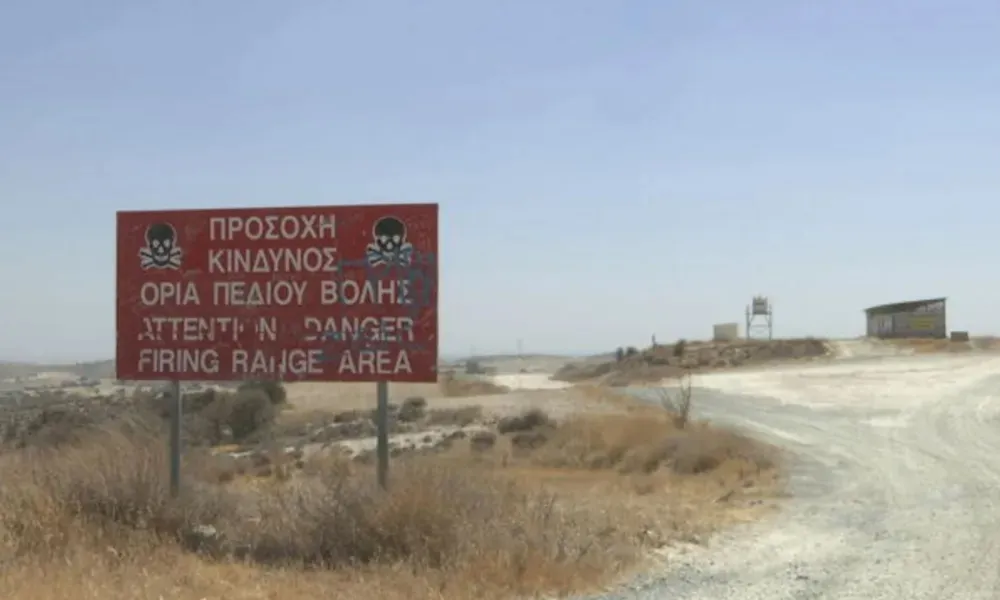

The investigation ordered by the Cyprus National Guard General Staff (GEEF) into last week's wildfire at the Kalo Chorio firing range in Larnaca faces significant limitations in relation to events that unfolded there and the outbreak of the blaze, which endangered nearby communities. The findings of the inquiry are expected this week.
However, what has become the subject of discussion in military circles and beyond is the decision by the National Guard leadership to appoint a brigadier to conduct the investigation. According to a statement by the Ministry of Defence, "within the framework of establishing the causes and circumstances of the fire in the Kalo Chorio firing range area, as well as investigating any disciplinary and criminal responsibilities, the General Staff of the National Guard has appointed Brigadier Savvas Stefanou as criminal investigator. The completion of this process constitutes an essential and necessary step towards the objective, complete and documented recording of events, as well as determining the circumstances under which the incident occurred."
Based on that decision, any investigation into potential responsibilities of officers senior to the investigating officer is automatically excluded. In other words, the National Guard leadership, namely the chief, deputy chief and chief of staff, who hold the ranks of lieutenant general (the first two) and major general (the latter), fall outside the scope of the inquiry.
In military investigations, whether disciplinary or criminal, the investigating officer may examine officers of the same rank, provided they are not senior to him, as well as officers of lower rank. As a result, he will not be able to examine whether any disciplinary or criminal offences may arise in relation to the National Guard leadership.
The criticism regarding the appointment of a brigadier, which concerns the rank rather than the individual himself, intensified following the indirect acceptance of responsibility by National Guard chief Lieutenant General Emmanouil Theodorou, who publicly apologised for the training activity at the Kalo Chorio firing range involving explosions used to destroy ammunition and the major wildfire that followed.
A military source told Politis that when an officer conducting an investigation determines that it may need to be expanded to include more senior officers, he may resign from the role and the investigation can then be assigned to a more senior officer or, at the very least, one of equal rank to those being investigated.
There is also the option, should it be deemed necessary, of appointing an independent investigator, thereby avoiding difficulties arising from rank restrictions.
What he did not answer
Another significant aspect that is also attracting considerable comment is what some see as an attempt by the National Guard chief to shift responsibility onto military personnel while removing potential responsibilities of the political leadership from the discussion, particularly following the defence minister's initial statements.
Lt Gen Theodorou stated, among other things, that "this was a planned training activity, as was known to all the communities, involving professionals who deal with explosives disposal, in cooperation with an allied country, and it had been planned long in advance."
He also assured the public that "the National Guard had issued an announcement in good time about this activity, as it does for every other activity that involves live-fire exercises in a specific area."
Based on these comments, the chief made no mention of the apparent breach of a standing National Guard order prohibiting activities at the firing range during the summer months.
Furthermore, his statement that the activity had been planned in advance and that the surrounding communities had been informed indicates that everyone within the National Guard was aware that ammunition destruction operations would be taking place during a period of extremely high temperatures.
Questions also arise from the fact that the first briefing by the Defence Minister made no mention of a training activity involving a United States military unit.
Indeed, Defence Minister Vasilis Palmas issued conclusions only hours after the fire, stating that responsibility had a "name and surname" and placing responsibility on the 70th Engineer Battalion.
He had stated that "despite the prohibition in place, the 70th Engineer Battalion proceeded with the destruction of the specific ammunition, resulting in the outbreak of the fire, which endangered human lives and caused damage to property."
The significant question that emerges is how the battalion that implemented a decision can bear responsibility while those who planned the training activity do not.
Could it have taken place later?
Another issue that has attracted attention since last week is whether the training activity should have taken place in the middle of summer under such temperatures, or whether it could have been postponed until autumn or another period.
Military sources told Politis that reserving the Kalo Chorio firing range, the only range that meets the requirements for exercises of this type, requires advance planning and completion of procedures set out by the National Guard.
Given that the exercise involved a US military unit, all required planning was carried out in advance and all relevant National Guard departments were informed.
Why, however, did nobody halt an exercise carrying an increased risk of causing a wildfire?
According to information obtained by Politis, the exercise was not of an urgent nature. In other words, there was no immediate need to destroy the ammunition.
As such, the explosions used for the destruction of the munitions could have taken place at another time of year.
Findings expected this week
Regardless of the above issues, the National Guard investigation into the circumstances under which the Kalo Chorio wildfire broke out is expected to be completed towards the end of the week.
However, neither the Ministry of Defence nor the National Guard has clarified whether any public announcements will be made concerning the findings.
The incident is also expected to be examined by the House of Representatives when parliamentary work resumes.