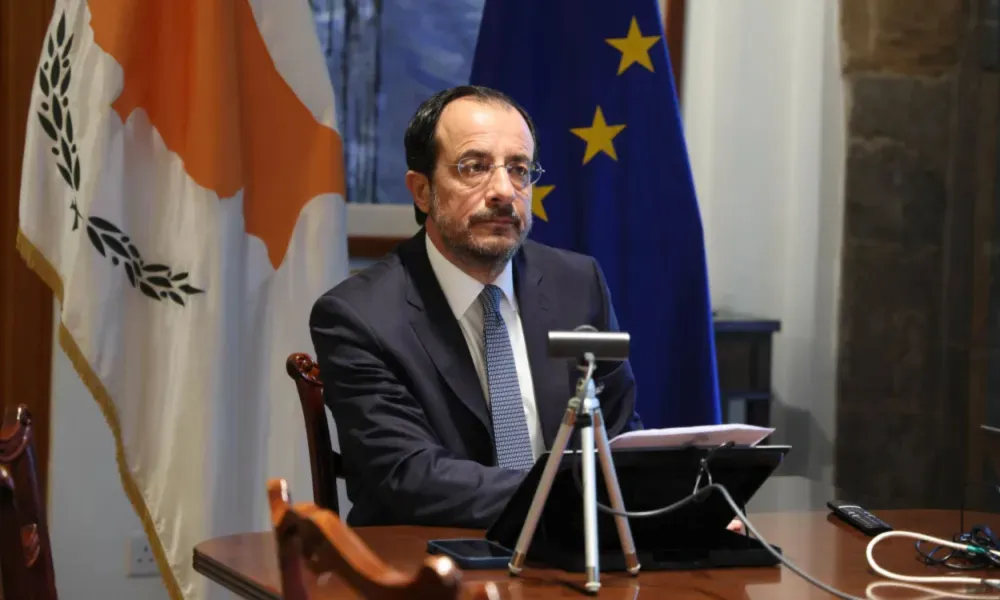

President Nikos Christodoulides on Tuesday unveiled a new policy framework and action plan for the vocational education, employment and care of young adults with disabilities, describing it as a long-term reform designed to close longstanding gaps in support after graduation from special schools.
Presented at the Presidential Palace, the initiative introduces three equal pathways for young people transitioning into adulthood:
- Continued learning and vocational training.
- Supported employment and participation in the open labour market.
- Creative engagement and care programmes.
Mr Christodoulides said the success of the policy would ultimately be measured by its impact on people's lives rather than by budgets or the number of measures announced.
"There are political decisions that are judged not only by the amount of funding involved or the number of actions they contain, but by the extent to which they change the lives of our fellow citizens," he said.
Addressing a gap after graduation
According to the president, the government inherited a system that included a range of support structures for graduates of special education programmes but suffered from a critical weakness.
Links between education, training, employment and care services were limited, leaving many young adults with disabilities outside higher education, employment programmes and day-care services after completing school.
As a result, many remained excluded from active social and economic participation, creating challenges both for them and for their families.
Mr Christodoulides said concerns raised directly by young people with disabilities and their parents helped shape the government's response.
He referred to a young man from Paralimni, Nektarios, who had spoken to him about uncertainty over his future after leaving school.
To address the issue in the short term, the government last year extended attendance at special schools until the age of 22, instead of 21.
New MIEEK programme
The first pathway focuses on young people wishing to continue their education and vocational development.
From September, a new Inclusion and Vocational Empowerment Programme will be offered through the Post-Secondary Institutes of Vocational Education and Training (MIEEK).
The programme will operate in all cities and participants will receive a diploma upon completion.
Mr Christodoulides said the initiative creates an organised route through which graduates of special education programmes can continue developing skills and preparing for employment after the age of 22.
Focus on employment
The second pathway centres on productive employment and participation in the open labour market.
New Supported Employment Programmes and schemes designed to prepare participants for work in social enterprises will begin operating in September.
The president said the government wanted young people with disabilities to participate fully in economic and social life.
"We want them to work, create, contribute, be recognised for their many abilities and have equal opportunities in the open labour market," he said.
Upgraded day-care services
The third pathway concerns individuals who require different forms of support and care.
Under the plan, the government will modernise and enhance programmes delivered through Day Care Centres, providing stronger support and opportunities for meaningful participation.
Mr Christodoulides said young people who require additional assistance should have the same right to quality of life, dignity and social inclusion as everyone else.
Five ministries involved
The president emphasised that none of the three options should be regarded as superior to the others.
"They are equal. The right choice for each young person is the one that responds to their individual needs," he said.
He added that, for the first time, the state would operate through a coordinated approach rather than separate and disconnected policies.
The framework was developed through cooperation involving five ministries, alongside the Deputy Minister to the President and the Deputy Minister for Social Welfare, who coordinated the effort.
'A moral obligation'
Mr Christodoulides said the ultimate objective is to ensure young people with disabilities can participate fully in society through equal opportunities in education, training, employment, personal development and social inclusion.
"This is not simply a political goal. It is a moral obligation that we have as a state," he said.
Addressing young people with disabilities directly, the president said the government wanted to send a clear message.
"We see you, we hear you, we value you and we are here to do whatever is necessary to ensure that you participate actively in the economic, educational and social life of this country."
He added that inclusion means ensuring no one is left behind and that everyone has genuine choices and equal opportunities.