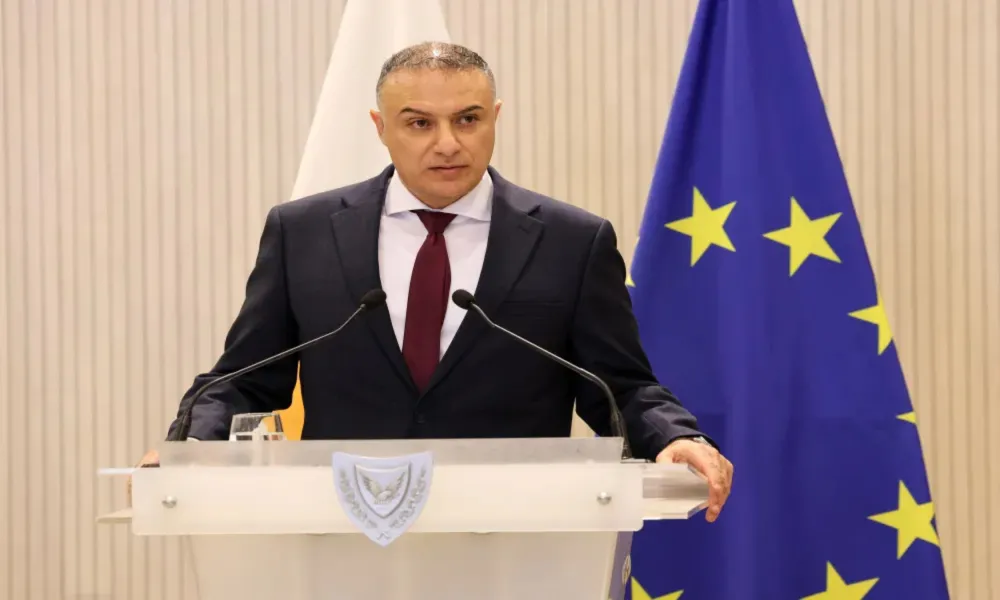

Farm organisations are set to hold their first meeting today with new Agriculture Minister Christos Senekis following the change of leadership at the ministry.
The meeting is expected to be largely introductory, allowing the minister and representatives of the agricultural organisations to become acquainted and exchange views.
At the same time, both sides are expected to discuss how they will coordinate going forward through an open channel of communication.
"We will be looking at how we communicate for the benefit of the primary sector, especially on issues that require consultation," Tasos Giapanis, secretary-general of Panagrotikos, told Politis.
Additional water supplies
Although no formal agenda has been set, the agricultural organisations intend to raise several issues they regard as urgent.
Their main concern is the supply of additional water quantities to areas served by the Southern Conveyor Project.
The organisations are dissatisfied with the quantities allocated this year by the Water Development Department (WDD), arguing that they are insufficient to cover demand and are placing increasing pressure on farmers.
Despite efforts by the department to provide an additional 3.5 million cubic metres of irrigation water, including 2 million cubic metres for the Paphos Irrigation Project and 1.5 million cubic metres for the Southern Conveyor Scheme, farmers remain unconvinced.
The groups are expected to highlight concerns from producers in Larnaca and the free Famagusta district, who depend heavily on the Southern Conveyor network and argue that current allocations do not meet the needs of crops.
Panagrotic Union of Cyprus (PEK) president Christos Papapetrou told Politis that additional water is urgently needed for seasonal crops such as potatoes, which are currently being planted for winter production.
He noted that potato growers will require water within the next two weeks and recalled that farmers supplied through the Southern Conveyor received limited quantities for tree crops and none for seasonal crops.
For its part, the WDD maintains that its three-year plan, based on current reservoir levels and future water projects, does not allow for additional allocations, particularly for seasonal crops.
The farming organisations remain unconvinced, pointing to this year's relatively satisfactory rainfall levels.
Senekis sees unfairness
The new minister has already publicly expressed the view that agriculture has been treated unfairly in terms of water allocation, particularly over the past one to two years.
Speaking last week, Senekis said that, provided reservoir levels allow it, the ministry intends to ensure that farmers also benefit from new measures aimed at strengthening water security.
Foot-and-mouth compensation
Alongside water issues, farm organisations intend to raise concerns over compensation linked to the recent foot-and-mouth disease outbreak.
According to Giapanis, some livestock farmers have yet to receive compensation for animals that were culled, while others received only a limited percentage of what they expected.
The organisations reject the Veterinary Services' position on the issue.
Veterinary Services Director Christodoulos Pipis previously stated that all livestock owners entitled to compensation had already been paid.
He said that only three owners representing four livestock units had not received compensation and had been informed accordingly.
According to Pipis, compensation decisions must comply with the law and follow legal guidance provided by the Law Office.
Rising production costs
Papapetrou said another important issue that will be raised, albeit briefly, is the steadily increasing cost of agricultural production.
He pointed to higher water charges and fertiliser prices among the factors pushing costs upward.
According to Papapetrou, farmers are unable to pass these increases on to consumers through higher prices.
"Weather conditions, geopolitical developments and decisions taken in Brussels all continue to impact European farmers and consumers," he said.
He argued that the challenge is even greater in Cyprus, where the small scale of agricultural production results in higher production costs than in larger economies.