
By Andreas D. Mavroyiannis
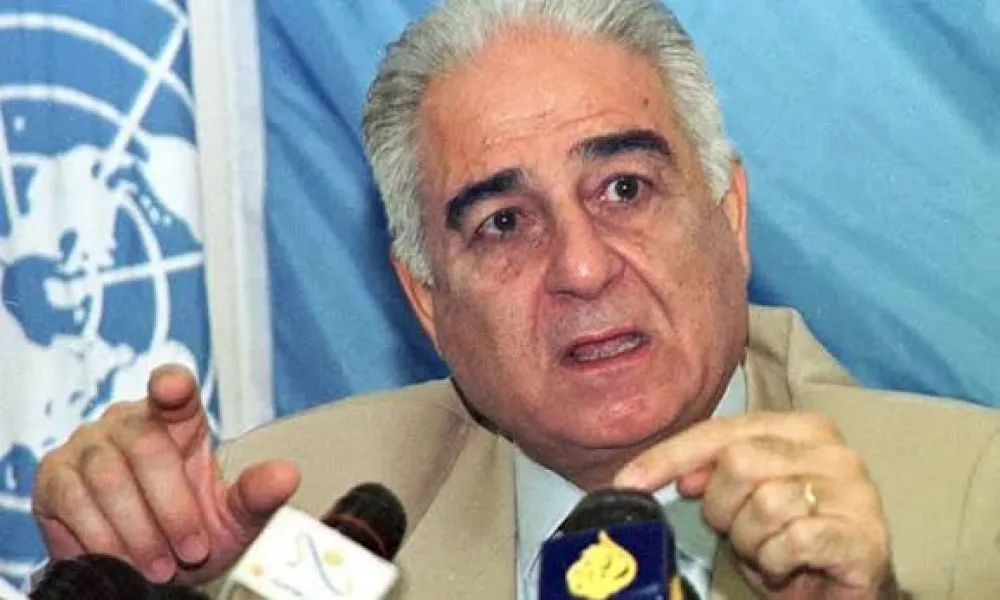
Benon Sevan, who passed away last Sunday evening at the age of 88, was the epitome of the true patriot of this land. He embodied its values and its traditions: trustworthiness, philotimo, generosity and modesty.
He undeservedly paid a price over the last twenty years when his name was drawn into the Oil-for-Food scandal in Iraq. It embittered him and wounded him deeply, but it could not overcome his human quality or his clear view of life and history.
Unfortunately, our people all too often adopt narratives put forward by third parties that are dressed up in official forms of affected seriousness.
That is why, first of all, I would like to set down briefly, as a witness, four points.
The 2005 allegations and the Volcker inquiry
Benon was unjustly accused in 2005 of taking bribes from Saddam Hussein. Kofi Annan, then Secretary-General of the United Nations, had been his close friend and, for many years, his colleague and collaborator. Annan placed him on leave and entrusted a major investigation to a committee of inquiry headed by Paul Volcker, former Chairman of the US Federal Reserve.
It was more or less an open secret among all of us in New York at the time that there was indeed a problem, and that it concerned mainly Kojo Annan, son of Kofi Annan. At most, Benon could have been faulted for failing, out of friendship with Kofi Annan, to report certain suspicious transactions in good time.
But the system mobilised to find a scapegoat in order to save the Secretary-General. It was felt that any proof of his guilt, and his resignation, would be a major blow to the UN.
My meeting with the Volcker team
I met the Volcker team and found that they were all enlisted in an incredible effort to target Benon in order to save Kofi Annan. I think it is worth mentioning that the entire investigation cost a total of 15 million dollars, and its findings spoke of a bribe of 135 thousand dollars to Benon.
Nothing was ever found implicating Benon in accepting bribes. That is why the Committee’s final reasoning was roughly as follows. During those years Benon had made periodic transfers of money from Cyprus to his account in New York, which he declared with full transparency. The investigators calculated that the total came to 135 thousand dollars.
Benon had a very simple and entirely truthful explanation: the money came from his aunt, for whom he was all she had in the world. Volcker’s investigators concluded that an elderly lady who received her pension from the Press and Information Office in cash could not have kept so much money in her home. They even preferred to claim (sic!) that Benon himself was responsible for her death, from a fall down a lift shaft, in order to silence her.
I remember telling them that they had no idea about human relationships and feelings, and that they could not understand the traditional values and principles of our society.
The decision to leave the United States
In late September 2005, events had taken a turn. Benon had resigned and his immunity had been lifted, and his arrest by the US authorities seemed most likely imminent. I advised him to leave the United States and come to Cyprus. He did so with a heavy heart. He could not believe that justice would not prevail, and Micheline, his late wife, was still working at the UN Secretariat.
My conversation with Paul Volcker
I met Paul Volcker a few months later. When I told him what I thought of the investigation and his report, he lowered his gaze and said they had done the best that could be done for the UN. I told him I hoped he understood that people and their names cannot be crushed in this way. He looked at me somewhat ironically and said: “this is how life goes my dear fellow”.
My meeting with Mark Malloch Brown
A little later, Mark Malloch Brown took over for a few months as Deputy Secretary-General of the UN. When I went to see him, he revealed to me that his mission was to “save” Kofi Annan.
When I spoke to him about Benon, he said that unfortunately the decisions had been taken, guided by what they considered best for the UN. He acknowledged that they might be unjust, but said Benon should seek justice through administrative and judicial procedures. The only thing we achieved at the time was respect for Benon’s pension rightsand the payment of his pension to Cyprus.
My last meeting with Kofi Annan
In December 2017, a few months before his death, I met Kofi Annan for the last time in Geneva. He asked me about Benon himself and confided that it weighed on his conscience. This was not because he believed he had done anything wrong or unjust, but because he had not been allowed to show solidarity with an old and good friend.
Forty years of service at the United Nations
Benon Sevan was born in Nicosia in 1937. His life was far from easy. He graduated from the Melkonian Educational Institute and studied in the United States. In the late 1950s and early 1960s he was actively involved in political affairs, and he was always distinguished by his concern for the country and its people.
He served the United Nations for 40 years, from 1965 to 2005. He undertook high-level missions, often dangerous and in war zones, and he always had the courage and determination to serve humanity.
In August 2003, by sheer luck, he survived the terrorist attack on the Canal Hotel in Baghdad, in which 22 members of the UN mission lost their lives.
A member of the Armenian community of Cyprus
To all his friends and colleagues he was always the sensitive, serious, effective and generous official. He served the principles and values of the organised international community passionately, with respect and dignity.
As a member of the Armenian community of Cyprus, he knew evil and injustice first-hand. He always did good and worked to build a better future, which he felt was his duty. He sought neither titles nor recognition, even though he held the highest position any Cypriot has ever held at the UN.
For me, his modesty and humanity were proverbial. In 2012, shortly before the start of the first Cyprus Presidency of the Council of the EU, I asked him, as the representative of the Armenian General Benevolent Union (AGBU), whether we could use some of the Melkonian premises for the needs of the Presidency. With tears in his eyes, he told me how honoured he was at the idea that he could contribute even that much.
Jasmine, always be proud of your father, as all of us are proud of this great man of our Armenian community, of Cyprus and of the whole world.
May his memory be an eternal blessing.