
There are cars that make history. Makarios’ Cadillac. Mr Bean’s Mini. The DeLorean from Back to the Future. Christodoulides’ armoured limousine. And then there is the black van of the Republic of Cyprus, an object of universal Cypriot significance.
A vehicle which, if one believes everything that has at various times been written about the technology at the centre of the case, was not exactly a means of transport. It was an institution. It was the Cypriot encyclopaedia Polignosi. We are talking about a vehicle with more responsibilities than the Interior Ministry.
Forbes
Remember the Forbes story that was first read by Andros Kyprianou?
The affair began as a spy thriller and has ended up somewhere between “Good morning, do you have an appointment?” and, shortly afterwards, “please visit your gastroenterologist because the predator that performed your digital colonoscopy found something that should be examined.”
Now the Independent Authority Against Corruption says that when it decided to open an investigation into all aspects of the matter, the possible conflict of interest of Deputy Attorney-General Savvas Angelides was included in its scope.
Indeed, according to the Authority, when it became clear during the 29 July meeting that the investigation would also look into him, Mr Angelides left the meeting. Who, between ourselves, would have sat there and let Poyiadjis grope him?
The Authority’s recent position, of course, contrasts with what the Attorney-General had said regarding the scope of the proposed investigation.
In another country, this might be seen as a serious institutional disagreement. In Cyprus, the announcement was issued on a Tuesday, so, as the children’s song goes, “I don’t work on Tuesday either because my nose hurts”.
The remarkable thing about the black van case is that the more we investigate it, the less we know about who investigated what.
At first, the Authority wanted to investigate. When it was told that the Legal Service had already done so, it sat tight and let Savvides tell us that the things it wanted to examine had already been examined.
Between ourselves, the Authority understood things that way because that is how it wanted to understand them.
When criticism began pouring in on social media, however, Mr Harry the Painter came forward and announced that those matters, especially those concerning Angelides, had not been investigated.
So, ultimately, Angelides will be investigated, leading us to the only safe conclusion: the only matter urgently requiring investigation is the investigation of the investigation.
And yet the van itself had far less difficulty finding information.
What did it investigate?
The European Parliament, in a briefing on the PEGA committee’s mission to Cyprus and Greece, recorded that WiSpear had sold equipment to the Cyprus Police and the Drug Law Enforcement Unit. It also recorded as an allegation that Nikos Anastasiades had spyware with him at Crans-Montana.
The same document also refers to the collection of data through WiSpear systems at Larnaca airport.
Court proceedings documented the unlawful collection of IMSI and MAC data from citizens.
In other words, just so we fully absorb this, for years we thought the most dangerous thing at Larnaca airport was the €9.50 sandwich.
In reality, you walked in to catch a flight to Athens and, by the time you took off your belt at security, the van’s technician knew whether you had acid reflux, whether you suffered from coronary artery disease, whether the socks you were wearing had holes in them and even your shoe size.
The questions, for appearances’ sake, were always routine:
“Do you have a laptop?”
“Yes.”
“Liquids over 100ml?”
“No.”
“MAC address?”
“Well, if you want it…”
At the Swiss resort
Then came Crans-Montana.
This is where the real epic begins.
To be precise, there is no public documentation proving all the stories that subsequently circulated regarding specific conversations and individuals.
There is, however, a recorded allegation that spyware accompanied the Cypriot delegation, carried by our beloved Victor Papadopoulos.
Beyond that point, everyone is entitled to imagine the rest of the scene.
And what a scene it was.
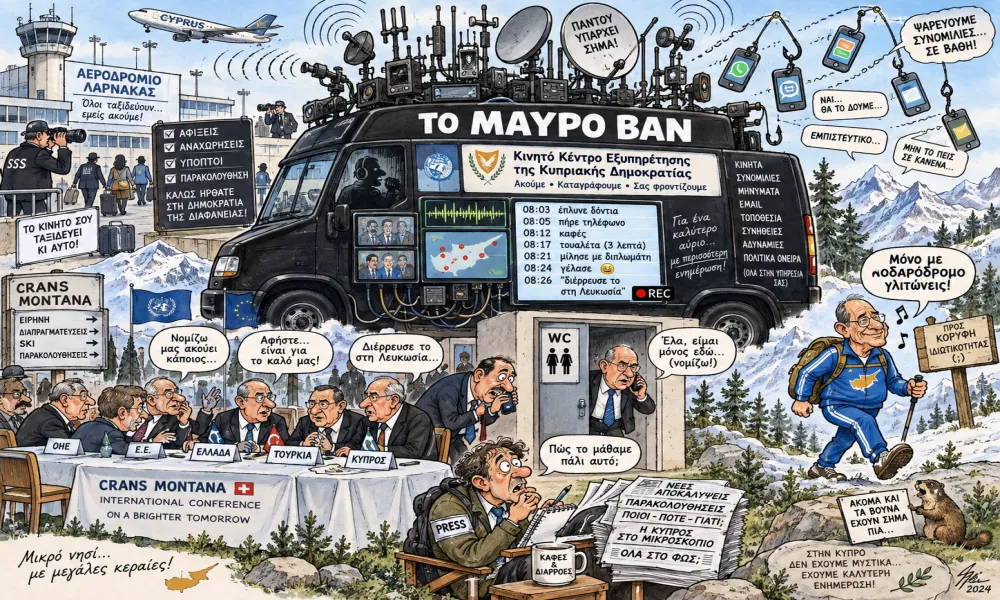
In the satirical Crans-Montana, there were no more secrets.
You knew what time the Filipina cleaner with the beautiful eyes passed outside Anastasiades’ suite.
You knew when Akinci got up from the table and how many pork sausages the Turkish Cypriot delegation consumed.
When Ozersay went to the toilet.
When Nami telephoned his wife.
What Guterres was saying about us.
What Espen Barth Eide was saying about the drunkard, as he allegedly referred to the Unmentionable One.
As for Cavusoglu, supposedly we had him plugged in around the clock. The man could have said “goodnight” to his driver and, back in Nicosia, three committees would already have convened to analyse what he meant by his tone of voice.
And the hooks of this imaginary electronic fishing expedition also caught our own people.
Political party leaders telephoning their girlfriends in Nicosia.
Officials leaking information.
Advisers briefing other advisers on what the adviser on the other side’s team had said.
In the Cyprus problem, as everyone knows, there is no information more valuable than being the first to leak it as an “exclusive”.
And afterwards we wonder:
How did everyone know so much?
How were conversations from the Swiss resort becoming known almost in real time?
How did stories circulate that Anastasiades was eager to return for his daughter’s infamous “tequila party”, a reference that has since entered public political commentary?
How did the stories emerge about Nikos Christodoulides celebrating when the talks collapsed?
How did everyone seem to have an opinion on what Christos Stylianides was discussing with Federica Mogherini?
In our version of events, only Foulis escaped.
Not because he had anti-spyware protection.
Nor because he changed SIM cards.
Those things he had back in Cyprus while, as Fanis Makridis wrote in his book, he was monitoring everybody else.
At Crans-Montana it was well known that his Israeli friends had recommended the oldest and safest anti-surveillance technology of all:
Walking.
One hour on foot every day in the Alps beneath the glacier.
If the glacier had collapsed, you would have known exactly who would be found underneath it.
He would pass the last chalet, climb two hillsides, gain elevation and, the moment the mobile phone lost the ability to be monitored, rub his hands together and say:
“Now we can talk.”
No VPN. No encrypted application.
He had a mountain for protection.
The Cypriot NordVPN.
And elsewhere
The story of the black van is, of course, not confined to Crans-Montana.
Over the years, allegations and questions have surfaced in public debate regarding business figures, political personalities and possible links between surveillance companies and state services.
AKEL, for example, sought answers regarding the relationship between companies owned by Dilian and Avni and the Police and the intelligence services, allegations that the government authorities of the time rejected or disputed.
At this point, however, the joke ends.
Because a system capable of collecting such a volume of electronic data is not a joke.
The joke is having a case involving a multimillion-euro van, spyware, intelligence companies, the Police, state services, airports, documented personal data breaches and questions regarding potential incompatibility, and then, seven years later, finding public debate still revolving around:
“But we thought the others had investigated it.”
The black van, if nothing else, appears to have been effective.
In its humorous version, it knew where you were, whom you called, what you said, when you left, when you returned and almost what time you brushed your teeth.
Our institutions, by contrast, require seven years, five announcements, three investigations and an exchange of letters to determine whether they investigated someone at all.
Perhaps, therefore, we should stop calling it the “black van”.
That does it an injustice.
Its proper name should be:
MCRC - Mobile Citizen Service Centre of the Republic of Cyprus.
Because in there, at least, someone seemed to know what was going on.