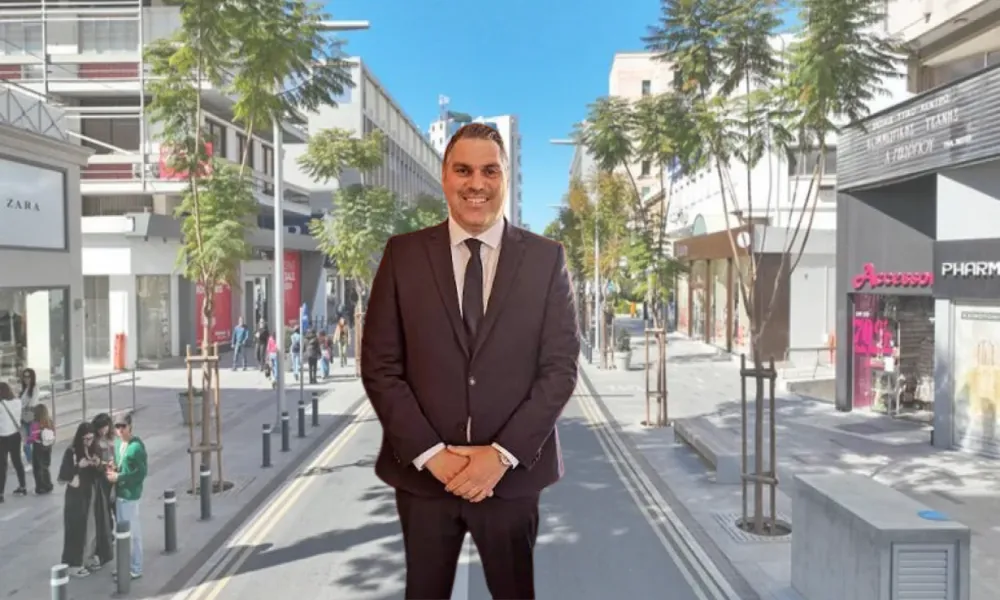

Nicosia Deputy Mayor Chrysanthos Fakas has stressed that the proposed reopening of Makariou Avenue to private vehicles must be part of a broader package of measures aimed at revitalising the city's commercial centre, arguing that there is no study showing that the return of cars alone would boost commercial activity.
Speaking on Politis radio's Morning Briefing programme with Katerina Eliadi, Fakas said the Municipality of Nicosia has prepared documentation supporting the Municipal Council's decision regarding the reopening of Makariou Avenue.
The proposal would allow vehicles to pass through the avenue on weekdays from morning until afternoon. During evenings and weekends, the current regime would return, with access limited to authorised vehicles.
The plan also includes access to certain side streets, allowing drivers to reach organised private and municipal parking facilities more easily.
‘Opening Makariou is not a panacea’
Fakas said the municipality's main objective is to make the city centre more accessible and, by extension, increase visitor numbers.
He acknowledged, however, that commercial activity on Makariou Avenue remains weak and that shops have not experienced the increase in business that had been expected following completion of the redevelopment project.
He rejected suggestions that supporters of the proposal are presenting the reopening of the road to private cars as a cure-all.
According to Fakas, no one is claiming that bringing cars back will, by itself, transform the situation. Rather, it is one measure within a broader package of actions.
He said qualitative research carried out on behalf of the municipality indicates that part of the public considers access to central Nicosia difficult and finding parking challenging, leading many people to choose alternative commercial destinations.
No study linking cars to higher commercial activity
Asked whether there is a specific study proving that allowing private vehicles onto Makariou Avenue would increase commercial activity, Fakas was unequivocal.
No such study exists, he said.
According to him, existing studies identify accessibility problems and reduced visitor numbers, but do not establish a direct causal relationship between the return of cars and the recovery of retail businesses.
In the same context, he referred to other interventions that should accompany any change to the traffic arrangements, including:
- tax relief,
- support measures for businesses,
- and incentives for new investment.
Strong residential growth, weak retail performance
The deputy mayor noted that, unlike commercial activity, residential use of the area has increased significantly in recent years following incentives introduced to attract residents back into the city centre.
According to him, the principal problem today is not attracting people to live in the area but strengthening commercial activity.
‘We are not opening Makariou to solve traffic’
Referring to congestion, Fakas argued that reopening Makariou Avenue could also help ease traffic pressures in the city centre, but stressed that this is not the primary objective.
“We are not opening Makariou Avenue to solve the traffic problem,” he said.
Nevertheless, he argued that the change could contribute to better traffic management in central Nicosia.
He also referred to the wider congestion challenges facing the capital and the effects of one-way road systems, saying current arrangements often force motorists to travel longer distances in order to reach parking areas.
‘Rents are now more affordable’
Addressing the issue of vacant shops along Makariou Avenue, Fakas said rental prices have fallen compared with previous years and are now lower than those found in shopping centres.
Despite this, he said new investors remain cautious and are waiting to see how developments regarding the future of the area unfold.
Fakas concluded that a comprehensive strategy is required, including improved accessibility, incentives, events and stronger business activity, if Makariou Avenue and Nicosia's commercial centre are to be genuinely revitalised.