
The completion of major road projects across Cyprus is increasingly being pushed into the next decade, with outstanding work continuing on key motorway schemes and no major road project currently under construction in Limassol.
A review by Politis, prompted by further delays to the Paphos–Polis Chrysochous road, found that significant gaps remain in the island’s road infrastructure plans.
Even in Nicosia, where projects are at a more advanced stage, motorists could have to wait until 2038 for the full completion of the capital’s ring road. The total cost of the project is estimated at between €350 million and €400 million.
Nicosia ring road to be built in phases
According to information obtained by Politis from the Public Works Department, the Nicosia ring road will be constructed under eight separate contracts, reflecting the scale and complexity of the project.
The road will extend from the Geri area in the east to the Nicosia–Troodos motorway in the west, linking major routes around the capital. The wider network will comprise approximately 32km of motorway, alongside a further 23km of primary and secondary roads.
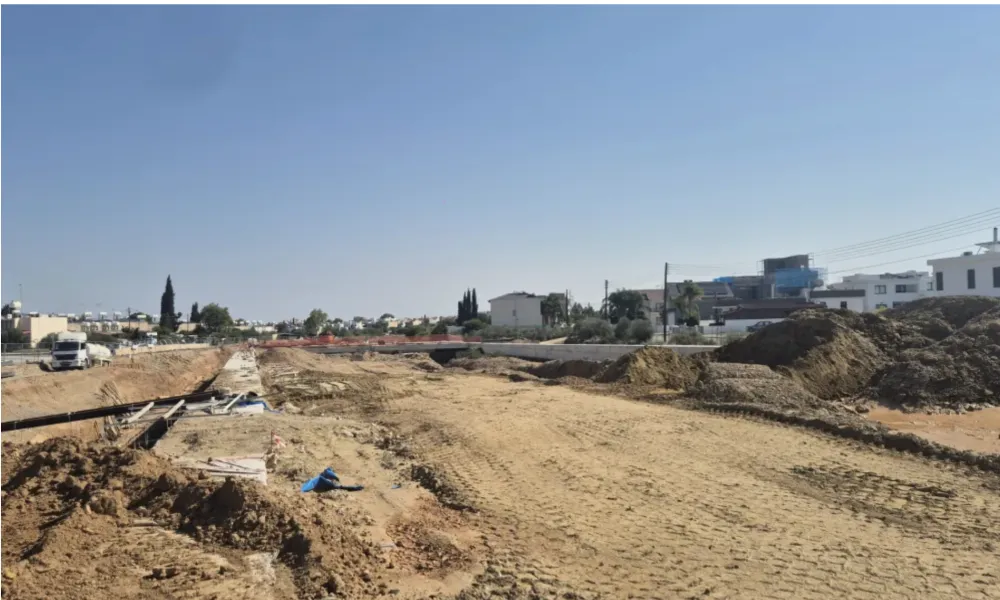
Construction is currently under way on Phase B3, which will connect Archbishop Makarios III Avenue in Lakatamia with the existing Nicosia–Palaichori road in the Anthoupoli area.
The section involves the construction of a 2.1km motorway with four traffic lanes and a 5m-wide central reservation.
The works also include a roundabout at the junction with the Lakatamia–Deftera road, a bridge over the Pedieos River, two overpasses and connecting roads leading to the Nicosia–Palaichori road at the entrance to the Anthoupoli residential areas.
The contract was awarded to the CYFIELD–IACOVOU consortium for €29.92 million, excluding VAT. Work began on 28 July 2025 and is scheduled to take 36 months, putting the expected completion date in July 2028.
The project receives 85% co-funding through the EU’s Cohesion Policy under the Thalia 2021–2027 programme.
Underground section planned for Lakatamia
Phase B1 is being advanced as the next priority. It will connect the Tseri–Strovolos Avenue with Archbishop Makarios III Avenue in Lakatamia.
The phase is estimated to cost €100 million, excluding VAT, with construction expected to take four years.
A key feature will be an underground section built using the cut-and-cover method, which involves excavating the route before covering it over.
The Public Works Department says the approach is necessary to limit the impact of a motorway passing through a residential area in Lakatamia.
A four-lane urban road is planned above the underground section to meet both current and future transport needs in the area.
The project will also include 4.5km of connecting and primary roads, two points linking the underground section to the surface road network, and three junctions.
The department aims to complete the design and advance the project towards construction by the end of 2028. If that timetable is met, the works could be completed around the end of 2032.
Other phases remain at various stages of planning
Further sections of the Nicosia ring road remain at earlier stages of preparation, with their delivery dependent on funding and progress on preceding works.
Phase A2 involves approximately 3.3km of road extensions in Tseri and Latsia, mainly towards the new GSP Stadium. The estimated cost is €4 million, excluding VAT, with tenders targeted for late 2027.
Phase B2, estimated to cost €4.5 million, covers secondary roads in Lakatamia and Tseri. It will be advanced at a later stage in cooperation with the Department of Town Planning and Housing.
Phase E will link the ring road to the Nicosia–Troodos motorway via Deftera, Agioi Trimithias and Paliometocho. The project is estimated to cost €50 million, with implementation envisaged between 2030 and 2033. However, no binding timetable has been set.
Phase D, which will extend the network eastwards towards the Geri Industrial Area, is estimated to cost €40 million and is tentatively scheduled for 2032–2034.
The Public Works Department has stressed that the timetable for the later phases depends on the progress of earlier sections. Their implementation is also linked to securing EU co-funding.
Around 20,000 vehicles use the ring road daily
Traffic data from the first operational section of the Nicosia ring road indicate that approximately 20,000 vehicles use Phase A1 each day in both directions combined.
Measurements taken in 2024 and 2025 put traffic levels within the original forecasts. Studies had projected that daily traffic in 2025 would range between 16,000 and 24,600 vehicles.
However, the road's impact on traffic across the surrounding network has so far been relatively limited.
Measurements in 2025 showed reductions of between 5% and 10% on nearby roads, including Spyrou Kyprianou Avenue.
The Public Works Department expects the completion of Melina Mercouri Avenue and Dimitri Christofias Avenue, formerly known as Argyroupoleos Avenue, to help redistribute traffic and ease congestion further.
New traffic surveys are being carried out between 3 and 26 October 2026, covering the ring road and major routes in the surrounding area. The aim is to assess the project's effects using updated data.
Full ring road expected to carry up to 65,000 vehicles a day
Once the entire Nicosia ring road is completed, traffic studies project that it will carry between 43,000 and 65,000 vehicles per day.
The Public Works Department expects the completed network to make a more substantial contribution to reducing congestion across the wider Nicosia area.
However, with several phases still awaiting construction and later sections dependent on funding and the delivery of preceding works, the full benefits of the ring road remain years away.