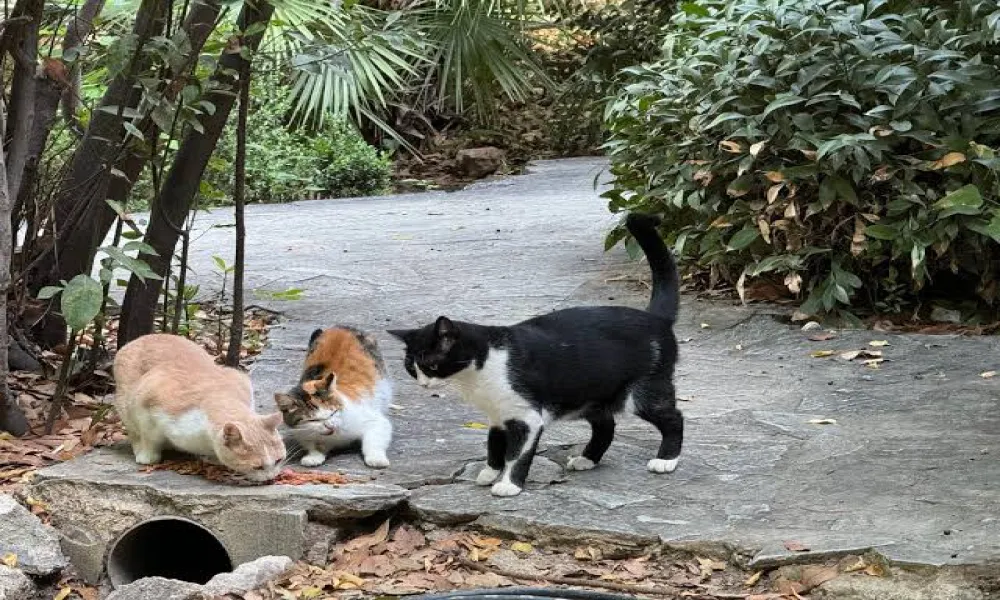

The growing population of stray cats in Cyprus has once again come under scrutiny, with recent research indicating that the number of stray cats on the island now exceeds two million, despite Cyprus having a population of less than one million people.
According to a recent study by researchers DeLeeuw and Eckman published in the scientific journal Frontiers in Animal Science, Cyprus may have the highest ratio of stray cats per capita anywhere in the world.
The issue was raised during discussions on the budget of the Ministry of Agriculture, Rural Development and Environment in parliament.
DISY MP Michalis Kounounis noted that increased state funding was expected to support stray cats and animal welfare efforts, while AKEL MP Nikos Kettiros highlighted concerns over the rapid growth of stray cat populations in various areas across Cyprus.
Kettirou noted that the issue raises concerns relating to public health, biodiversity protection and public safety, while population management should be carried out using scientifically based and animal-friendly methods.
In responses to both MPs, Agriculture Minister Maria Panayiotou Senekis said the government continues to implement the nationwide stray cat sterilisation programme through the Veterinary Services, in cooperation with district animal welfare committees and other stakeholders.
He also confirmed that the Council of Ministers, on 30 September 2026, approved an increase in the programme's budget from €100,000 to €300,000 for 2027.
However, the minister acknowledged that the increase alone will not solve the scale of the problem.
State responsibility but no binding national policy
According to the study by DeLeeuw and Eckman, the state remains formally responsible for animal welfare, yet binding national policies for systematic cat population control are lacking.
As a result, much of the burden falls on:
- Non-governmental organisations.
- Volunteers.
- Private veterinarians.
New measures under consideration
The minister said authorities are currently examining ideas and proposals aimed at strengthening existing efforts.
A ministry source told Politis that the sterilisation programme is under review by the Pancyprian Coordinating Committee for Animal Welfare, whose members include:
- The Director General of Agriculture and Rural Development.
- The Veterinary Services.
- The Pancyprian Veterinary Association.
- The Veterinary Council.
- Animal welfare organisations.
- Other relevant stakeholders.
The advisory committee met yesterday, although no recommendations are ready for publication at this stage.
"A drop in the ocean"
Experts and representatives of animal welfare organisations describe the previous annual allocation of €100,000 as a "drop in the ocean".
That funding was sufficient for only about 2,000 sterilisations per year, a figure regarded as dramatically insufficient given the size of the stray cat population.
Even the planned increase to €300,000, expected to cover approximately 6,000 sterilisations, is viewed as having only a marginal impact.
Questions have also been raised about whether the Veterinary Services can successfully implement the expanded programme, given that a significant part of their workforce remains engaged in efforts related to the reopening of livestock units affected by foot-and-mouth disease.
According to the minister's response to Kettirou, the Veterinary Services and the ministry will evaluate the effectiveness of the 2027 programme, after which a new proposal may be submitted to the Council of Ministers regarding future funding levels.
Heavy reliance on NGOs and veterinarians
The conclusions of the DeLeeuw and Eckman study, based on extensive interviews with 44 professionals and volunteers in Cyprus, Greece and Portugal, paint a challenging picture of stray cat management in Cyprus.
The study found that:
- There is no reliable, centrally recorded data on the size of the stray cat population, making policy planning and intervention difficult.
- Tourism affects stray cat populations, as visitors often feed cats during holiday periods, while unsterilised animals and new litters remain after tourists leave.
- Most animal welfare organisations in Cyprus are small, informal and heavily dependent on volunteers and private donations, limiting their operational capacity.
- In rural and more conservative areas, resistance to sterilisation programmes remains common, while some older residents continue to view cats as low-value animals or even pests.
- Although the state remains formally responsible for animal welfare, the lack of binding national policies means that much of the responsibility falls on NGOs, volunteers and private veterinarians.
- Cooperation with local authorities is generally weak and often depends on the willingness of individual officials rather than formal procedures.
- Caretakers of cat colonies play a critical role but often operate informally and outside organised networks, making coordination difficult.
- Successful approaches include large-scale geographically targeted sterilisation programmes, continuous monitoring of colonies, support for local volunteers and public education campaigns.
The study notes that the stray cat population in Cyprus exceeds two million animals, in a country with fewer than one million residents, potentially placing the island first internationally in terms of stray cats per capita.
How the voucher programme works
In his response to Kettirou, the minister outlined the structure of the nationwide sterilisation programme.
Each year, the Veterinary Services announce the scheme and inform relevant stakeholders, including:
- Registered animal welfare organisations.
- Local authorities.
- Private veterinarians.
The programme is implemented through district veterinary offices with the support of district animal welfare committees and operates through a voucher system.
Municipalities, communities and registered animal welfare organisations may participate.
Citizens and volunteers caring for large numbers of animals must coordinate with local authorities or registered animal welfare groups in order to participate. The same procedure applies to non-registered groups.
Local authorities may also cooperate with registered animal welfare organisations in implementing the programme on their behalf.
Voucher allocation is handled by the relevant district veterinary office, which informs participating organisations of both the number of vouchers allocated and the veterinary clinic or veterinarian designated to carry out the sterilisations.