
With an open-ended strike already under way and new warnings of industrial action, the Ministry of Education is facing two active fronts that threaten to further complicate the current school year.
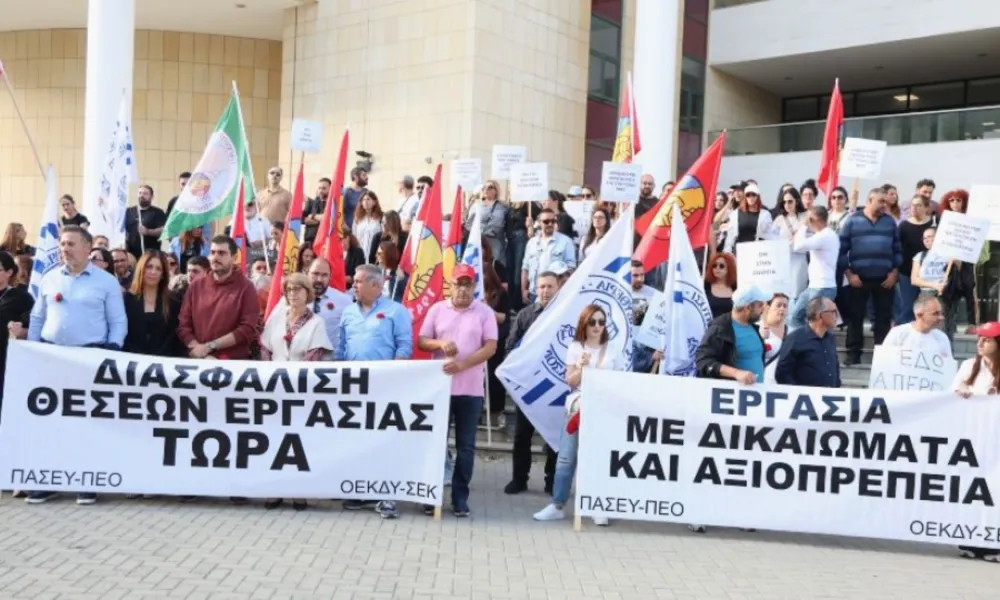
On one side are employees working in support programmes, who yesterday took their protest all the way to the Presidential Palace, demanding solutions to their employment-related problems.
On the other are POED, OELMEK and OLTEK, which have issued an ultimatum over formative assessment, warning of action if the ministry proceeds with implementation without prior agreement.
These are two different disputes, yet they share a common theme: the inability to bridge differences between the ministry and affected employees.
Ironically, in one case the unions accuse the government of failing to implement legislation that has already been passed, while in the other they are demanding the temporary suspension of specific regulations, arguing that the necessary conditions for implementation are not in place.
In both cases, however, the disagreements have now moved beyond the negotiating table, with the government being called upon to manage the growing reactions.
From the strike line to the Presidential Palace
Yesterday marked the fourth day of the indefinite strike by teachers working in support programmes, who took their protest outside the Presidential Palace.
With slogans such as "We will never stop, Minister," the strikers marched from the Ministry of Finance, calling for the personal intervention of President Nikos Christodoulides.
Supporting the protest were the presidents of POED and OELMEK, as well as members of the parliamentary Education Committee, including AKEL MPs Giorgos Koukoumas, Christos Christofides and Anastasia Hasikou.
In a memorandum addressed to Christodoulides, the unions OEKDY-SEK and PASEY-PEO called for political intervention regarding the payment of unemployment benefits and the completion of staffing procedures for support programmes.
According to the unions, some employees have gone five months without income and, despite the fact that it is already November, staffing procedures remain incomplete.
The issue is particularly striking because legislation regulating their employment was approved last April, yet key outstanding issues have not been resolved.
The unions say they had urged the Ministry of Education to agree implementation procedures in advance in order to avoid the current problems.
Instead, they argue, the new academic year began with hundreds of employees left without income and others without work assignments.
Workers had also submitted a memorandum to the President of the Republic on 3 September, yet the issues they raised remain unresolved.
They are now requesting a direct meeting with him, insisting that a political decision is required to break the impasse.
Ultimatum over assessment
On the same day that the striking workers gathered outside the Presidential Palace, the three educational organisations opened a new front with the Ministry of Education.
In a joint letter to Education Minister Athena Michaelidou, POED, OELMEK and OLTEK called for the suspension of formative assessment for the 2026-2027 school year, making clear that any unilateral implementation would trigger a response.
The organisations do not reject the philosophy of formative assessment itself.
However, they question whether the education system is ready for its introduction.
They point to:
- The failure to fill the positions of inspector-advisers and senior educators.
- A lack of clarity regarding responsibilities.
- The need to separate the supportive assessment process from numerical evaluation linked to promotion.
The organisations also note that formative assessment is intended to be conducted every two years rather than annually, raising questions about how the ministry intends to implement it simultaneously across the entire teaching profession.
They specifically request the suspension of Regulations 9 and 10, as well as the launch of dialogue under Regulation 23(1), which concerns procedures for examining labour disputes.
At the same time, they warn that if the ministry proceeds without agreement, they will consider taking industrial action.
The latest dispute adds to ongoing disagreements over the teacher appointment system, an issue for which the educational organisations have already sought the intervention of the President of the Republic.