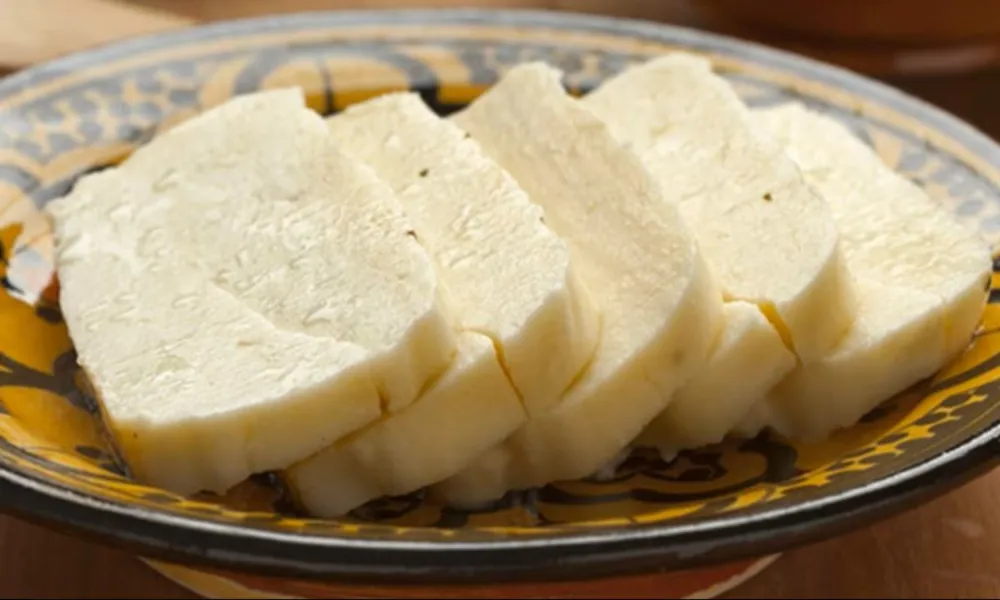

The value of halloumi exports stands at around €350 million a year, with the United Kingdom remaining the product's largest market, absorbing approximately 45% of production.
Sweden, Greece and other European countries follow, Michalis Koulouros, executive secretary of the Cyprus Cheesemakers Association, told CNA.
According to the Statistical Service, halloumi exports reached €201.9 million in the first half of the year, accounting for 12.8% of total exports. During the corresponding period last year, exports stood at 199.637 and represented 11.03% of overall exports.
Cheesemakers believe there is room to increase exports, but say the main obstacle is the available milk quota.
Koulouros said an increase in halloumi production depends on having sufficient milk available under the quota.
All milk not used for pasteurisation, yoghurt and other cheeses is currently directed towards halloumi production, he explained.
“There is no additional milk available to increase production. Whatever milk is available, they turn it into cheese,” he said.
Production could increase either through adjustments to the quota or through greater milk production, Koulouros added, acknowledging efforts by the Agriculture Ministry to provide incentives in this direction.
Concerns over 51% ratio
The milk quota and its potential impact on exports remain a major concern for the industry.
Koulouros said the new decree safeguards production but expressed concern over the possibility of the ratio reaching 51% sheep and goat's milk.
Such a requirement, he said, would make it impossible to maintain current production levels and could affect exports, given that between 80% and 85% of halloumi produced in Cyprus is exported.
With the quantities of milk currently available, applying a 51% sheep and goat's milk requirement would result in a dramatic reduction in the volume of halloumi produced, he said, because there would not be enough milk to maintain current output.
A decree from the Energy Ministry currently sets a minimum ratio of 15% for halloumi production from 15 May to 31 December 2026.
The proportion of different types of milk used in the product can continue to be regulated by decree until 2029, when the five-year extension to the transitional period granted by the European Commission for compliance with the product's PDO specifications expires.
US market attracts interest
Cyprus cheesemakers are also seeking to expand into the United States, which the industry sees as a potentially significant new market.
“It is a particular market and it needs a little more time for them to increase their sales, but it is certainly a market that interests cheesemakers,” Koulouros said.
“America is a huge market in itself, so it is definitely of interest.”
Asked whether specific steps or contacts had been made to enter the US market, Koulouros said some Cyprus cheesemakers are already exporting halloumi to the United States.
However, he cautioned that the nature of the market means rapid expansion should not be expected.
“It is not possible to increase our exports to America tenfold within a year,” he said.
Nevertheless, its size offers substantial opportunities.
“If halloumi succeeds in America, there is enormous potential for very significant growth of the product and investment in the sector.”
Koulouros said discussions with the government indicate that maintaining halloumi exports remains a priority.
“I believe that wherever there is interest in halloumi, the necessary steps will be taken so that we can enter all markets that are open to us,” he said.
Cyprus cheesemakers also participate individually in major international food exhibitions.
Koulouros highlighted SIAL Paris, taking place from 17 to 21 October, which attracts large numbers of international visitors.
Seven Cypriot cheesemakers will participate in this year's exhibition.
Source: CNA